



India’s external trade framework has gone through a structural recalibration with the introduction of Foreign Trade Policy 2023, which came into effect on April 1, 2023. In contrast to earlier regulations, FTP 2023 represents a significant change towards a dynamic and responsive trade regime with no predefined sunset clause. This policy structure reflects India’s goal to establish itself as a service & manufacturing export hub that is globally competitive while guaranteeing regulatory stability for both importers and exporters.
Foreign trade policy functions as the central policy instrument governing imports and exports of goods and services in India. The Foreign Trade Development and Regulation Act, 1992, which gives the Central Government the authority to create, modify, and announce trade policy measures, is the source of its statutory authority. Although it does not supersede tax legislation, FTP 2023 works closely with customs law, GST law, FEMA regulations, and sector-specific statutes.
The Directorate General of Foreign Trade (DGFT), which answers to the Ministry of Commerce and Industry, is in charge of the policy. By granting permissions, offering incentives, settling trade disputes, and interpreting policy regulations, the DGFT acts as both a regulator and a facilitator. By reorienting it toward digitization, ease of doing business, export promotion, and WTO-compliant incentive structures.
Objectives of Foreign Trade Policy 2023
The fundamental goal of India’s foreign trade policy is to develop exports that will eventually be able to compete on a global scale while keeping in mind the necessity of reasonable import regulations. It should not concentrate solely on liberalization. The strategy seeks to achieve a workable balance. When feasible, it promotes trade while exercising caution in areas that could affect public health, environmental protection, or national security.
The policy also takes into account a more comprehensive grasp of the current factors that contribute to export success. FTP 2023, which aims for USD 2 trillion in exports by 2030, acknowledges that exporters require dependable infrastructure, solid regulations, and streamlined procedures in addition to incentives. It seeks to facilitate Indian companies’ easier integration into global value chains by promoting export-oriented manufacturing, services, and digital trade.
Making trade easier is another clear priority of FTP 2023. Many of the procedural reforms are drawn from India’s commitments under the WTO Trade Facilitation Agreement. Paperless workflows, online authorisations, electronic certificates, and defined timelines for grievance handling are intended to reduce delays and uncertainty. The broader goal is to lower transaction costs and improve India’s logistics performance and overall ease of doing business.
India’s foreign trade policy also aims to more equitably distribute export growth throughout the nation. The policy links local job creation, MSME involvement, and regional development with trade expansion through programs like Districts as Export Hubs. This strategy acknowledges that local economies, not only those in large industrial hubs, can benefit greatly from exports.
Finally, the policy reshapes export incentives to align with global trade rules. Older schemes that faced challenges at international forums have been replaced with remission-based mechanisms like the Remission of Duties and Taxes on Exported Products. This ensures that Indian exporters remain competitive without running into subsidy related disputes. Reinforcing this approach, RoDTEP benefits were extended to EOUs and SEZs from 1 June 2025 through Notification 26/2025.
Key Features and Changes in Indian Foreign Trade Policy 2023
One of the most significant changes in FTP 2023 is the absence of an end date. The policy remains in force until amended, allowing the government to introduce targeted modifications through notifications rather than periodic overhauls. This approach enhances predictability for businesses making long term investment decisions. The 2025 amendments include Para 4.63 updates (Dec 2025), import policy tweaks for ITC HS Chapter 71 synced with Finance Act 2025, and port restrictions on Bangladesh imports.
Another defining feature is the classification of export and import items under the Indian Trade Classification Harmonised System. Goods are categorised as Free, Restricted, or Prohibited. Export and import activities are generally free unless specifically regulated. This principle reinforces trade liberalisation while preserving regulatory control where necessary, with Schedule II export policy updates in early 2025 and new Para 2.20A prohibiting certain goods from specific origins.
FTP 2023 strengthens the role of DGFT as the central authority for trade facilitation. DGFT decisions on authorisations, classifications, and interpretations are final and binding. The Policy Interpretation Committee and Policy Relaxation Committee play an advisory role, ensuring consistency and flexibility in implementation.
Digitisation is deeply embedded in the policy. Issuance of Importer Exporter Code, Registration Cum Membership Certificate, Certificates of Origin, Bank Realisation tracking, and export incentives are now fully electronic. This reduces physical interface, minimises discretion, and accelerates processing timelines.
The policy also reinforces the principle that exports should be zero rated. While FTP itself does not override tax laws, it aligns closely with GST and customs frameworks to ensure that taxes and duties do not become embedded costs in export pricing.
Pillars of Foreign Trade Policy 2023
The Indian Foreign Trade Policy 2023 rests on several foundational pillars that collectively shape its policy direction.
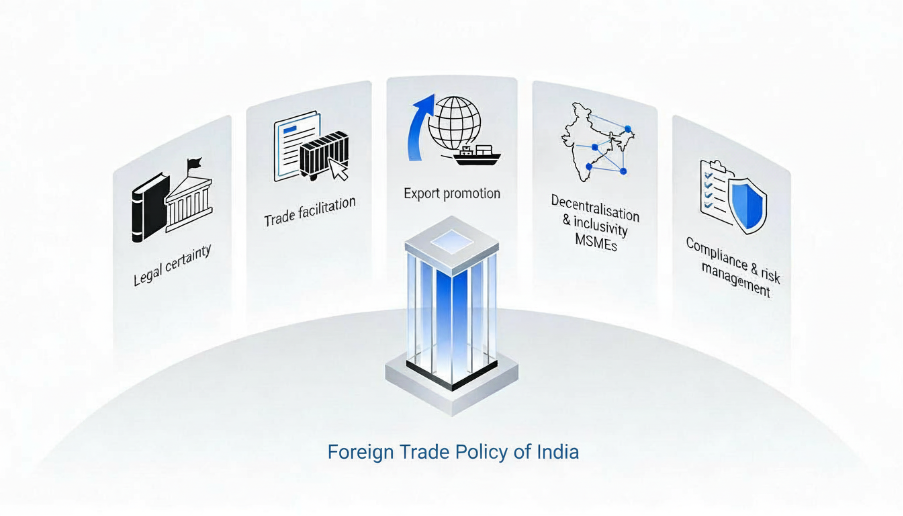
The first pillar is legal certainty and institutional clarity. The policy clearly defines the roles of the Central Government, DGFT, customs authorities, and other agencies. Authorisations, exemptions, and incentives operate within a defined legal hierarchy anchored in the FTDR Act.
The second pillar is trade facilitation and ease of doing business. Measures such as free passage of export consignments, electronic documentation, e-IEC, e-BRC, and 24X7 helpdesk support demonstrate a strong facilitative orientation.
The third pillar is export promotion through targeted schemes. These include duty exemption schemes, duty remission schemes, EPCG scheme, and special treatment for export-oriented entities such as EOUs and SEZs.
The fourth pillar is decentralisation and inclusivity. Districts as Export Hubs, support for MSMEs, and recognition of towns of export excellence broaden the export base beyond traditional industrial clusters.
The fifth pillar is compliance and risk management. Provisions relating to denied entity list, penal actions, and actual user conditions ensure that benefits are availed only by compliant entities.
Planning to Enter the Indian Market?
Make informed decisions
Get a Free Consultation ↗Scheme Details under FTP 2023
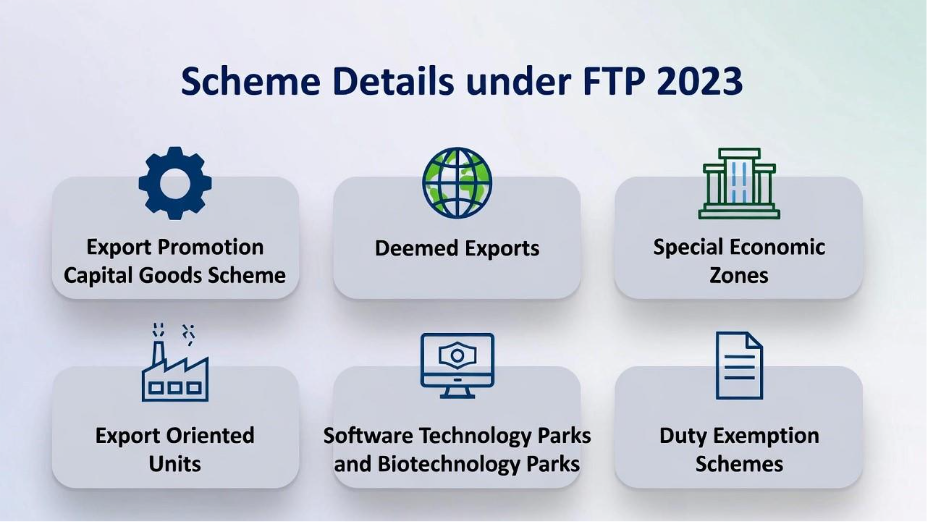
1. Export Promotion Capital Goods Scheme
The EPCG scheme is a cornerstone of FTP 2023’s export promotion strategy. Its primary objective is to facilitate import of capital goods for producing quality goods and services for export at globally competitive prices.
Under EPCG, capital goods can be imported at zero or concessional customs duty, subject to fulfilment of export obligation of 6 times the duty saved within 6 years. Capital goods include machinery, equipment, spares, fixtures, tools, and catalysts required for production or service delivery.
Export obligation under EPCG is typically linked to a multiple of the duty saved on imported capital goods. The obligation must be fulfilled within the prescribed time frame, and failure attracts duty recovery with interest and penalties.
The scheme encourages technology upgradation, productivity enhancement, and capacity expansion, particularly in manufacturing and service export sectors.
2. Deemed Exports
Deemed exports refer to transactions where goods are supplied within India but are treated as exports for policy benefits. These supplies do not result in physical movement of goods outside India but are deemed exports because of their strategic importance.
Typical deemed export categories include supplies to EOUs, SEZs , EPCG authorisation holders, and certain government funded projects. Benefits available under deemed exports include duty exemption, duty drawback, and refund of terminal excise duty where applicable.
FTP 2023 recognises deemed exports as an integral component of the export ecosystem, particularly for domestic manufacturers supplying export-oriented projects.
3. Special Economic Zones
SEZs operate under a separate legislation, namely the SEZ Act, 2005, but are closely linked with FTP provisions. SEZ units enjoy duty free import and procurement of goods and services for authorised operations.
Supplies from Domestic Tariff Area to SEZ units are treated as exports and are eligible for export benefits. SEZs play a critical role in attracting foreign investment, promoting exports, and generating employment.
FTP 2023 acknowledges SEZs as strategic export enclaves while maintaining policy alignment with customs and GST frameworks, with RoDTEP restoration enhancing benefits from June 2025. However, the SEZ tax holiday sunset clause ended in 2023, discontinuing direct tax benefits like 100% income tax exemption for new units approved after March 31, 2020. Existing SEZ units approved on or before June 30, 2020, and commencing operations by that date continue to enjoy their full original 15-year tax holiday under section 10AA, without renewal or extension period.
4. Export Oriented Units
EOUs are units established with the objective of exporting their entire production, subject to permissible DTA sales. EOUs are entitled to duty free import of capital goods, raw materials, and consumables.
FTP 2023 continues the EOU scheme with a focus on manufacturing competitiveness, value addition, and export performance. EOUs operate under strict compliance requirements, including net foreign exchange earnings and bonding obligations, similarly benefiting from 2025 RoDTEP restoration.
5. Software Technology Parks and Biotechnology Parks
STP and BTP schemes are designed to promote exports in knowledge intensive sectors such as software development, IT enabled services, and biotechnology.
Units operating under STP and BTP enjoy duty exemptions on imports of capital goods and inputs, subject to export obligations. FTP 2023 integrates these schemes within the broader export promotion framework while ensuring regulatory oversight.
6. Duty Exemption Schemes
Duty exemption schemes allow duty free import of inputs that are physically incorporated in export products. Advance Authorisation and Duty-Free Import Authorisation are the primary instruments, with 2025 amendments (e.g., Notif. 20/2025-26, 28/2025-26) enabling QCO input imports and Para 2.03 (A) flexibilities for AA holders.
Advance Authorisation permits pre-export import of inputs, while DFIA operates on a post export basis. Both schemes aim to neutralise customs duty incidence on export production.
FTP 2023 lays down detailed provisions on eligibility, value addition norms, actual user condition, pre import requirements, and accounting of inputs.
Implementation Procedure
Implementation of FTP 2023 is largely digital and decentralised through DGFT’s online platform. Entities must obtain an Importer Exporter Code linked to PAN as a prerequisite for engaging in foreign trade.
Authorisations under EPCG, Advance Authorisation, DFIA, and other schemes are issued electronically by DGFT regional authorities. Applications are processed based on declared information, supported by electronic records such as shipping bills and e BRC.
Export proceeds are monitored through electronic bank realisation certificates integrated with RBI systems. Non-realisation of export proceeds can lead to recovery of incentives and penal action.
Grievance redressal mechanisms include personal hearings, policy relaxation committee decisions, and settlement commission provisions for export obligation defaults.
Impact and Benefits of FTP 2023
FTP 2023 provides significant benefits to exporters, manufacturers, and service providers. Duty exemption and remission schemes reduce input costs and improve price competitiveness in international markets.
Schemes such as EPCG enable technology upgradation without upfront duty burden. EOUs and SEZs benefit from integrated tax-free operating environments conducive to large scale exports.
Digitisation reduces compliance costs and processing time, while decentralised initiatives expand export opportunities across regions.
From a macroeconomic perspective, FTP 2023 supports export led growth, employment generation, foreign exchange earnings, and integration into global supply chains. This is further amplified by 2025 FTAs like Oman CEPA (98% duty free Indian exports), the India UAE Comprehensive Economic Partnership Agreement, the India Australia Economic Cooperation and Trade Agreement, and the recently concluded Trade and Economic Partnership Agreement with EFTA countries. In addition, the proposed India EU Free Trade Agreement, expected to be signed on 27th January, is likely to establish a significant framework for trade in goods, services, digital commerce, and sustainable supply chains. Once operational, the India EU FTA is expected to improve market access, reduce tariff and non-tariff barriers, and deepen India’s economic integration with one of its largest trading partners, providing further momentum to India’s export ecosystem in the coming years.
Conclusion
Foreign Trade Policy 2023 represents a strategic evolution in India’s trade governance framework. By shifting from a time bound policy model to a dynamic, amendment driven approach, the policy provides stability and flexibility in equal measure.
For companies, FTP 2023 serves as a blueprint for international expansion in addition to being a regulatory instrument. It is a tool for policymakers to balance competitiveness, growth, and compliance. FTP 2023 provides a crucial institutional basis for India’s goal of becoming a major export powerhouse, and 2026 is expected to be even more dynamic due to the momentum of trade agreements and regulatory changes.