


After nearly two decades of on-and-off talks and some hard negotiations, The India-EU Free Trade Agreement is finally on the verge of becoming a reality. As of January 2026, policy makers from both sides are pushing hard to wrap things up in time for the big India-EU Summit in New Delhi on January 27. If all goes to plan, we’ll soon see the official announcement of this landmark deal. Dubbed as a true win-win: slashing tariffs on most goods, opening doors wider for services and investments, and getting better alignment on regulations in key sectors.
Bilateral goods trade hit around USD 136 billion in FY 2024-25, with India shipping out merchandise of about USD 75 billion and bringing in USD 60 billion worth goods from EU. That makes the EU a major player in India’s export mix (roughly 17%) and gives India about 9% of the EU’s overall exports. With the EU’s massive €17+ trillion economy and India’s 1.4 billion-strong market, this partnership has the potential to reshape global trade flows and even help set new standards for 21st-century deals.
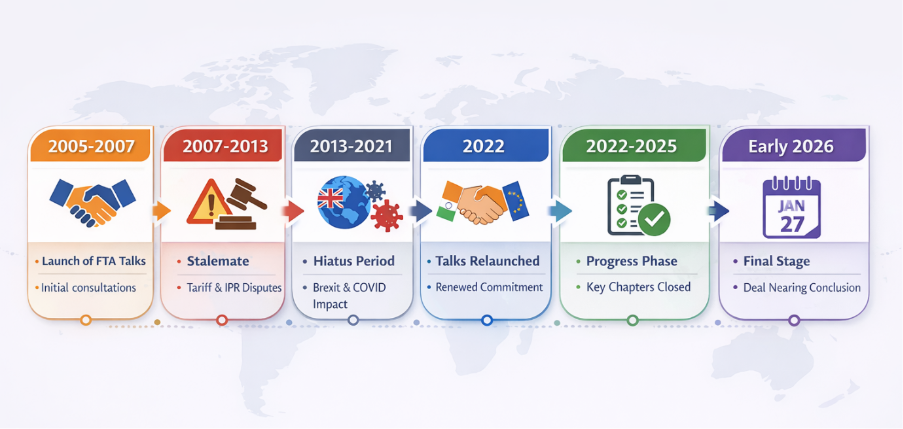
Timeline of India-EU FTA Negotiations
Early Foundations (2005-2007)
The process began with preliminary discussions in 2005. Those early exchanges paved the way for the formal launch on 28 June 2007 of negotiations toward a Broad-Based Trade and Investment Agreement. The agenda was very comprehensive from day one: covering goods, services, investment protection, SPS and TBT rules, rules of origin, competition policy, government procurement, intellectual property rights, geographical indications and sustainable development. Communications released at the time repeatedly stressed the excellent economic complementarity. India’s services momentum perfectly complemented Europe’s strength in high-tech and advanced manufacturing.
Intensive Negotiations and Stalemate (2007- 2013)
Multiple rounds of negotiations took place between 2007 and 2013, but no progress was made. The main divides came down to the regulatory approaches and market access expectations. The EU pushed for tariff elimination on more than 95% of traded goods, while India was willing for just 90%, mainly to protect sensitive domestic industries. High Indian tariffs on fully built automobiles, wines, and spirits resulted into a major point of contention.
At the same time, the EU pressed for intellectual property protections that went beyond the WTO’s TRIPS framework, which raised serious concerns in India about continued access to affordable generic medicines. Other difficult areas included data security recognition for Indian IT service providers, labour and environmental standards, and opening up India’s government procurement market. By 2013 the talks had effectively frozen, with both sides recognising that the necessary political convergence simply wasn’t there.
The Changing Global Context (2013-2021)
The time frame from 2013 to 2021 was marked by limited engagement. While India focused on shallower preferential trade agreements with developing countries, the European Union pursued bilateral agreements with partners such as Canada, Japan, and Chile. The COVID-19 pandemic and United Kingdom exit from the European Union in 2020 significantly altered trade priorities. Vulnerabilities in supply chain exposed during this period became a key divider for renewed engagements.
Formal Relaunch of Negotiations (2022)
At the India-EU Summit held in May 2021, leaders agreed to relaunch negotiations. On 17 June 2022 the formal relaunch happened: full talks on a comprehensive FTA, plus parallel tracks on investment protection and geographical indications. The European Commission and India’s commerce ministry both put out statements stressing a balanced, ambitious deal that actually fits the economic realities of today.
Developments Between 2022 and 2024
By 2024 India had started tying its market access offers much more directly to firm investment commitments from the European side. This tactic was very similar to the one that had just worked well in the trade and investment agreement with the EFTA countries, signed in March 2024 and scheduled to come into force from October 2025. During this phase the talks also went much deeper into non-tariff barriers, with extra attention paid to pharmaceuticals, chemicals, and food products, areas where Europe’s strict regulatory standards have created major roadblocks for Indian exporters for many years.
Acceleration in 2025
Political momentum intensified in 2025. The February 2025 visit by the President of the European Commission established a year-end deadline and saw the FTA publicly described as the largest trade agreement of its kind that the EU was pursuing. Negotiation rounds in March and July moved things forward quickly, closing approximately 20 out of 24 chapters by the end of the year. Sensitive sectors including agriculture and dairy were deliberately left out of tariff liberalisation to protect farmers and ensure food security for both sides.
Final Stage in January 2026
On 8 and 9 January 2026, Brussels meetings confirmed everyone was still all in on a rules-based agreement that protects MSMEs and farming communities. By 19 January 2026 India’s Ministry of Commerce and Industry was saying the negotiations had reached the final stage, with the announcement expected at the 27 January India-EU Summit. The fact that top European leaders are joining the Prime Minister of India makes it clear just how strategically important this has become.
Core Elements of the Agreement
The India-EU Free Trade Agreement is shaping up to be a pretty broad and ambitious deal, touching on just about every major area of economic ties between the two.
Trade in Goods
Trade in goods is built around slashing or removing tariffs on the bulk of tariff lines. India has been vocal about wanting meaningful market access in Europe for its products, while the EU is after better openings for its machinery, industrial items, and higher-end goods. Sectors such as textiles, leather, and machinery are likely to get the most benefit, as lower duties could significantly boost exports for both India and the EU.
Trade in Services
For services, the focus is on opening up sectors like IT, business services, financial services, and transport. Given India’s strength in services, this chapter should help Indian providers face fewer hurdles in the EU. At the same time, the EU is looking for clearer, more predictable rules when its companies want to operate in India.
Investment and Regulatory Cooperation
Investment gets serious attention too: better protections, solid dispute settlement mechanisms, and efforts to make regulations line up better so businesses don’t face unnecessary headaches. The goal is a more stable environment that draws in long-term investment from both directions.
Intellectual Property and Geographical Indications
Intellectual property rights and geographical indications are also covered in depth. This is especially important for India’s pharma sector, software, and artisan products, as well as Europe’s famous wines, cheeses, and other GIs. Expect mutual recognition for things like Darjeeling tea, Basmati rice, and various European origin-labelled foods and drinks.
Sustainable Development Standards
Sustainable development provisions are part of the negotiations, reflecting global concerns around environmental protection, labour standards and climate commitments. Both parties are expected to uphold commitments consistent with international agreements on environmental protection. Regulatory mechanisms related to climate policies, including carbon pricing, have been among the more complex issues in negotiation.
Negotiation Dynamics and Remaining Issues
Progress is clear, but several tricky elements are still very much in play for the India-EU Foreign Trade Agreement to be finalised:
Tariffs and Market Access
Tariffs and market access remain the main battleground. The EU calls for substantial and rapid duty reductions. India pushes for a more measured pace with protections in sensitive zones. Tariff rate quotas offer one practical way forward. They permit limited quantities at lower duties, then revert to normal rates to protect local producers.
Technical and Non-Tariff Barriers
Non-tariff barriers remain a persistent challenge. Variations in standards, certification system, and regulatory procedures can quietly slow down trade and increase compliance cost. Mutual recognition agreement are under active considerations, as they would enable firms to use certifications approved in one jurisdiction when entering the partner market.
Carbon and Environmental Standards
Carbon pricing and environmental standards create ongoing tension. The EU’s approach targets emissions cuts, yet it can add costs for exporters from carbon-heavier economies. The challenge lies in finding common paths that honour climate aims without harming trade benefits.
Intellectual Property Rights
On intellectual property, the EU seeks stronger safeguards than international baseline requirements. India focuses on preserving space for its pharmaceutical generics and technology sectors. The ongoing work aims at frameworks that protect creators without blocking access to affordable drugs or technology.
Agriculture and Sensitive Sectors
Agriculture has been deliberately kept largely outside the liberalisation push. Both parties understand the stakes for rural communities, political stability, and food security, so they have agreed to shield sensitive agricultural sectors from major changes.
Economic Benefits for India and the EU
This FTA has the potential to supercharge two-way trade. Projections show EU exports to India could rise by over 50%. India benefits hugely from lower duties on textiles and leather (currently up to 10%), especially after losing GSP preferences from the EU in 2023.
Beyond that, India gains better openings in IT, pharma, and auto parts, plus more EU foreign direct investment (the EU already accounts for 16.6% of FDI inflows to India since 2000). For the EU, it’s access to India’s massive consumer base of 1.4 billion people with reduced tariffs (India’s average is about 9.3%) on machinery, chemicals, luxury items, and more.
| Aspect | Benefits for India | Benefits for EU |
|---|---|---|
| Trade Growth | Exports up by 33-35% in goods/services | Exports up by 52-56% |
| Investment | €10 billion EU FDI potential unlocked | Secure environment for €67.7 billion stocks |
| Sectors | IT/pharma boost; diversification from US | Autos/chemicals market access |
| Overall | Job creation in MSMEs; supply chain resilience | Trade diversification from China |
Collaboration in critical minerals, technology, and green energy further amplifies gains.
Challenges and Areas of Contention
Persistent challenges include tariff asymmetries. Non-tariff barriers, such as EU regulations under REACH for chemicals and sanitary norms, delay Indian exports. India seeks mutual recognition to address these.
Sustainability provisions pose hurdles; India resists binding labour/environmental commitments that could constrain growth, while the EU’s CBAM (effective 1 January 2026) imposes charges on carbon-intensive imports like steel. Exemptions and easier access to steel scrap are under negotiation.
Intellectual property demands beyond TRIPS threaten India’s generics industry, and geopolitical risks, including US tariffs, add pressure. Agriculture exclusions mitigate farmer concerns.
Strategic Implications for Foreign Business in India
This FTA lines up well with India’s Atmanirbhar Bharat vision. It gives foreign investors reliable and predictable entry into the EU’s huge economy while letting them plug straight into India’s expanding market. Stronger legal protections and better regulatory alignment should make it much easier for EU companies to move into promising areas such as renewable energy and digital infrastructure.
For businesses setting up shop in India, the deal makes supply chain diversification a lot more practical. Simpler visa rules and smoother professional mobility will help bring in skilled people without the usual delays. The EU-India Trade and Technology Council, which started in 2022, adds real value here too. It is already pushing forward cooperation in semiconductors and green technologies, creating concrete opportunities for innovative firms.
India’s Districts as Export Hubs programme fits perfectly alongside this. It encourages local partnerships and lets EU companies share their expertise to help upskill Indian MSMEs on the ground.
After 18 years of tough negotiations, this agreement is finally close to happening. It will change how the two economies work together by driving deeper integration and shared growth. It also pushes back against the fragmentation we see in global trade and positions India and the EU as steady partners against unilateral moves. Plus, it opens the way for closer joint work on big issues like climate resilience.
Once ratified, the countries can expect steady long-term growth, with regular talks keeping everything adaptable to new realities. As a consultancy that helps foreign businesses navigate India, we believe this deal will open up opportunities on a scale we have not seen before. It will strengthen India’s position as one of the world’s leading investment destinations.