



At IX USISPF Leadership Summit 2026, US Ambassador Sergio Gor named three signals. Record investment of $20.5 billion. High level visits, including Secretary Rubio’s tour. A trade deal nearing completion. Here is what he said, and why it matters for foreign investors.
The IX US-India Strategic Partnership Forum Leadership Summit 2026 saw US Ambassador to India Sergio Gor taking the stage and did something ambassadors rarely gets to do. He bragged, a little, and earned it. Twenty and a half billion dollars. That is what the US Embassy in New Delhi helped bring into American shores this year, more than any other American embassy on the planet, and not by a narrow margin either.
“All the embassies compete to bring investment back into the United States,” Gor said, addressing the summit. “You’ve got these beautiful embassies in Europe, and they come up on stage and say, ‘We’re proud to announce $500 million, we’re proud to announce $700 million.’ Our embassy in New Delhi this year, we were very proud to announce that we brought in $20.5 billion in new investments.”
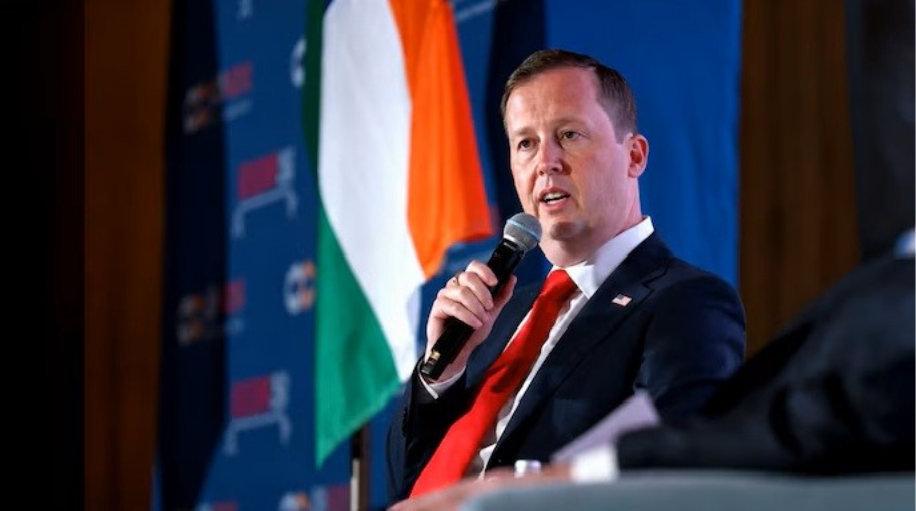
Big numbers make headlines. They rarely explain themselves. So, it’s worth sitting with what Gor said right after, because that’s where the real story lives.
The Question Every Investor Asks
Most diplomats are not busy with the ceremonies; they are busy in answering same anxious questions again and again. Ambassador Gor didn’t dress this up either. “Not a week goes by without an American company coming to see me and asking, ‘Ambassador, is it safe to invest in India? Will our intellectual property be protected here? Will the laws change next month? Is the tax system here safe, or is someone going to come and shake us down in six months?”
These are not unusual questions. Any investor entering an unfamiliar market tends to ask. What makes this moment worth noting is the Ambassador’s response.
“It’s incredibly gratifying to be able to say that the United States trusts India,” Gor said. “We work with India, and we look forward to identifying the next opportunities for both of our countries.”
Trust, unlike investment figures, cannot be measured in dollars. It builds slowly, through consistency, through predictable policy, through the quiet reassurance that a business set up today will not face a different set of rules tomorrow. If any random person has said it, people might not even be talking about it. Coming from the sitting US Ambassador to India, it is closer to public seal of approval. The kind foreign businesses spend great deal of money on consultants trying to find an answer.
Trust Building: One Visit at a Time
Since taking up his post, Ambassador Gor has hosted various senior American officials, from the Secretary of the Army to the Secretary of Commerce.
The most talked about visit, however, belonged to Secretary of State Marco Rubio, who spent four days travelling across India and visited cities like Kolkata, Jaipur, Agra and Delhi. What stayed with Gor was a small moment during the G7 summit in France, where Prime Minister Narendra Modi personally asked Rubio how he had enjoyed Jaipur.
By Gor’s account, Rubio was captivated, by the history layered into the streets, the colours that seem to belong to no other place, the sheer beauty of cities that have stood for centuries. He is reportedly already planning another visit before the year ends. This is a huge positive sign for the country.
Diplomatic visits are usually driven by agendas and schedules. When a Cabinet Secretary wants to visit the country again, not out of obligation but genuine interest, it reflects something about the country itself.
Gor also spoke about the time he spent with President Trump in Washington. The President, he said, still speaks of his past visits to India with genuine warmth. “He has very fond memories of India. His last visit was one of the most remarkable visits that he continues to talk about,” Gor recalled.
A Trade Deal Nearing the Finishing Line
Trust talks aside, Gor also handed the summit something more concrete. The long-negotiated India-US trade agreement, in the works for close to eighteen months and central to the two countries’ shared ambition of hitting $500 billion in bilateral trade, is at the final stretch.
“Most of this deal is complete. There are a few items that remain from both sides, but it’s in the last 1 or 2 percent of that deal,” Gor said, adding that a recent US Supreme Court matter had briefly slowed the pace but not derailed it.
Trade agreements of this scale rarely move quickly. Delays tend to happen. The exact scepticism Gor spent the rest of his speech trying to address. Hearing that negotiators are down to the final few percentage points of legal text offers something concrete. That is, the final timeline near, and the deal will soon be signed.
Delhi’s Growing Role on the Global Stage
Beyond bilateral ties, India has also stepped into a larger regional role. Ambassador Gor confirmed that New Delhi recently hosted a meeting of the Quad, the strategic grouping of the United States, India, Japan and Australia. Within two weeks, foreign ministers from all four countries are expected to meet again in the Philippines, with a further ministerial meeting planned in Australia.
Interestingly, Gor did not shy away from acknowledging India’s more difficult neighbourhood. “India is in a tough part of the world,” he said. “There are some tough and rough neighbours, and you have individuals that wake up in a bad mood and things change in that part of the world.”
He was equally quick to point to what holds the relationship steady regardless, a shared democratic tradition, complete with a robust opposition, something he noted not every nation can claim. It is this combination, ambition tempered by realism, that seems to define how Washington now views New Delhi.
What This Means for Businesses Watching from Outside
For entrepreneurs and companies still weighing whether India deserves a place in their expansion plans, US Ambassador’s statement offers reassurance from a source with no reason to oversell it.
Setting up a business in a new country always comes with its share of questions, on regulation, on taxation, on how disputes get resolved. India has spent the better part of the last decade addressing exactly these concerns, streamlining company registration, simplifying compliance for foreign entities, and building institutional mechanisms that protect intellectual property more consistently than before.
What the Ambassador’s remarks add is a human confirmation of what policy documents can only describe on paper. American companies are not simply testing the waters in India. They are staying, expanding, and in many cases, encouraging others to follow.