



India increased the EPF wage ceiling for mandatory coverage from INR 15,000 to INR 25,000 per month. The Union Cabinet approved the change on 16 September 2026, with the revised ceiling taking effect from 17 September 2026. Foreign businesses employing people in India should identify potentially affected employees, review EPF wage calculations and assess whether payroll systems and contribution practices need to be updated.
On 16th September 2026, the Union Cabinet approved a change that will alter payroll calculations for lakhs of employees in India. The statutory wage ceiling for mandatory Employees’ Provident Fund (EPF) coverage has shifted from INR 15,000 to INR 25,000 per month. A press release from the Ministry of Labour and Employment confirmed that the revised ceiling will take effect from 17th September 2026. The Government has stated that the change is expected to bring more than 51 lakhs additional employees within the mandatory EPFO coverage. The previous INR 15,000 ceiling has stood untouched since September 2014 when it was last revised upward from INR 6,500, making it a significant revision in a decade.
For any foreign company employing people in India, this is not just a headline to skim past. It changes who must be enrolled in India’s principal social security net and reopens payroll assumptions that many overseas HR and finance teams built years ago. It touched employee eligibility, contribution calculations, payroll configurations and cost of running an Indian workforce. It is advised to get in touch with professional regulatory advisory service to understand the intricacies revolving around it. But before that, let’s look briefly about what has actually changed and its impact on the businesses.
What Has Changed in India’s EPF Coverage
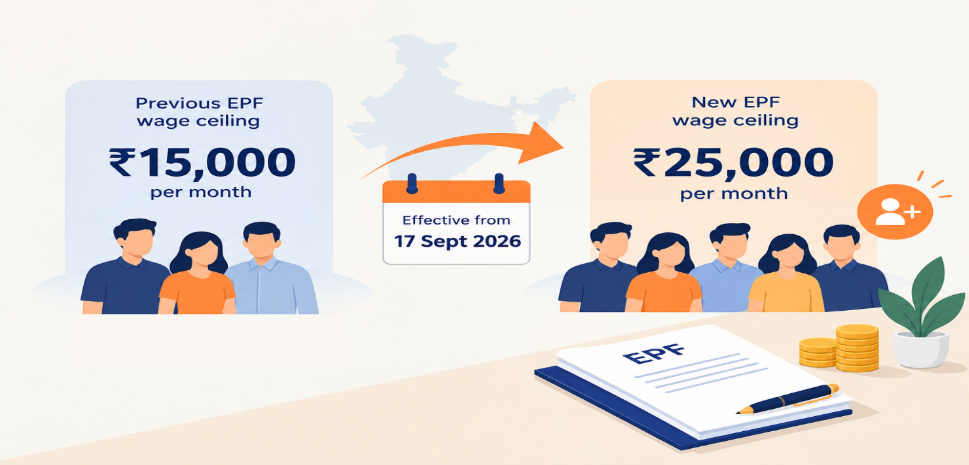
The wage ceiling is the monthly limit used to determine mandatory EPFO coverage. It is not same thing as gross salary, basic pay or cost to company.
| Particular | Position until 16 September 2026 | Position from 17 September 2026 |
|---|---|---|
| EPFO wage ceiling | INR 15,000 per month | INR 25,000 per month |
| Ceiling last revised | September 2014 | September 2026 |
| Additional employees expected under mandatory coverage | — | More than 51 lakh |
The cabinet’s announcement raises the ceiling of the doorway through which employees enter mandatory EPF, EPS, and EDLU protection. However, it does not by itself, restate how contributions are calculated once the employee is inside that doorway. The Ministry of Labour and Employment and EPFO are now expected to carry out the statutory and administrative steps needed to implement it. This includes circulars, portal updates and scheme instructions.
Which Employees Are Affected by The Revised EPF Ceiling
The employees that are directly affected by this change are those whose EPF-relevant wages sit between INR 15,000 and INR 25,000 a month and who were previously outside mandatory coverage, purely because of old ceiling. Indian payroll law works with a defined concept of wages. An employee drawing INR 24,000 in gross monthly pay cannot be assessed correctly until the employer has isolated the components that count as EPF wages under the applicable rules.
There is also a distinction worth holding onto between employees already inside the EPF system and those who will qualify newly. An employee who became a member years ago when their wages were below the earlier ceiling remains the member. The revised threshold may impact both new hires and certain categories of existing employees, depending on EPFO implementation guidance and the employee’s membership status.
Planning to Enter the Indian Market?
Make informed decisions
Get a Free Consultation ↗How Does the Change Affect Foreign Employers in India
A foreign parent designing an Indian salary structure often starts from a home-country template and assume the components will translate neatly. The employees most affected by this change sit in the INR 15,000 to INR 25,000 wage band, a group that previously fell outside mandatory coverage purely because of where the ceiling was fixed.
For employers the impact comes down to three areas. First, they need to identify which employees are covered based on the wages considered under EPF rules. Second, they need to check whether the contributions are being calculated on the statutory ceiling or on a high-wage amount. And finally, the employee’s own contribution may also change, which can affect their monthly take home pay while increasing their EPF savings.
How Could the Change Affect Payroll Contribution
A change in the EPF wage ceiling can affect payroll in more than one way. An employer needs to look separately at the employee’s contribution, the employer’s contribution and the overall cost of employment. The employee contributions are calculated at 12 % of the applicable wages. The employer’s contribution is divided between the relevant EPFO scheme as prescribed under the rules. The change in the ceiling can be shown through a simple illustration:
| Basis | Calculation | Monthly employee contribution |
|---|---|---|
| Earlier ceiling | 12% of INR 15,000 | INR 1,800 |
| Revised ceiling | 12% of INR 25,000 | INR 3,000 |
This is illustrative only. These figures only show what the contribution would be if 12% was applied to the full ceiling. They should not be treated as the actual contribution for every employee. The actual figure depends on the wage base applicable to that employee, their membership history and the operational instruction EPFO issues as implementation proceeds. An employer who already contributed on actual wages above the old ceiling, rather than capping contributions at INR 15,000, may see a smaller shift than one whose payroll was built strictly around the earlier limit.
How is the EPF Change Different from the PMVBRY Incentive
The increase in the EPF wage ceiling is separate from the Pradhan Mantri Viksit Bharat Rojgar Yojna (PMVBRY). The scheme approved by the Union Cabinet in July 2025, provides eligible employers with financial support for additional employees who meet the scheme conditions. The support can be up to INR 3000 per month for an eligible additional employee, with longer support available qualifying manufacturing establishments.
PMVBRY has its own eligibility requirements, including conditions relating to additional hiring, employee retention and regular filing of Electronic Challan cum Return (ECR).
For a foreign business employing people in India, EPF and PMVBRY should be assessed separately. The revised EPF ceiling affects statutory coverage and payroll calculations. PMVBRY is a separate employment incentive that an eligible employer may be able to claim.
What Should Foreign Businesses Review in Their Indian Payroll
For a foreign business with presence in India, it is important to understand how the revised ceiling affects its existing payroll structure. A structured payroll review can cover the following points:
- Identify employees whose statutory wages fall between INR 15,000 and INR 25,000.
- Confirm the applicable wage components considered for EPF purposes under prevailing EPF laws and judicial guidance.
- Check whether current contributions are calculated on the ceiling or on actual eligible wages.
- Calculate the potential change in both employer and employee contributions for affected employees.
- Update payroll systems and relevant salary or compensation records once the applicable requirements are confirmed.
- Ensure relevant UAN, Aadhaar and KYC details of the employee are properly maintained, where required.
- Keep track of further notifications, circulars and implementation instructions before making system-wide changes.
The move from INR 15,000 to INR 25,000 is the significant change to India’s EPFO wage ceiling in more than a decade. It reflects a deliberate policy choice to keep statutory social security coverage aligned with rising wages. For a foreign business employing, or about to start employing people in India, the practical task is not just noting down the numbers. It is working out whether that number changes anything at all.
Businesses that treat this as an opportunity to tidy up their payroll assumptions tend to fare better when the next round of implementation guidance arrives. Given that many of the details still depend on the upcoming circulars related to EPFO and scheme amendments, it is worth having the calculations done properly rather than working on an estimated number. For a clear, employee specific view of how the revised EPFO threshold applies to your Indian payroll, get in touch with professionals at Stratrich.
Conclusion
The move from INR 15,000 to INR 25,000 is the significant change to India’s EPFO wage ceiling in more than a decade. It reflects a deliberate policy choice to keep statutory social security coverage aligned with rising wages. For a foreign business employing, or about to start employing people in India, the practical task is not just noting down the numbers. It is working out whether that number changes anything at all.
Businesses that treat this as an opportunity to tidy up their payroll assumptions tend to fare better when the next round of implementation guidance arrives. Given that many of the details still depend on the upcoming circulars related to EPFO and scheme amendments, it is worth having the calculations done properly rather than working on an estimated number. For a clear, employee specific view of how the revised EPFO threshold applies to your Indian payroll, get in touch with professionals at Stratrich.
Frequently Asked Questions (FAQs)
The Union Cabinet approved raising the EPFO wage ceiling for mandatory coverage from INR 15,000 to INR 25,000 per month on 16th September 2026. It officially took effect on 17th September 2026. The change is expected to bring more than 51 lakh additional employees within the mandatory EPFO coverage.
No, not necessarily. The revised figure is a coverage threshold, not a fixed contribution base applied uniformly. Whether it affects a given employee depends on their applicable EPF wages, their existing membership status and the contribution practice their employer already follows.
Employees whose EPF-relevant wages fall between INR 15,000 and INR 25,000 a month are most likely to be affected by the update. It is important to keep in mind that gross salary alone is not a reliable way to identify the group, since Indian payroll uses a specific, defined concept of wages for EPF purposes.
No. PMVBRY is a separate Employment Linked Incentive Scheme, approved by the Cabinet on 1 July, 2025. It offers eligible employers up to INR 3,000 per month per additional employee retained for at least six months. It depends on conditions such as minimum additional hiring and establishment size. It should be assessed independently rather than assumed to cover any rise in EPF contribution.
A foreign company should identify employees that are affected by the revised ceiling using the correct EPF wage definition. They should look into how the contributions are currently calculated, update salary template and costs models where needed, and keep track of EPFO circulars as the implementation details are issued. Considering several aspects are still pending formal guidance, it is wise to have payroll calculations verified against the latest rules before finalising any changes.