



Picking the right business in India is less about spotting trends and more about where the real demand is building. Some sectors are growing because of structural shifts in how Indians work, consume, and access services. Others are expanding because of the government policies and schemes that are actively reducing cost and risk of entry. For anyone planning a business setup in India, this distinction is critical: trending businesses come and go, but sectors backed by structural demand and active government support consistently deliver returns that last.
With MSME accounting for 21.1% of India’s GDP and nearly half of all merchandise exports, profitable business in India is not concentrated at the top; it runs deep across sectors that are still wide open to compete.
This blog covers the best profitable business Ideas in India in 2026. Each one has a defined market, realistic entry conditions, and a potential for high ROI. If any foreign business is evaluating where to build or invest in India, these are the sectors where the risk-to-return ratio is most favourable.
Best Profitable Business in India Backed by Government Policy in 2026
The seven sectors discussed below come with a verifiable government commitment, a clear demand rationale, and a realistic entry point for foreign businesses looking towards India.

1. Electronics Manufacturing: A Most Profitable Business in India Under ECMS 2026
The Union Budget 2026-27 nearly doubled the Electronics Components Manufacturing Scheme (ECMS) outlay from INR 22,919 crore to INR 40,000 crore. The intent is clear – shift India’s electronics industry from final assembly to in-country production of PCBs, camera modules, displays, and advanced sub-assemblies. India Semiconductor Mission 2.0 sits alongside this, targeting semiconductor equipment, materials, and full-stack domestic IP.
For foreign operators, the opportunity is not in large greenfield fabs. It is in capital-efficient, specialised units supplying mobile OEMs, automotive electronics manufacturers, and export-oriented niche categories such as medical devices, smart metering, and IoT hardware. The revised customs warehousing framework, based on self-declarations and electronic tracking, directly improves working capital management for such operations. CGTMSE collateral-free credit coverage of up to INR 500 lakh per unit makes these ventures bankable without heavy upfront equity.

2. Renewable Energy: Trending Business in India with 500 GW Growth Potential
The MNRE allocation for 2026-27 stands at INR 32,915 crore, a 30.1% increase over the previous year, with the solar sector receiving INR 30,539 crore. India’s 500 GW renewable capacity target by 2030 creates an investment pipeline that is large, multi-year, and partially de-risked through government-backed power purchase frameworks.
The Budget’s cost-reduction measures are particularly significant for foreign capital:
| Policy Measure | Commercial Impact |
|---|---|
| BCD waiver on capital goods for lithium-ion cell manufacturing | Reduces domestic BESS production costs |
| BCD exemption on sodium antimonate for solar glass | Lowers solar module input costs |
| INR 20,000 crore over 5 years for CCUS technologies | Opens clean energy services market |
| Infrastructure Risk Guarantee Fund | Reduces developer exposure during construction phase |
| Restructuring of PFC and REC | Strengthens long-term project financing |
The PM Surya Ghar Muft Bijli Yojana, with an allocation of INR 22,000 crore, represents the single largest renewable energy programme in India’s history. For a foreign operator bringing licensed BESS technology into India, the combination of BCD waivers on capital goods and long-term service contract structures creates a revenue model that is simultaneously asset-backed and recurring. This is among the most clearly policy-protected trending business in India corridors available today.
Planning to Enter the Indian Market?
Make informed decisions
Get a Free Consultation ↗
3. Agro-Processing: Profitable Business in India with Govement-Backed Export Potential
The Union Budget 2026-27 allocates INR 1.63 lakh crore to agriculture and rural development, with a 27% allocation increase for livestock and fisheries, and a stated target of creating 50 lakh non-farm jobs through agro-processing parks and rural MSME clusters.
The government’s introduction of Bharat-VISTAAR which is a multilingual AI platform integrating AgriStack and ICAR data to provide farm-level advisory. It is aimed at raising raw material consistency, which is historically the biggest operational risk for food processing investors. For foreign operators, that is a meaningful structural improvement in food processing industry.
Sub-sectors receiving direct policy and credit support include:
- Spices, condiments, and ready-to-eat ethnic foods for domestic and export markets
- Dairy and fisheries-based value-added products under dedicated credit subsidy schemes
- Millets, organic produce, and high-value crop co-products targeting health-conscious urban and international buyers
- Units operating within SFURTI-supported artisan and agro-MSME clusters
The profitable business in India case here is straightforward for operators who already hold international distribution. Low-cost, policy-supported raw material sourcing combined with export-oriented processing margins creates a structurally durable advantage that purely domestic food companies cannot easily replicate.

4. Digital Services & SaaS: Best Profitable Business in India for Foreign Tech Investors
The Union Budget 2026-27 proposes a tax holiday until 2047 for foreign companies delivering cloud services to global clients using data centre infrastructure in India. That single provision, paired with a safe harbour expansion for IT and ITeS operators and a trust-based compliance overhaul under the New Income Tax Act 2025, materially changes the return profile for technology-led foreign investment.
Investments of approximately USD 70 billion are already under way in Indian data centre infrastructure, with a further USD 90 billion announced. The demand base for digital services is reinforced by a MSME credit gap that the Reserve Bank of India’s Expert Committee has estimated at INR 20 to INR 25 trillion, a gap that enterprise SaaS, embedded finance, and digital lending platforms are well placed to address.
High-margin models for foreign investors:
- Enterprise SaaS for MSMEs – accounting, inventory, and ONDC-linked commerce tools, with low marginal delivery cost at scale
- Fintech and embedded finance – credit risk platforms and payment infrastructure serving the formalising MSME base
- Data analytics and AI services – public data infrastructure across agriculture, health, and urban mobility creates a ready market for analytics-as-a-service
- Data centre infrastructure – with a 2047 tax horizon, this is one of the longest-duration investment certainty windows available in any emerging market today
The best profitable business in India within digital services is largely a function of how well a foreign operator can localise an existing technology asset. Regulatory frameworks under RBI, SEBI, and PFRDA are well-defined, and compliance costs, while real, are predictable.

5. Biopharma & Healthcare: High-ROI Business Setup in India Under SHAKTI Scheme
The Biopharma SHAKTI (Strategy for Healthcare Advancement through Knowledge, Technology and Innovation) scheme carries an outlay of INR 10,000 crore over five years, focused on building a domestic production ecosystem for biologics and biosimilars. Three new NIPERs will be established, seven existing institutes upgraded, and over 1,000 accredited clinical trial sites created, with CDSCO being strengthened to meet global regulatory standards.
Five Regional Medical Value Tourism Hubs in PPP mode are proposed, integrating medical, educational, and research facilities with AYUSH centres, diagnostics, post-care, and rehabilitation infrastructure. For foreign healthcare technology and MedTech operators, these hubs represent ready-built institutional infrastructure with guaranteed patient flow linkages.
The investment logic here is particularly clean for foreign operators holding IP or clinical technology: the Indian government is building the institutional demand side, while private operators supply the technology, service protocols, and quality systems. EBITDA margins for organised diagnostic and specialised healthcare service operators in India have historically ranged between 15% and 25%, supported by low incremental cost structures once clinical and technology infrastructure is in place.
6. Logistics Infrastructure: Trending Business in India Targeting Sub-9% GDP Cost
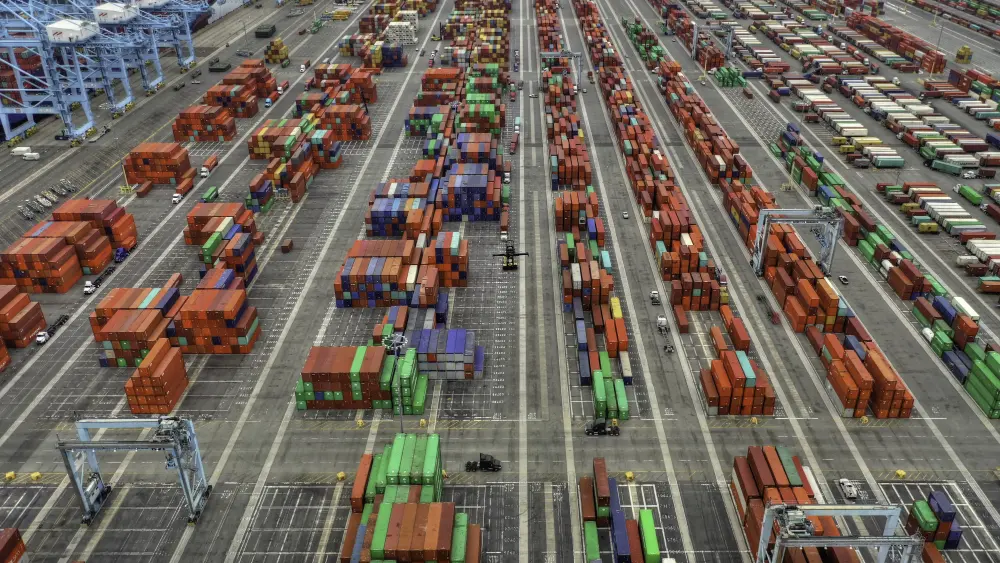
The Union Budget 2026-27 targets a reduction in India’s logistics costs from current double-digit levels to below 9% of GDP through dedicated freight corridors, 20 new national waterways, and a digitised single-window cargo clearance system. The Surat-Dankuni dedicated freight corridor, seven high-speed rail corridors, and a Container Manufacturing Scheme with a INR 10,000 crore allocation over five years collectively define an infrastructure upcycle with clear downstream demand for logistics services.
Foreign operators command a structural advantage in specialised logistics, particularly cold chain, pharmaceutical supply chain, and precision freight, where Indian domestic operators remain fragmented and under-capitalised. The government’s emphasis on modal-shift incentives and national waterway development opens asset-light entry points for technology-enabled operators who can deliver efficiency without owning heavy infrastructure.
Urban last-mile logistics, backed by ONDC-linked e-commerce growth, represents one of the most capital-efficient trending business in India models available, as route-optimisation technology and fleet partnerships can replace asset ownership while still capturing premium delivery margins.

7. Skilling & Vocational Training: Profitable Business in India with Low Competition
The Union Budget 2026-27 sets aside INR 1.52 lakh crore for education and skilling, and the structure of that commitment tells you something important. A Standing Committee on “Education to Employment and Enterprise” is being established specifically to close the gap between what institutions produce and what industries actually need. That is not a typical government skilling initiative; it is an acknowledgement that the existing pipeline is misaligned, and a commitment to fix it with private sector input.
The sectoral demand is already defined. The AVGC industry is projected to need 2 million professionals by 2030. Creator labs backed by government funding are being established in 15,000 secondary schools and 500 colleges. Bodies such as ICAI, ICSI, and ICMAI are being enabled to deliver short, modular, industry-linked courses in Tier-II and Tier-III markets, towns where trained manpower is scarce and competition among training providers is low.
For a foreign business, the entry logic is clean. Align an internationally recognised certification with the NSQF framework, plug into the existing government-facilitated distribution network, and the heavy lifting of market development is largely done. Delivery costs per learner drop sharply once the platform is operational, and with India’s working-age population still growing through the early 2030s, this is a market with a long runway and no near-term saturation risk.
Is India the Right Market for Your Business Setup in 2026?
The most profitable business in India outlined above share a common characteristic: each is backed by specific, quantified government allocation in the Union Budget 2026-27, and each has an institutional framework in place to support private participation. The investment case for India in 2026 is not built on optimism about regulatory reform; it is built on reform that has already happened, fiscal allocations that are already committed, and demand pools that are already forming.
Foreign businesses who align with these government-capex cycles and enter with a genuine technology, distribution, or IP advantage are positioned for returns that India’s high-growth, policy-protected segments have historically delivered. What determines outcomes is the quality of sector selection and the speed of execution.