


Ultimate Beneficial Ownership and Control Disclosures in India is about finding the real person standing behind a company’s shares, not just the name written in the shareholder register. Indian law requires businesses to trace ownership further, all the way through intermediate entities, until the actual individual who holds or controls the interest is identified. This matters most for foreign-owned companies, since a parent company’s shareholding percentage alone does not tell you who really controls the business. What actually decides the outcome is the rights that individual holds at the end of the chain.
A foreign-owned Indian company’s compliance work does not end once its shares are allotted to a parent company abroad. Indian law requires companies to look past the registered shareholders and, in certain cases, find the individual who actually holds or controls the business. This is what beneficial ownership for Indian company compliance is about. Many overseas groups get caught off guard by this requirement, since it depends on the structure behind the shareholding, not just the percentage written in the register.
If you are a foreign business setting up in India, or already operating an Indian subsidiary, understanding beneficial ownership matters. The real question is not who legally holds the shares. It is whether an individual falls under India’s Significant Beneficial Owner (SBO) framework, set out in Section 90 of the Companies Act, 2013.
Indian law also draws a line between different types of beneficial ownership. Section 89 covers beneficial interest in shares, while Section 90 sets out the separate disclosure rules for SBOs. It’s worth noting that the term Ultimate Beneficial Owner (UBO) is common in international compliance and KYC circles, but the Companies Act itself only uses the term SBO. This means a foreign-owned Indian subsidiary must apply the correct legal test, since getting it wrong can expose the subsidiary and its officers to penalties. A foreign business can consult a professional to avoid such penalties, but before reaching to professional, let’s understand what beneficial ownership actually means.
What Does Beneficial Ownership Mean?
Beneficial ownership refers to the actual economic interest or control that a person holds over share even when their name does not appear on the company’s register of members. It concerns the person who enjoys the economic benefit of an interest or can exercise the rights attached to it, even where another person is the registered holder.
As per Section 89, if one person is named in the company’s register as the shareholder but another person holds the beneficial interest, declarations are required by both sides. The section also defines beneficial interest broadly to include, directly or indirectly, rights to exercise rights attached to shares or receive or participate in dividends or other distributions. It is important to keep certain distinctions in mind.
- Registered Owner: the person whose name appears in the company’s register of members.
- Beneficial Owner: the person who has the relevant beneficial interest in the shares.
- SBO: an individual who meets the eligibility criteria as mentioned under Section 90 and the SBO rules of Companies Act 2013.
- UBO: A widely used compliance term for the ultimate natural person who owns or controls an entity. However, it is not a single, universal statutory category under Indian company law.
It is important to know these differences. An overseas company may be the registered shareholder of an Indian subsidiary, while the statutory SBO analysis may require examination of individuals further up the ownership chain.
Who is a Significant Beneficial Owner in India
A significant beneficial owner in India is an individual who satisfies the eligibility criteria for indirect or combined (Direct + Indirect) ownership, or who exercises the specified form of significant influence or control.
The 10% threshold should not read as meaning that every individual holding 10% of an Indian company’s shares is automatically an SBO. The rules specifically require an indirect element of the share, voting-rights and distribution-right test. An individual with no indirect rights or entitlement under the relevant test is not treated as an SBO merely because of a direct holding alone.
| SBO test | What the rule examines |
|---|---|
| Shares | At least 10% held indirectly, or through a combination of indirect and direct holdings |
| Voting rights | At least 10% of voting rights held indirectly, or through a combination of indirect and direct holdings |
| Distributions | Right to at least 10% of total distributable dividend or other distribution through indirect holdings, alone or with direct holdings |
| Significant influence or control | The right to exercise, or actual exercise of, significant influence or control other than through direct holdings alone |
“Significant influence” means the power to participate, directly or indirectly, in a financial and operating policy decisions without amounting to control or joint control.
“Control” takes its meaning from the Companies Act and includes the right to appoint a majority of directors or control management or policy decisions, directly or indirectly, including through shareholding, management rights or shareholder or voting agreements.
What Are the SBO Rules Under Section 90 of the Companies Act
Section 90 of the Companies Act, 2013 requires every company to identify individuals who hold significant beneficial ownership and to ensure appropriate disclosures are made. The operative details sit in the Companies (Significant Beneficial Owners) Rules 2018, notified by the Ministry of Corporate Affairs. It was later substantially revised by the Companies (Significant Beneficial Owners) Amendment Rules,2019.
The 2019 amendments refined the definition of SBO. It clarified how indirect holdings are calculated through corporate bodies, LLPs, partnerships, trusts, HUFs and pooled investment vehicles. Furthermore, it also tightened the company’s own obligations to actively identify its SBOs rather than wait for voluntary declaration.
The Framework exists because a shareholding register only shows immediate, legal owner. It says nothing about who sits behind an intermediate holding company or a trust structure. For beneficial ownership for India company purposes, the law therefore looks at direct holdings, indirect holdings, voting rights, dividend entitlements and the exercise of significant influence or control, rather than a legal title alone.
The Companies (Significant Beneficial Owners) Amendments Rules, 2023 extends similar reporting obligations to Limited Liability Partnership, requiring LLPs to identify and report their own significant beneficial owners under a parallel framework administered by the MCA.
How Is Beneficial Ownership Traced Through a Foreign Ownership Structure?
The main difficulty for any foreign ownership structure lies in tracing the chain correctly. Let’s consider a simplified fictional structure for a better understanding:
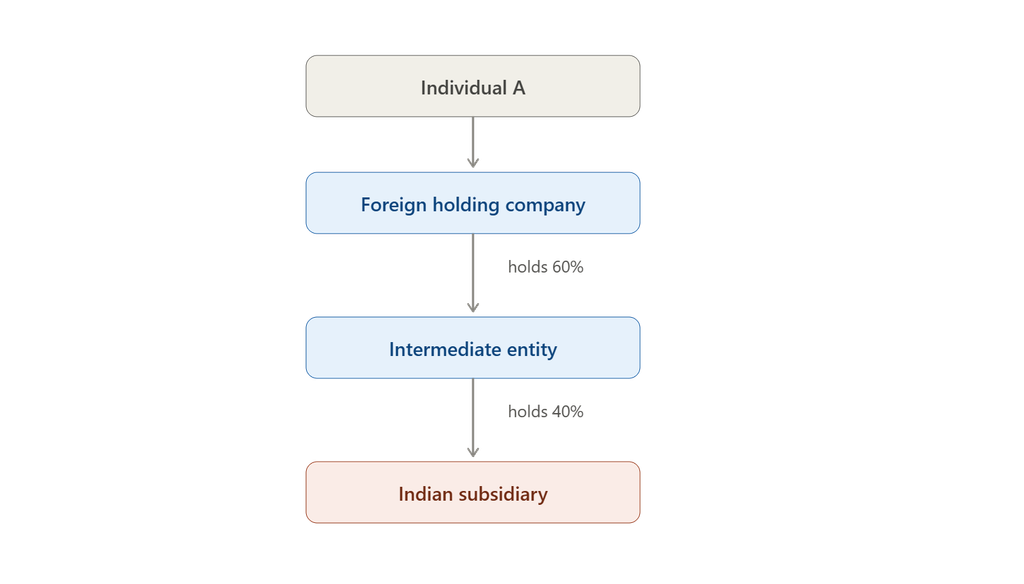
On paper, the Indian subsidiary’s register of members shows the Intermediate Entity as its shareholder holding 40%. But Individual A’s indirect interest in the Indian subsidiary is calculated by working down the chain, applying the percentage held at each level. Whether individual A crosses the 10% indirect threshold depends on the exact shareholding at each layer, not on the 40% figure that appears in the Indian company’s own records.
The analysis does not stop there. If Individual A additionally holds a right to appoint directors, a veto over key decisions under a shareholder’s agreement, or disproportionate voting rights compared to shareholding, it may amount to significant influence or control. A minority shareholder with strong contractual control rights can qualify as an SBO even where a majority stakeholder does not exercise comparable control. This is why a foreign parent’s headline shareholding percentage in its Indian subsidiary is rarely the end of enquiry. What actually matters is the individual at the end of the chain and the rights that individual actually holds.
Which BEN Forms Are Required for SBO Disclosure in India
UBO disclosure in India is commonly used to describe compliance with the SBO framework. For companies, the principal forms operate as follows:
| Form | Responsible party | Purpose |
|---|---|---|
| BEN-1 | Individual SBO | Declaration of significant beneficial ownership to the company |
| BEN-2 | Reporting company | Return filed with the Registrar after receiving the SBO declaration |
| BEN-3 | Reporting company | Statutory register of significant beneficial owners maintained by the company |
| BEN-4 | Reporting company | Notice seeking information where the company has reasonable cause to seek SBO information |
*BEN stands for Beneficial Ownership. BEN-1, BEN-2, BEN-3, BEN-4 are series of statutory forms which are used to declare, track, register, and report significant SBO to the Ministry of Corporate Affairs (MCA) and Registrar of Companies (RoC)
An individual who becomes an SBO, or whose significant beneficial ownership changes, must generally submit BEN-1 to the reporting company within 30 days of acquiring the SBO position. The company then files BEN-2 with Registrar within 30 days of receiving the declaration. The company must also maintain BEN-3.
If the company has reasonable grounds to believe that a person is an SBO, knows someone who may have that information, or was an SBO during the preceding three years but is not registered, it may issue BEN-4 seeking the required information.
When Does a Foreign Owned Indian Company Need to Examine UBO Disclosure?
An overseas parent should assess the SBO position where establishing an Indian subsidiary, but the analysis should not be treated as one-time incorporation. A fresh review is needed after:
- A change in the Indian Company’s shareholder
- An acquisition or transfer of shares
- A change in Voting rights
- A restructuring of the foreign ownership chain
- A new intermediate holding company
- A change in control rights
- A change involving trust, partnership or LLP
- A change in the ultimate individual connected with the ownership structure
The company has a duty to take necessary steps to identify an SBO. In certain scenarios, Rule 2A also requires a reporting company to issue BEN-4 where a non-individual member holds at least 10% of the company’s shares, voting rights or rights to receive or participate in dividends or other distributions.
It is important to note that a foreign-owned company does not automatically have an SBO just because its shares are held by a foreign company. The upstream ownership and control structure must be examined against the statutory criteria.
How Should an Indian Subsidiary Assess Foreign Beneficial Ownership?
When it comes to analysing foreign beneficial ownership for Indian subsidiary, the Indian company should be able to explain how its immediate shareholder fits into the wider group structure. The review generally involves mapping the ownership chain to the relevant natural persons and examining:
- The identity of each corporate shareholder
- Ownership charts showing the chain to the ultimate holding level
- Relevant constitutional or corporate ownership records
- The nature of voting
- Agreements affecting control or significant influence
- Trust or partnership arrangements, where applicable
- Changes in the overseas ownership structure
- Information required for the relevant BEN forms
The objective for such evaluations is not to create a generic document file for every foreign shareholder. Rather, the records should be supporting documents to substantiate the company’s determination of whether an SBO exists and to support the information reported or maintained under The Companies Act framework.
Foreign corporate documents may also be needed to be reviewed carefully where the ownership chain includes multiple jurisdictions. A change in an overseas parent that does not alter the Indian company’s immediate registered shareholder can still affect the SBO analysis.
What Happens If the SBO Is Not Identified or Disclosed?
Section 90 places obligations on both the individual SBO and the reporting company. If the company has reasonable cause to believe that relevant information has not been provided, it can issue a BEN-4 notice. The recipient has 30 days from the date of the notice to respond.
If the information is not provided, or is unsatisfactory, the company must apply to the National Company Law Tribunal within 15 days of the ending of notice period. The Tribunal can then order restrictions on the shares concerned, such as a ban on transfer, suspension of dividend or other distribution rights, and suspension of voting rights.
Financial penalties for non-compliance also apply.
| Who | Penalty |
|---|---|
| Individual who fails to declare | INR 50,000, plus INR 1,000 per day for continuing failure, up to INR 2 lakh |
| Company that fails to comply | INR 1 lakh, plus INR 500 per day, up to INR 5 lakh |
| Officer in default | INR 25,000, plus INR 200 per day, up to INR 1 lakh |
Wilfully providing false or incorrect information or suppressing material information in a declaration leads to action under Section 447 of the Company Act.
What Are the Exemptions From Significant Beneficial Ownership Disclosure?
Rule 8 does not create a blanket exemption for foreign companies. Instead, the SBO Rules specify particular categories of holdings to which the rules do not apply. These includes holding by:
- The Investor Education and Protection Fund Authority
- The reporting company’s holding reporting company, subject to the prescribed reporting requirements
- The Central Government, State Government or local authority
- Certain reporting companies, corporate bodies or entities controlled by the Central or State Government
- Specified SEBI-regulated investment vehicle
- Investment vehicles regulated by RBI, IRDAI or PFRDA
The exemption applies to the extent specified by Rule 8. A foreign parent should therefore not assume that its overseas status alone removes the Indian subsidiary’s SBO obligations.
How Foreign Business Can Prepare for SBO Compliance
A foreign group establishing or operating an Indian subsidiary can use the following practical sequence:
- Map the complete ownership structure, including every relevant intermediate entity
- Identify the natural persons at the end of the relevant ownership chain
- Review direct and indirect holdings against the SBO tests
- Examine voting, significant influence and control rights, including relevant agreements
- Review trust, partnership, LLP and pooled investment structures where they form part of the chain
- Collect supporting ownership and control records needed to substantiate the analysis
- Determine whether an SBO declaration is required under Section 90 and the SBO Rules
- Complete the applicable BEN forms and maintain the statutory register
- Reassess the position after material ownership or control changes
The current MCA BEN-2 instructions kit confirms that BEN-2 remains the reporting mechanism for a reporting company following receipt of an SBO declaration and provides for filing through the MCA system.
Conclusion
Beneficial ownership for an Indian company is not just about one percentage figure on paper. It means tracing ownership and control all the way through every intermediate entity, until an actual individual is identified. Section 89 deals with beneficial interest in shares. Section 90 and the SBO Rules cover significant beneficial ownership, which looks at indirect holdings, voting rights, distribution rights, and significant influence or control.
For a foreign parent, this means one thing. The shareholding percentage shown against its name in the Indian subsidiary’s records is rarely the full picture. The company, and the individuals behind it, need to understand exactly where they stand under this framework, file the correct BEN forms where required, and update these records whenever the ownership structure changes.
Professionals at Stratrich Consulting can help understand these Intricacies. Have questions about UBO? Get in touch with us.
Frequently Asked Questions (FAQs)
UBO disclosure is a commonly used compliance term for identifying the individual who ultimately owns or controls an entity. Under Indian company law, the specific statutory framework is the Significant Beneficial Owner regime under Section 90 and the Companies (Significant Beneficial Owners) Rules, 2018. “UBO” and “SBO” should therefore not be treated as identical legal terms.
An SBO is an individual who meets the applicable indirect or direct-plus-indirect 10% tests for shares, voting rights or distribution rights, or who exercises significant influence or control in the manner specified by the rules. An indirect component is relevant to the statutory definition.
Not in itself. The Companies Act SBO is an individual. A foreign parent company may, however, form part of the ownership chain through which an individual is identified as an SBO under the indirect-holding rules.
Not automatically. Foreign ownership does not itself create an SBO. The Indian subsidiary must examine its ownership and control structure against the statutory tests. If an individual qualifies as an SBO, the applicable declaration, reporting and record-keeping requirements arise.
No. UBO is a widely used international compliance term, while SBO is a specific statutory concept used by the Companies Act framework. Other regimes, including RBI KYC requirements, use their own beneficial-owner tests.