



Starting a business in India as a UK company involves picking a structure, confirming which FDI route applies, and filing through the MCA’s SPICe+ portal. Once documentation is complete and a resident director is appointed, the Certificate of Incorporation usually arrives within seven to ten working days.
India has spent last few years becoming a much easier place for a foreign company to establish its presence. Registering a company in India takes around seven to ten working days once a complete SPICe+ filing is done. For a UK founder who assumes a slower timeline when it comes to starting a business in India, this number might come off as a surprise.
The INDIA-UK Comprehensive Economic and Trade Agreement (CETA) that came into effect on 15th July 2026, has further fuelled the shift. For UK businesses planning to enter India, the question of establishing presence is a far more nuanced one. The easier method to navigate the incorporation question would be through the right business consulting support. However, it does help to understand the fundamentals first, just to ensure you are on the right track. That is what this blog sets out to do.
What does CETA Changes for a UK Company
The introduction of CETA further gives a boost to trade between the two countries. Considering trade has not been a hallmark feature of relations between the two countries, the agreement aims to bolster the numbers. Interesting for UK businesses is the fact that India has implemented a phased removal of tariffs that will take immediate effect and will progressively get better over the course of 10 years. As per government projections, the gains to GDP will be substantial measuring INR 3.3 lakh crore (£25.5 billion) in annual bilateral trade. On both sides of the fence, the impact of CETA will be positively felt on the economy.
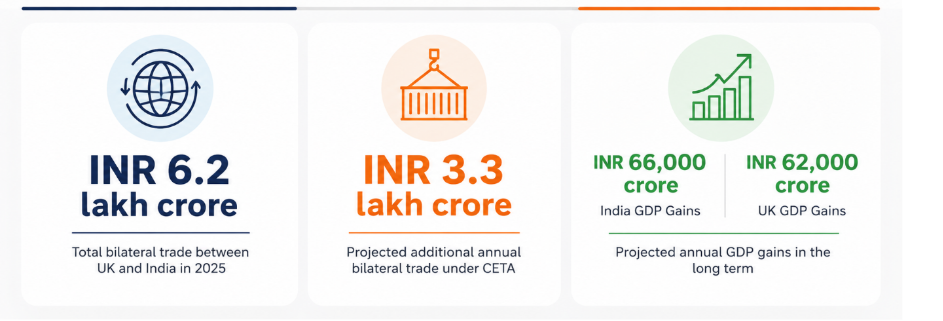
Source: Department for Business and Trade (UK Government), UK-India Trade Deal: Conclusion Summary (2025) and Impact Assessment of the Free Trade Agreement between the UK and India.
Another key aspect of CETA is the introduction of the Double Contribution Convention. For a UK business looking to setup their own team operating in India, the entire exercise is far more cost effective and easy from a compliance standpoint.
Planning to Enter the Indian Market?
Make informed decisions
Get a Free Consultation ↗Choosing the Structure That Actually Fits Your Plans
There are four broad ways a UK company can establish itself in India. The choice between them shapes almost everything that follows, from how quickly you can start invoicing customers to how much liability sits with the parent company in London.
| Structure | Can it earn revenue in India? | Best suited to | Regulator |
|---|---|---|---|
| Wholly Owned Subsidiary (Private Limited Company) | Yes | Full trading, hiring staff, signing local contracts | Ministry of Corporate Affairs, RBI |
| Branch Office | Yes, within RBI-permitted activities | Established businesses extending existing operations | Reserve Bank of India |
| Liaison Office | No | Market research before committing capital | Reserve Bank of India |
| Limited Liability Partnership | Yes | Professional services and flexible joint ventures | Ministry of Corporate Affairs, RBI |
Most UK companies that intend to trade, hire locally, and build an Indian customer base choose a wholly owned subsidiary, which is structured as a private limited company. It allows full foreign ownership in most sectors and keeps liability contained within the Indian entity rather than exposing the UK parent. Furthermore, it is the structure that Indian banks, vendors, and government departments process most often, which in practice means fewer surprises along the way.
A liaison office suits a different stage of thinking altogether. It requires an understanding of how the Indian market works, meet potential distributors, and build good relationships before committing any capital. The Reserve Bank of India’s Master Direction is unambiguous on what a liaison office can and cannot do. For example, a liaison office cannot trade, and it cannot earn income inside India.
Every rupee it spends has to arrive as a remittance from the UK head office. Such restrictions keep the structure simple but also limits what it can achieve commercially.
There are recent regulatory changes that opens this route to companies that previously would not have qualified. The RBI has removed the old minimum net worth requirements for branch and liaison offices, which sat at roughly INR 96 lakhs (USD100,000) and INR 48 lakhs (USD50,000) respectively. A smaller UK company exploring India for the first time no longer needs to clear that bar before it can even open a liaison office.
Sitting between the two is the branch office. It can undertake a wider range of activities than a liaison office. These activities include export, import, research, and consultancy work. However, it remains legally an extension of the UK parent rather than a separate Indian entity. That distinction matters because it means any liability the branch takes on in India travels straight back to the parent company in the UK.
What Actually Counts as Foreign Investment and Which Route It Takes
Once a UK company decides to put money into an Indian entity, that investment falls under the Foreign Exchange Management Act, 1999 (FEMA), and the Consolidated FDI Policy. The Department for Promotion of Industry and Internal Trade (DPIIT) updates this on an ongoing basis. Together, these two frameworks answer questions like how much of an Indian company can a foreign entity own and does that level of ownership need government approval before the money can move. There are two defined routes that the investors can take to make investment in India- Automatic route and Government route.
Automatic Route vs Government Route
Most investment in India moves through the automatic route. As the name suggest, it’s automatic, that means, no prior approval is required from the government or the Reserve Bank of India. A UK company invests, shares are allotted, and the transaction is reported to the RBI afterwards rather than cleared beforehand.
More than 90% of all foreign direct investment (FDI) into India follows this route. In most sectors it allows 100% foreign ownership without a local partner.
The government route is the exception, reserved for a defined list of sectors:
- Defence, beyond certain thresholds
- Media and broadcasting
- Multi-brand retail
Investment in these areas needs prior clearance through the Foreign Investment Facilitation Portal, typically taking six to ten weeks. Any proposal above roughly INR 500 crore is referred to the Cabinet Committee on Economic Affairs before it can proceed.
A Note for Companies with Layered Ownership Structures
DPIIT’s Press Note 2 of 2026, alongside the amended FEM Non-Debt Instruments Rules, tightened scrutiny on investment structures with any link to countries sharing a land border with India. A straightforward UK parent investing directly into an Indian subsidiary is unlikely to be affected. It becomes relevant when a UK entity sits beneath a holding structure involving other jurisdictions, in which case that ownership chain is worth mapping clearly before filing, since both the RBI and DPIIT will ask for it during approval.
The 30-Day Reporting Deadline After Share Allotment
Once shares have been allotted to the UK parent, a filing deadline starts running that is easy to lose track of amid everything else happening around a new incorporation. The Indian subsidiary has 30 days from the date of allotment to report the investment to the RBI through the FIRMS portal, using Form FC-GPR. Missing that window brings penalties under FEMA, so it is worth building into the compliance calendar from the very start.
Getting Through Incorporation Without the Usual Delays
Company incorporation in India used to mean filing five to eight separate applications across different government departments. That has changed. The Ministry of Corporate Affairs now handles everything through one online form called SPICe+, also known as Form INC-32. It runs on the MCA’s V3 portal. One filing now covers incorporation, director identification numbers, PAN, TAN, GST registration, EPFO and ESIC codes, and bank account opening in one application.
Sort Your Board Before You File
Indian law requires at least one director who has resided in India for 182 days or more in the preceding financial year. It means that a board seat must go to someone based in India, whether that is a locally hired executive or a trusted resident director brought in specifically for this purpose. Leaving this decision until incorporation is already underway is the single most common reason UK applications stall.
UK-based directors need to arrange an apostilled or notarised copy of their passport, proof of address, and a Digital Signature Certificate (DSC) issued by an MCA-recognised certifying authority. None of these documents is unusual to obtain, but they take longer to arrange from London than most founders expect, so starting this process early is worth more than almost any other piece of preparation.
Step by Step Process of SPICe+ Filings
With the board sorted and documents in hand, the filing itself follows a fairly predictable sequence:
- Reserve the name. Handled through Part A of SPICe+. Once approved, the name stays reserved for 20 days, so Part B needs to follow within that window.
- File Part B, the incorporation application, alongside the electronic Memorandum and Articles of Association.
- File AGILE-PRO-S, the linked form that handles GST, EPFO, ESIC, and the company’s bank account application in one go.
- Pay registration and stamp duty fees, calculated against the company’s authorised share capital, through the same portal.
- Receive the Certificate of Incorporation. With complete and accurate documentation, this typically arrives within seven to ten working days.
- File Form INC-20A within 180 days, the declaration of commencement of business, confirming that the subscribed capital has actually reached the company’s Indian bank account.
Every SPICe+ filing needs certification from a practising Chartered Accountant, Company Secretary, or Cost Accountant. Directors and subscribers must also add their digital signature. The certified professionals are directly held accountable if anything filed turns out to be inaccurate. This is the main reason why most UK companies bring in an consultant from the start of the process rather than handling SPICe+ portal on its own.
Staying Compliant Once the Company Is Actually Trading
Receiving the Certificate of Incorporation is the start of a UK company’s relationship with Indian regulators. The ongoing compliance calendar is worth understanding before the first deadline arrives. Here is what sits on the compliance calendar
- Annual financial statements and returns – filed with the Registrar of Companies
- A statutory audit – mandatory for every private limited company regardless of turnover
- GST returns – filed monthly or quarterly depending on revenue
- Advance tax payments and annual corporate income tax filings
- FEMA reporting – for any further capital brought in, share transfer, or remittance sent overseas
- Transfer pricing documentation – for transactions between the Indian subsidiary and its UK parent, since Indian tax law treats these as related-party dealings that need to be justified on commercial terms
None of this is unusual set against international standards. A UK finance team will recognise most of these obligations. What tends to catch people out is the deadline discipline behind them. Several of these penalties are calculated per day of default rather than as a single flat fine. A team that is used to the rhythm of Companies House filings should not assume Indian deadlines move at the same pace or carry the same margin for error.
Building a compliance calendar together with an Indian chartered accountant from the outset costs considerably less, in both time and money, than recovering from the first missed filing.
Where This Leaves a UK Company Weighing Up India
With the introduction of MCA’s SPICe+ portal and simplified process, setting up in India for UK companies is no longer a slow and complicated process. What actually matters is the preparation before that. Getting the structure right, knowing which FDI route applies, appoint an Indian resident-director, and build a compliance calendar beforehand.
With CETA now in force and the framework around foreign investment continuing to move in the director of simplicity, 2026 is a genuinely good time for UK companies to turn to India. The systems are in place, the trade relationship is favourable, and a well-prepared application moves through the system quickly. The question is no longer “how to start a business in India as a UK company” rather which structure fits the plan, what documents are required and the compliance requirements. Get in touch with professionals at Stratrich Consulting to get accurate answers to these questions.