



For a foreign company, an FDI sectoral cap is not just a percentage limit on shareholding. It sets the maximum foreign equity allowed in a sector, but ownership also depends on beneficial holding, voting rights and downstream investment structures. Control is assessed separately, covering rights to appoint directors or influence management. Even a 100% cap can carry licensing, security or residency conditions, so foreign investors must look beyond the headline number before finalising any entry, acquisition or subsidiary structure.
A foreign company is allowed to invest in an Indian business, but they cannot structure that investment in the way they want to. This happens because of the sectoral caps that are placed under FDI rules of India. These rules are not a single percent that applies across economy. Each sector carries its own ceiling on foreign shareholdings, its own entry route, and often its own conditions on management and governance. All these rules and regulations are mentioned in the consolidated FDI policy issued by the Department for Promotion of Industry and Internal Trade (DPIIT) and given legal effect under the Foreign Exchange Management Act (FEMA), 1999.
A permitted FDI percentage rarely tells the complete compliance story. The entry route, the voting and management rights attached to the shares, and presence of downstream investment can all affect whether the proposed structure is workable or not. Before finalising an entry, acquisition or subsidiary structure, foreign businesses need to look beyond the headline number and examine how ownership and control works. Hiring a professional can help you understand these complexities with ease. But before that, let’s discuss FDI Sectoral caps for various sectors and control restrictions that applies.
What does a sectoral cap mean for foreign investment in India?
A sectoral cap is the maximum foreign investment permitted in a particular Indian sector or activity under India’s FDI policy. The cap is expressed as a percentage of the relevant Indian entity’s capital, but it operates within the wider framework of entry routes and sector-specific conditions. DPIIT’s Consolidated FDI Policy states that investment by non-residents can be made only to the extent permitted by the applicable sectoral cap, while investors must also comply with relevant sectoral laws, security conditions and other regulatory requirements.
The first practical step is therefore to identify the actual business activity of the Indian entity. A company can operate in several areas, and the FDI treatment can differ depending on the activity the company is carrying out. For example, sectors like manufacturing, insurance, banking, defence, media and retail are all governed based on different conditions.
What is the key difference between Automatic Route and Government Route?
Before structuring an investment into Indian entity, a foreign investor needs to establish which approval pathways govern the transaction. Every foreign investment into India comes through one of the two regulatory pathways under India’s FDI policy.
Automatic Route
Under the Automatic Route, foreign investors do not need prior approval from the Central Government to make any investment, provided the transaction complies with the applicable FDI conditions. It is important to keep in mind that Automatic Route does not mean automatic compliance. Pricing rules, reporting requirements, sectoral caps, licensing conditions and other applicable laws continue to apply.
Government Route
Under the Government Route, prior government approval is required. Applications for government approval are made through the Foreign Investment Facilitation Portal which is administered by DPIIT. A Government Route can be applied depending on the percentage of foreign investment, any specific activity or sector-specific conditions. For example, Defence sector permits up to 74% FDI under the Automatic Route in the specified activity, while investment beyond that (up to 100%) falls under the Government Route.
Major sectoral caps and ownership thresholds foreign businesses should know
The table below mentions the key sectors along with foreign investment limits, entry limits and ownership or control considerations.
| Sector / Activity | Foreign Investment Limit | Entry Route | Key Ownership or Control Consideration |
|---|---|---|---|
| Defence | 100% | Automatic up to 74%; Government beyond 74% | Industrial licensing, security clearance and sector-specific conditions apply |
| Insurance company | 100% under 2026 policy amendment | Automatic, subject to IRDAI verification | At least one of the chairpersons, MD or CEO must be a resident Indian citizen |
| Private-sector banking | 74% | Automatic up to 49%; Government beyond 49% up to 74% | RBI and Banking Regulation Act requirements also apply |
| Brownfield pharmaceuticals | 100% | Automatic up to 74%; Government beyond 74% | Additional brownfield conditions apply |
| Scheduled air transport / domestic airlines | 49% | Automatic | Chairman and at least two-thirds of directors must be Indian citizens, with substantial ownership and effective control vested in Indian nationals |
| Multi-brand retail trading | 51% | Government | Detailed sourcing and infrastructure conditions apply |
| News and current affairs through digital media | 26% | Government | Sector-specific Ministry of Information and Broadcasting conditions apply |
| Print media, news and current affairs | 26% | Government | Additional media ownership and operational conditions apply |
| Telecom services | 100% | Automatic up to 49%; Government beyond 49% | Licensing and security requirements of the Department of Telecommunications apply |
| Private security agencies | 74% | Automatic up to 49%; Government beyond 49% | Subject to the Private Security Agencies Regulation Act framework |
| Pension sector | 49% | Automatic | PFRDA registration and specific ownership/control conditions apply |
| Infrastructure companies in securities markets | 49% | Automatic | SEBI and securities-market regulations apply |
Sectoral classification plays an important role. For example, news and non-news broadcasting. News and current affairs through digital media are capped at 26% under the Government Route, whereas non-news television channels get 100% FDI under the Automatic Route.
Why is the sectoral cap percentage alone not enough in India?
Let’s look at some scenarios. Consider three businesses with initial foreign cap of 100%, 74% and 49%. They do not necessarily have the same regulatory position.
A 100% cap may permit complete foreign ownership, but the investment can still be subject to licensing, security, governance or regulatory requirements. Insurance sector provides a useful example. DPIIT’s 2026 review provides for 100% foreign investment in an Indian insurance company under the Automatic Route, subject to IRDAI verification and The Insurance Act related rules. It also requires at least one chairperson, managing director or chief executive officer to be a resident Indian citizen.
A 74% cap may also contain a split route, for example in the defence sector. The sector permits up to 74% FDI under the Automatic Route. Investment beyond 74% requires government approval. Another example for this scenario would be Brownfield Pharmaceuticals projects. It permits 100% foreign investment, but only 74% under the Automatic Route, with the investment beyond that level requiring Government approval.
A 49% cap can be even more nuanced. In some sectors, the cap is 49% itself. However, in some sectors, 49% cap is where the entry route changes. For example, Private-sector banking. It has 74% overall foreign investment cap, with investment up to 49% under the Automatic Route and investment up to 74% under the Government Route.
Such intricacies are the reason why a foreign investor should distinguish between maximum foreign ownership, automatic-route availability, and sector-specific control conditions.
How is ownership determined for foreign investment in India?
Ownership restrictions on foreign investment in India cannot be judged by shareholding alone.
Shareholding shows how much equity someone holds in an Indian company. However, it does not always capture the full picture of foreign investment exposure. Under the RBI framework, for downstream investment purposes, “ownership” means holding more than 50% of the equity instrument of an Indian company on a beneficial basis. Control, on the other hand is judged separately, based on rights over directors, management or policy decisions.
Beneficial ownership can have a significant influence on its own. If a declaration under the Companies Act shows that a person resident outside India actually holds the beneficial interest, RBI can treat the investment as foreign investment, even if a resident Indian citizen made investment on the paper.
Direct and indirect foreign investment plays its part too. Direct foreign investment is the money that a person resident outside India puts directly into an Indian Company or a qualifying LLP. Indirect foreign investment arises through downstream investment. Regulators may look at indirect foreign investment, meaning foreign money that flows in through an Indian holding company, investment vehicles or other Indian entity. DPIIT’s rules specifically require adding up direct and indirect foreign investment.
These factors matter as they sit at the core of any analysis of ownership restrictions on foreign investment in India. It is especially true when multiple holding companies, trusts, funds or overseas entities stand between the ultimate investor and the Indian operating company.
What is downstream investment and how does it affect Indirect Foreign Ownership?
Downstream investment refers to an Indian entity with foreign investment investing in another Indian company or LLP. The fact that both entities are incorporated in India does not necessarily make the second investment purely domestic.
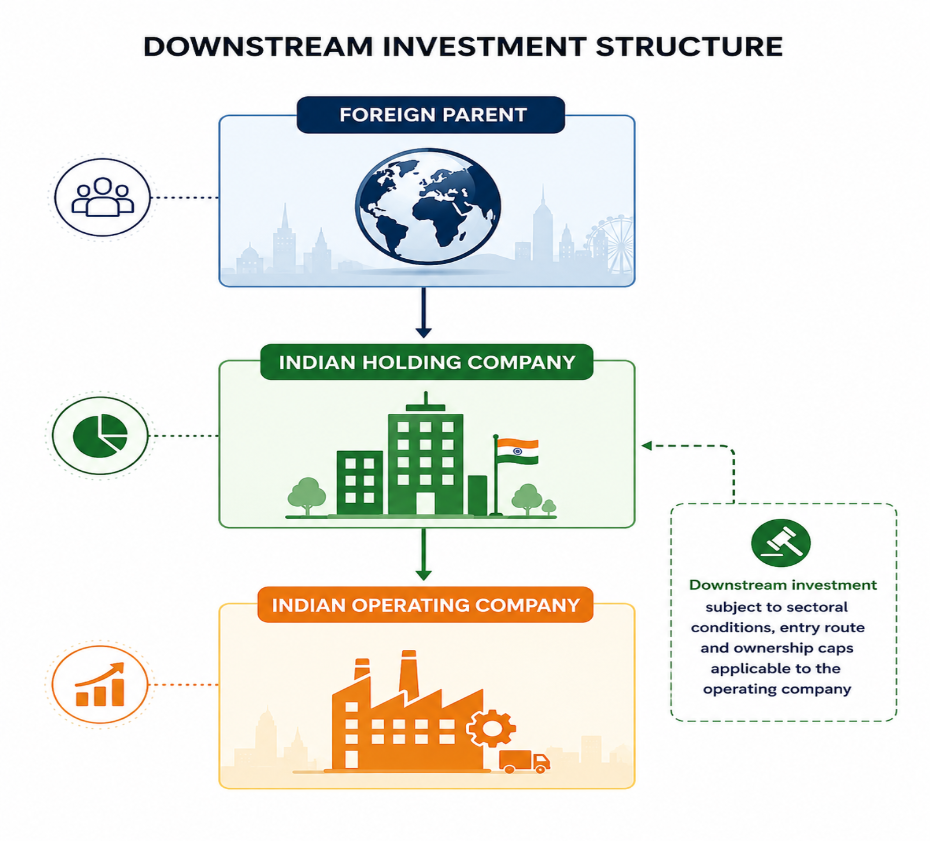
Where the Indian holding company is not owned and controlled by resident Indian entities, its downstream investment can be subject to the sectoral conditions, entry route and caps applicable to the business of the Indian Operating company. Under DPIIT rules, downstream investment by an Indian entity not owned or controlled by resident entities must comply with conditions applicable to the sector receiving the investment.
DPIIT’s methodologies state that total foreign investment comprises direct and indirect foreign investment and that the calculation applies at every stage of the investment. For multinational groups, this means that a proposed acquisition should not be assessed only at the level of the immediate Indian target. The complete investment chain needs to be mapped.
Why does Control become a foreign investment issue?
The control restrictions become significant where the proposed structure gives a foreign investor the rights beyond its percentage ownership. These may include:
- The right to appoint a majority of directors
- Rights over management or policy decisions
- Voting arrangements
- Shareholder agreements affecting board policies
- Contractual arrangements that alter voting rights or effective decision making
It is important to keep in mind that not every veto or protective provision amounts to foreign control. The substance of the rights and the applicable sectoral framework need to be considered.
For example, a foreign investor might hold 40% of an Indian company while having contractual rights to appoint most of the board and determine significant policy decisions. The 40% figure alone would not provide a complete regulatory assessment. DPIIT’s framework expressly recognises the relevance of shareholder and voting agreements in determining ownership and control, especially where the government ownership is required.
Certain sectors impose even more specific requirements. For example, in scheduled civil aviation the applicable policy requires the chairman and at least two-thirds of directors to be Indian citizens, with substantial ownership and effective control vested in Indian nationals.
Insurance provides another example. The 2026 policy amendments permit up to 100% foreign investment but still require at least one of the chairpersons, managing director or CEO to be a resident Indian citizen.
Sector-specific control conditions and common structuring mistakes
Some regulated sectors have requirements that go beyond the foreign investment percentage. Defence can involve security clearance and licensing conditions. Insurance requires compliance with insurance laws and regulations, including the requirement that at least one specified senior position in an Indian insurance company with foreign investment be held by a resident Indian citizen. Pension investments must comply with PFRDA requirements. However, there are certain mistakes foreign investors should avoid. These include:
- Looking only at the headline FDI cap
- Assuming 100% FDI means unrestricted foreign control
- Classifying the business too broadly instead of identifying the precise regulated activity
- Ignoring indirect or downstream investment
- Treating shareholder agreements as separate from the foreign investment analysis
- Relying on an outdated sectoral-cap table without checking subsequent amendments
Final thoughts
The framework for FDI sectoral cap in India should not be treated as a standalone percentage that answers whether a proposed foreign investment is permissible. A proper assessment considers the sector and activity, applicable entry route, foreign ownership percentage, voting and management rights, beneficial ownership, indirect investment, downstream structure and any sector-specific ownership or control conditions.
Therefore, for foreign businesses, the practical test is to review the complete investment structure before funds are committed or transaction documents are finalised. A structure that appears compliant when viewed only through its shareholding percentage may produce a different result once control rights, ownership chains and downstream investments are considered.
Want to know more about FDI Sectoral caps or how the Ownership works, get in touch Stratrich Consultancy. With years of experience working with top global business, professionals at Stratrich can help you navigate through these complexities with ease.
Frequently Asked Questions (FAQs)
A sectoral cap is the maximum foreign investment permitted in an Indian entity for a particular sector or activity, including applicable indirect foreign investment unless otherwise provided. It is a composite limit and must be read together with the relevant entry route and sector-specific conditions.
Not necessarily. A 100% cap indicates that foreign investment may reach the full permitted equity limit, but sector-specific licensing, governance, residency, security or operational conditions may still apply. Insurance, telecommunications and defence illustrate how a high foreign investment limit can coexist with additional regulatory requirements.
Under the Automatic Route, prior Central Government approval is not required for the foreign investment, subject to compliance with applicable conditions. Under the Government Route, prior government approval is required. The route depends on the relevant sector, activity and investment conditions.
Yes. Where downstream investment is treated as indirect foreign investment, the investee Indian entity must comply with the applicable entry route, sectoral cap, pricing requirements and other FDI-linked conditions. The RBI framework expressly applies these requirements to qualifying downstream investment.
Yes. Under the RBI framework, control can include rights arising through shareholding, management rights, shareholder agreements and voting agreements. This does not mean every contractual protection creates control. The substance and extent of the rights must be assessed under the applicable legal and sectoral framework.
The starting points are the current DPIIT FDI Policy and subsequent Press Notes, together with the FEMA framework, NDI Rules and the RBI’s current Master Direction on Foreign Investment in India. Sector-specific regulators and ministries should also be checked where the activity is regulated. The RBI Master Direction was updated through 15 June 2026.