



GIFT City is a Gujarat-based financial district where GIFT IFSC enables foreign businesses to conduct permitted cross-border financial activities under IFSCA regulation. Foreign businesses looking to establish a presence can choose from structures including Indian companies, foreign branches, fund managers, or finance companies. Entry typically follows four steps: confirming the eligible activity, picking a legal structure, incorporating and gaining SEZ approval, then applying for IFSCA licensing.
GIFT City, short for Gujarat International Finance Tec-City is a planned business district between Ahmedabad and Gandhinagar. It contains both a Domestic Tariff Area (DTA) and a notified Specialised Economic Zone (SEZ), within which GIFT IFSC operates as India’s International Financial Services Centre. For a foreign business, it is important to understand that establishing an office or company in GIFT City does not make the business an IFSC entity. GIFT IFSC has its own financial-services regulatory framework. However, it still remains within the Indian legal system and continues to interact with Indian company law, taxation, foreign exchange, and SEZ regulations.
The framework around GIFT IFSC has moved considerably since it was first conceived. IFSCA now regulates a wider range of activities than it did two years ago, and fund management rules were rewritten in 2025. Aircraft and ship leasing frameworks have also been amended repeatedly, while the tax notifications governing withholding and reporting for IFSC units. have continued to evolve. Most significantly, the entire income-tax code has been recast: the Income-tax Act, 2025 replaced the six-decade-old Income-tax Act, 1961 with effect from 1 April 2026, renumbering the core IFSC deduction from the former Section 80LA to Section 147.
For foreign businesses, understanding how GIFT City is structured is the first step towards assessing whether it is suitable for their proposed business in GIFT city.
What is GIFT City and Where Is It Located?
GIFT City is spread across 886 acres between Ahmedabad and Gandhinagar in Gujarat. In that area, around 261 acres are notified as the Special Economic Zone and the remaining 625 acres forming the Domestic Tariff Area. Expansion of the footprint has been discussed periodically, but no enlarged area has been finally notified as of August 2026.
For a foreign business the geographical boundaries are only part of the picture. There are various terms that are used in relation to GIFT City. Understanding the differences between them is important because each refers to a different part of the development or its regulatory framework.
| Area | What it means for a foreign business |
|---|---|
| GIFT City | The wider planned business district between Ahmedabad and Gandhinagar. |
| GIFT SEZ | The notified multi-services Special Economic Zone within GIFT City, governed by India’s SEZ framework. |
| GIFT IFSC | The International Financial Services Centre operating within GIFT SEZ for permitted international financial activities. |
| DTA | The Domestic Tariff Area within GIFT City, where businesses generally operate under the ordinary Indian regulatory framework. |
| IFSCA | The statutory regulator for financial products, services and institutions operating within an IFSC. |
These distinctions have practical consequences for foreign businesses. A foreign technology company, professional-services firm or ordinary trading business establishing itself in the DTA is not automatically an IFSC business. The special regulatory and tax provisions associated with GIFT IFSC depend on the entity’s status, approved activities and compliance with the relevant conditions.
What is GIFT IFSC and How Does It Work?
GIFT IFSC is India’s International Financial Services Centre, located within GIFT SEZ. It provides a specialised regulatory framework for permitted international financial services and cross-border transactions from an Indian location.
It is not an offshore territory outside India. An IFSC financial institution or branch permitted or recognised under the applicable framework may receive specific treatment under India’s foreign-exchange regulations. Under the Foreign Exchange Management (International Financial Services Centre) Regulations, 2015, specified financial institutions or branches set up in an IFSC and permitted or recognised by the Government or relevant regulator are treated as persons resident outside India for specified FEMA purposes.
That treatment does not automatically apply to every entity established in GIFT City, GIFT SEZ or GIFT IFSC. The FEMA position depends on the nature of the entity, its regulatory status and the activity it undertakes.
That distinction is important for foreign businesses because it explains how GIFT IFSC can support cross-border financial activity while remaining within India’s legal architecture. It does not, however, remove Indian regulatory oversight. Incorporation, taxation, SEZ obligations, beneficial ownership, corporate governance and applicable FEMA requirements continue to matter.
Who Regulates GIFT IFSC and Who Controls It?
The International Financial Services Centres Authority (IFSCA) is the unified financial regulator for GIFT IFSC. It was established on 27 April 2020 under the International Financial Services Centres Authority Act, 2019 and is headquartered at GIFT City. Its statutory role covers the development and regulation of financial products, financial services and financial institutions in India’s IFSCs.
Before IFSCA was established, IFSC activities were regulated separately by the RBI, SEBI, IRDAI and PFRDA. IFSCA now performs the relevant regulatory functions for activities falling within its statutory mandate. That does not mean IFSCA controls every business or every legal issue in GIFT City.
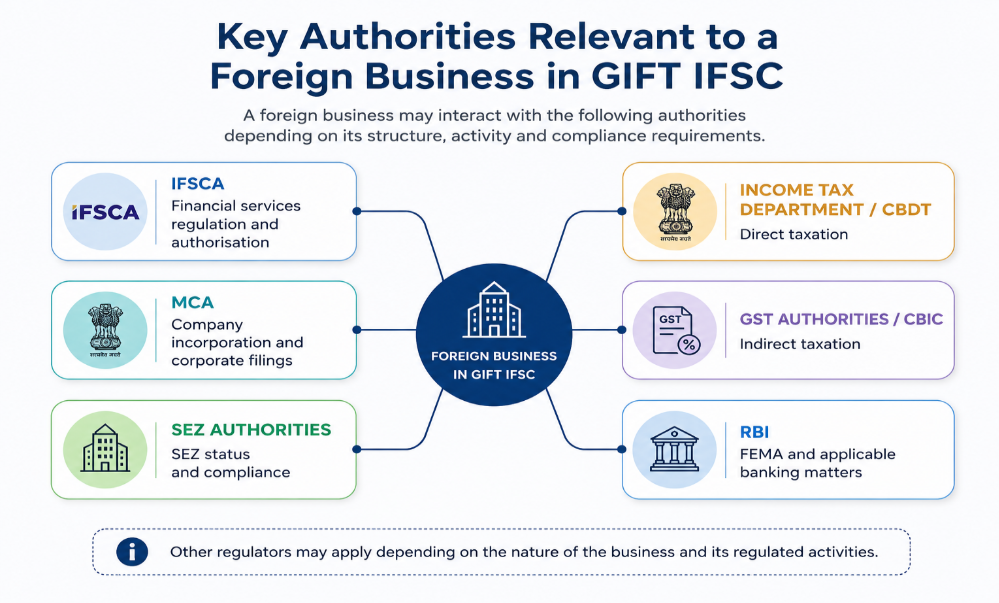
A significant change took effect in February 2026. The amended SEZ Rules provide that the Administrator (IFSCA) issues the Letter of Approval in Form GA for setting up a unit in an IFSC. This has made the SEZ approval process more closely integrated with the IFSC framework.
What Businesses and Activities Can Operate in GIFT IFSC?
GIFT IFSC is no longer confined to a narrow set of banking and fund-management activities. IFSCA’s current framework covers a range of financial and related activities, although each remains subject to its own eligibility, registration, authorisation and compliance requirements.
Key areas include:
- Banking: IFSC Banking Units undertake permitted wholesale banking, lending, treasury and related activities under the applicable banking framework.
- Fund management: Fund Management Entities operate under the IFSCA (Fund Management) Regulations, 2025, which replaced the 2022 regulations. The 2025 framework introduced changes to scheme structures, corpus requirements and operating arrangements, with additional amendments and circulars issued during 2026.
- Capital markets: The IFSCA (Capital Market Intermediaries) Regulations, 2025 provide the framework for broker-dealers, clearing members, custodians, investment advisers, investment bankers, research entities and other specified intermediaries. IFSCA introduced unified registration for multiple capital-market activities in 2026.
- Insurance and reinsurance: Eligible insurers, reinsurers and other permitted applicants can establish IFSC Insurance Offices and undertake authorised classes of insurance or reinsurance business.
- Finance companies and finance units: These structures can undertake specified financial activities, including permitted leasing and treasury-related activities, subject to IFSCA requirements. The finance-company framework was also subject to an amendment in May 2026.
- Aircraft and ship leasing: GIFT IFSC has dedicated frameworks for these activities, with the aircraft and ship-leasing frameworks continuing to be updated. IFSCA’s ship-leasing framework, for example, was updated in May 2026.
- Bullion markets: The IFSCA (Bullion Market) Regulations, 2025 cover bullion exchanges, clearing corporations, depositories and vault managers.
- TechFin and ancillary services: IFSCA introduced the TechFin and Ancillary Services Regulations, 2025, with further amendments in May 2026.
- Global In-House Centres: The GIC framework was replaced by the IFSCA (Global In-House Centres) Regulations, 2025, with FAQs issued in February 2026.
- Foreign university activities: IFSCA also maintains a regulatory framework for international branch campuses and related activities in GIFT IFSC.
The important point is that an entity’s address does not determine what it can do. A company incorporated in GIFT City cannot start banking, managing funds, providing regulated investment services or conducting insurance business without the applicable regulatory approval.
Why are Foreign Businesses Considering GIFT IFSC?
For foreign businesses, GIFT IFSC is most suitable for activities that involve international transactions or financial services. The potential reasons for considering it include:
- conducting permitted cross-border financial services from an Indian base;
- operating in foreign currency where the relevant framework permits it;
- establishing a fund-management platform;
- undertaking international banking or treasury functions;
- establishing aircraft or ship-leasing operations;
- accessing regulated capital-market infrastructure;
- establishing a financial-technology or related services operation; and
- locating specialised financial group functions in India.
The benefits of GIFT IFSC are not limited to tax benefits. A foreign business should consider whether its customers, transactions, business model and regulatory needs are suitable for the IFSC framework.
GIFT IFSC is not the right fit for every foreign company. For example, a business mainly selling products or services in India may be better suited to a regular Indian subsidiary or another suitable structure.
What Are the Tax Incentives Available in GIFT IFSC?
GIFT IFSC offers several tax benefits, but their availability depends on the nature of the business, approved activity and applicable conditions.
Section 147 Tax Deduction (formerly Section 80LA)
The principal IFSC income-tax incentive is now Section 147 of the Income-tax Act, 2025 (the successor to Section 80LA of the Income-tax Act, 1961, which governed tax years up to 31 March 2026). A qualifying Unit of an IFSC can claim a deduction of 100% of eligible income for any twenty consecutive tax years, at the taxpayer’s option, out of a twenty-five-year period beginning with the tax year relevant to the year in which the unit obtains the requisite IFSCA permission or registration, subject to statutory conditions and certification requirements. This enhanced twenty-out-of-twenty-five-year window (up from the earlier ten-out-of-fifteen) applies from 1 April 2026.The deduction applies to income from the business for which the unit has been approved to operate in the IFSC and must be claimed within the prescribed twenty-five-year period. This is not the same as saying that every GIFT IFSC company is tax-free for twenty years. The deduction applies to qualifying income and requires the entity to satisfy the relevant statutory conditions.
Other IFSC Tax Benefits
Beyond Section 147, other provisions provide targeted relief for specific activities and transactions. Other provisions provide targeted relief for particular activities, funds, derivatives, leasing structures and specified transactions.
There have also been important compliance-related tax changes. CBDT Notification No. 6/2025 provides a TCS relaxation for qualifying IFSC units during the ten assessment years selected for the Section 147 deduction, subject to the notification’s declaration and reporting conditions.
With effect from 1 April 2026, these incentives sit within the Income-tax Act, 2025 (as amended by the Finance Act, 2026), which lengthened the IFSC-unit holiday to twenty consecutive tax years out of twenty-five and retained the concessional minimum-tax floor (a 9% MAT/AMT rate for IFSC units deriving income solely in convertible foreign exchange). Finance Act 2025 also extended the sunset dates associated with several IFSC exemptions, deductions and relocation provisions to 31 March 2030. It introduced or extended specific provisions relating to aircraft and ship leasing, IFSC insurance structures, treasury activities and investment funds. These provisions remain activity-specific and should not be interpreted as a universal extension of every GIFT City tax benefit.
GST and Tax Considerations
Tax treatment also extends beyond income-tax incentives, particularly where an IFSC unit undertakes SEZ-related transactions.
Indirect tax treatment also requires careful classification. Supplies of goods or services to an SEZ unit for authorised operations can qualify as zero-rated supplies under the IGST framework, subject to the applicable conditions. Zero rating should not be confused with a blanket GST exemption for all transactions of an IFSC entity.
For a foreign business, the tax analysis should therefore cover the nature of the income, the entity’s regulatory status, its approved activity, the Section 147 election, withholding requirements, transfer pricing, related-party transactions and the tax treatment of payments to and from the overseas group.
What Types of Entities Can be Established in GIFT City?
There is no single “GIFT City company” structure. The appropriate legal form depends on the activity and the applicant. Potential structures for GIFT City include:
- an Indian company established as an IFSC unit;
- a permitted branch of a foreign company;
- an IFSC Banking Unit;
- a finance company or finance unit;
- a Fund Management Entity;
- an IFSC Insurance Office;
- capital-market intermediary structures; and
- other specialised entities recognised under IFSCA regulations.
Incorporation, SEZ approval and regulatory authorisation are separate concepts. Incorporation creates the legal entity. SEZ approval establishes the entity as a unit within the notified SEZ. Registration, authorisation or licensing permits the entity to undertake the particular regulated activity.
That distinction becomes especially important for foreign businesses. A company may be incorporated under the Companies Act but still be unable to conduct its intended financial activity until it has obtained the relevant IFSCA approval.
Is 100% Foreign Ownership Allowed in GIFT City?
100% foreign ownership can be permitted in GIFT IFSC, but it is not a universal rule that overrides activity-specific regulation.
Foreign investment remains governed by FEMA, India’s FDI policy and the regulatory framework applicable to the particular activity. The FDI policy provides a framework for foreign investment in financial services, but sectoral conditions and regulatory requirements can still apply. Regulated activities such as banking and insurance involve additional eligibility, capital, governance and fit-and-proper considerations.
For a foreign parent, the ownership analysis should therefore cover:
- the permitted level and route of foreign investment;
- the proposed activity;
- sector-specific conditions;
- ultimate beneficial ownership;
- capital and net-worth requirements;
- FEMA reporting;
- transactions with Indian residents; and
- any restrictions applicable to particular investors or jurisdictions.
Foreign ownership should be assessed alongside the licence rather than treated as a separate, purely corporate question.
Can Indian Residents Invest or Open Accounts in GIFT City?
Indian residents can participate in GIFT IFSC in specified circumstances, but the applicable route depends on the resident’s status, the financial product and the nature of the transaction.
The RBI permits resident individuals to use the Liberalised Remittance Scheme for permitted transactions, subject to the applicable annual limit. The RBI’s LRS framework currently provides for an overall limit of USD 250,000 (approximately INR 2.15 crore) per resident individual per financial year for permitted transactions.
IFSCA has also issued specific frameworks concerning accounts of persons resident in India. The position is therefore more nuanced than a simple “residents can” or “residents cannot” answer. Resident individuals, Indian companies, NRIs, OCIs and other foreign investors can fall under different rules depending on the account, fund, security or financial service involved.
A foreign business considering Indian-resident participation should consequently examine the relevant FEMA, RBI and IFSCA provisions for the exact product rather than relying on a general statement about GIFT IFSC eligibility.
What Determines the Cost of Setting Up a Business in GIFT City?
There is no meaningful universal “GIFT City setup cost”. A regulated financial institution and a small ancillary-services business can have fundamentally different capital, staffing, infrastructure and compliance requirements.
The cost should therefore be calculated only after the proposed activity and entity structure are known. Published fee schedules should be checked at the time of application because regulatory fees and requirements can change.
What Compliance Requirements Apply After Setting Up in GIFT City?
Setting up the entity is only the beginning of the compliance cycle. Depending on the structure and activity, continuing obligations can include:
- MCA annual filings and financial statements;
- statutory audit;
- income-tax returns and supporting certificates;
- GST compliance where applicable;
- SEZ reporting and authorised-operations requirements;
- IFSCA regulatory returns;
- FEMA and RBI reporting where applicable;
- AML, KYC and sanctions controls;
- beneficial-ownership records;
- governance and key-person requirements;
- regulatory capital or net-worth monitoring;
- transfer pricing documentation;
- related-party transaction disclosures; and
- sector-specific reporting and disclosures.
Fund managers, banks, insurers, capital-market intermediaries and finance companies each have different prudential and reporting obligations. IFSCA’s continuing regulatory updates during 2026, including changes to fund-management governance, capital-market reporting and KYC-related requirements, illustrate why post-establishment monitoring is as important as the initial licence.
Conclusion
GIFT IFSC has developed into a substantially more detailed regulatory and business framework than the early descriptions of GIFT City suggested. For a foreign business, its relevance depends on the nature of the proposed activity, customer base, entity structure and foreign ownership. It also depends on capital requirements, applicable tax provisions, operational substance and the compliance the business is prepared to maintain.
The practical approach is to first identify the proposed activity and the applicable IFSCA category. The ownership and operating structure should then be assessed under FEMA and FDI rules, followed by a review of the tax and compliance requirements. As the framework continues to change, businesses should rely on the rules and notifications in force when they establish and begin operations.
Planning to set up a business in GIFT City? Stratrich can help you assess the right structure, regulatory requirements and compliance needs for your proposed operations.
Frequently Asked Questions (FAQs)
GIFT City combines a Domestic Tariff Area with a notified Special Economic Zone. The DTA is generally subject to the ordinary Indian business and tax framework, while GIFT IFSC operates within the SEZ under a specialised framework for permitted international financial activities. Businesses in GIFT IFSC remain subject to Indian law, including applicable company law, taxation and foreign exchange requirements. The principal difference is the specialised regulatory treatment available to qualifying IFSC activities and entities.
IFSCA regulates financial products, financial services and financial institutions operating within India’s IFSCs. It was established on 27 April 2020 under the IFSCA Act, 2019 and consolidated the relevant IFSC regulatory functions previously exercised separately by RBI, SEBI, IRDAI and PFRDA. IFSCA does not, however, regulate every activity in GIFT City. MCA remains relevant for company law, tax authorities administer taxation, and SEZ authorities remain involved in SEZ matters.
The process begins by identifying the precise financial activity and the applicable IFSCA regulatory category. The business then selects its legal structure, assesses ownership and capital requirements, incorporates where necessary, obtains the relevant SEZ approval and applies for the IFSCA registration or authorisation. Office, staffing, governance, technology, AML/KYC and reporting requirements must also be addressed. A company should not begin a regulated activity merely because it has been incorporated. The required regulatory authorisation must be obtained first.
The principal income-tax incentive is the Section 80LA deduction, which allows a qualifying IFSC unit to claim 100% of eligible income for any ten consecutive assessment years out of fifteen, subject to statutory conditions. Other provisions provide targeted relief for specified funds, transactions and leasing activities. Finance Act 2025 extended the sunset dates for several IFSC incentives to 31 March 2030. These provisions do not make every GIFT IFSC business tax-free. Eligibility depends on the entity, approved activity, nature of income and applicable compliance conditions.
The principal income-tax incentive is the Section 147 deduction under the Income-tax Act, 2025 (formerly Section 80LA of the Income-tax Act, 1961), which allows a qualifying IFSC unit to claim 100% of eligible income for any twenty consecutive tax years out of twenty-five, subject to statutory conditions. Other provisions provide targeted relief for specified funds, transactions and leasing activities. The Finance Act 2025 and Finance Act 2026 extended the sunset dates for several IFSC incentives to 31 March 2030. These provisions do not make every GIFT IFSC business tax-free. Eligibility depends on the entity, approved activity, nature of income and applicable compliance conditions.
There is no single official timeline for every GIFT City company registration. The process can involve incorporation, SEZ approval and IFSCA licensing, with timing affected by the proposed activity, ownership, documentation, capital arrangements and regulatory queries. The February 2026 SEZ amendment introduced Form GA for Letters of Approval issued by the Administrator (IFSCA) for IFSC units. Complex regulated businesses can require additional review and approvals, so an end-to-end timeline should be treated as activity-specific rather than guaranteed.
A consulting firm can support a foreign business by assessing whether GIFT IFSC fits the proposed activity, identifying an appropriate entity and regulatory route, coordinating incorporation and approval documentation, and mapping tax, FEMA, SEZ and ongoing compliance requirements. The most useful advisory role is usually at the structuring stage, before the business commits to an entity or tax position. Professional support should complement direct review of the applicable IFSCA regulations, tax provisions and FEMA requirements, particularly because the framework is activity-specific and continues to be amended.