



When a foreign parent charges its Indian subsidiary for services like technology support, procurement or strategic planning, the contract behind that fee is an intercompany service agreement. Because the two entities belong to the same group, Indian tax law classifies this as an international transaction requiring arm’s length pricing. Beyond drafting the agreement, the subsidiary needs invoices, service evidence and transfer pricing documentation that together justify the payment to authorities.
A foreign parent may provide finance, HR, technology, management or strategic support to its Indian Subsidiary and charge a service fee for that support. Commercially, the arrangement appears straightforward. In India, however, the payment raises a separate question on the agreement, the services provided, the pricing, withholding tax, GST, transfer pricing and foreign exchange compliance.
An intercompany services agreement in India provides the contractual basis for the arrangements between the companies, but the agreement alone does not settle the tax position. The Indian subsidiary should be able to answer what it received, why the services were required, how the fee was calculated and how the payment has been treated under the applicable Indian rules. This is where a professional consultant can guide a business to navigate through these complexities. But before you dial the number, let’s discuss a little what Intercompany service agreement actually entails.
What Is an Intercompany Service Agreement in India?
An intercompany service agreement is a contract between related companies under which one group entity provides defined services to another entity for an agreed consideration. In this context, the foreign parent company is the service provider, and the Indian subsidiary is generally the service recipient.
The arrangement creates an intercompany transaction because the parties are within the same corporate group. For tax purposes, the relationship matters even though the entities are commercially connected. Under the Income-tax Act, 2025, Section 163 covers the provision of services between associated enterprises as an international transaction. This provision broadly carries forward the role previously associated with Section 92B of the Income-tax Act, 1961.
What Services Can a Foreign Parent Provide to an Indian Subsidiary?
The services foreign parent provides depends on the group’s operating model. Common arrangement includes:
- Management and administrative support
- Finance, accounting and reporting support
- HR and recruitment support
- IT, software and technology support
- Strategic or business planning
- Technical and professional services
- Centralised procurement or shared-service function
- Legal or compliance support, where appropriately structured
The important question is not simply whether the parent company incurred a cost. The Indian entity should be able to identify the service it received and its commercial purpose. A broad statement that the parent provides “management support” may provide less useful evidence than a defined scope covering particular functions, deliverables and responsibilities.
What Should an Intercompany Service Agreement in India Contain?
The agreement should be detailed enough for the contractual terms to be matched with invoices, accounting records and transfer pricing documentation. The following areas are commonly addressed:
| Area | What it covers | Why it matters |
|---|---|---|
| Parties and relationship | Legal entities and group relationship | Establishes who is providing and receiving the services |
| Scope of services | Functions, deliverables and exclusions | Helps establish what was actually provided |
| Pricing | The Pricing Mechanism for the services rendered. | Supports the transfer pricing analysis |
| Invoicing and payment | Frequency, currency and payment terms | Keeps contractual and accounting records aligned |
| Tax provisions | Withholding and applicable tax compliances | Helps address cross-border tax obligations |
| Records | Service evidence and supporting documents | Helps demonstrate performance and receipt |
| IP and confidentiality | Ownership, access and information handling | Relevant where technology or proprietary material is involved |
| Termination and dispute resolution | Contract duration and exit provisions | Provides commercial certainty |
Not every clause is a statutory requirement. The agreement is a commercial document, while the tax and regulatory requirements arise from separate laws.
How Is Intercompany Service Fees Taxed in India?
A payment by an Indian subsidiary to its foreign parent needs to analyse whether the amount is taxable in India. The classification of the underlying service matters. Management support, technical services, professional services, and other categories have different tax consequences. The tax treatment depends on the nature and scope of the services, where they are performed, the terms of the agreement and the provisions of applicable Double Taxation Avoidance Agreements (DTAA).
Where a payment to a non-resident is taxable in India, withholding requirements apply. The Indian subsidiary may need to deduct withholding tax before making the payments. The rules earlier covered under Section 195 of the Income-Tax Act, 1961 are now covered under Section 393(2) of the Income-tax Act 2025 for specified payment to non-residents.
If the foreign parent claims tax benefits under a DTAA, it may need to provide a Tax Residency Certificate (TRC), No Permanent Establishment Declaration and other prescribed information. From tax year 2026-27, Form No. 41 replaces Form No. 10F for the relevant non-resident self-declaration.
Intra-Group Services Under Indian Transfer Pricing
Intra-group services under Indian transfer pricing rules are particularly relevant where an Indian subsidiary pays its foreign parent for services.
The Income-tax Act,2025 requires income and expenditure arising from international transactions to be determined according to the arm’s length price. An arm’s length price is the price that independent parties would reasonably agree for a comparable transaction. Section 161 applies this principle, while Section 163 expressly includes provisions of services and cost allocation arrangements within the international transaction framework. For service arrangements, some questions should be kept separate:
- Was the service actually provided?
- Did the Indian subsidiary receive a commercial benefit from it?
- Is the amount paid consistent with an arm’s length outcome?
An agreement and invoice can help answer the first question, but they do not provide the answer to the other two questions.
The Indian entity should therefore maintain evidence such as correspondence, reports, deliverables, meeting records, service descriptions, or other records appropriate to the nature of the services.
For tax year 2026-27, the transfer pricing framework is contained in Chapter X of the Income-tax Act 2025. The current accountant’s report is Form No. 48, which replaced Form 3CEB. The Income Tax Department states that Form 48 is required for persons entering into international transactions and is filed annually under Section 172.
How Is the Service Fee Determined?
There is no single formula to determine the service fee. Transfer pricing analysis may consider methods such as the Comparable Uncontrolled Price Method, Cost Plus Method or Transactional Net Margin Method. Section 165 of the Income-tax Act, 2025 requires the most appropriate method for the transaction to be selected.
For example, under a cost-plus arrangement, the parent may calculate the relevant costs of providing the services and adding an appropriate mark-up. For shared services, the group may use an allocation key to determine how much of the common cost should be charged to the Indian subsidiary. This could be based on factors such as usage, employee headcount or the extent of services received.
The service fee should therefore be supported by the nature of the services, the cost involved, the basis used to allocate costs and the transfer pricing analysis.
GST on Services Provided by a Foreign Parent
A foreign parent providing services to its Indian subsidiary creates an import of services for GST purposes. The GST framework also recognises import of services to be covered under reverse charge mechanism where GST has been paid by the recipient of such services from outside India.
Where the applicable reverse charge mechanism applies, the Indian recipient is responsible for paying the tax rather than the overseas supplier. GST provision confirms that an import of services involves a supplier outside India, a recipient in India and the place of supply being in India.
Valuation also needs attention as the involved parties might be related. Where the relevant conditions are met, GST valuation rules can provide specific treatment for related-parties supplies, including circumstances involving full input tax credit.
GST should therefore be assessed alongside, rather than substituted for, the income-tax and transfer pricing analysis.
Document and Compliance for the Indian Subsidiary
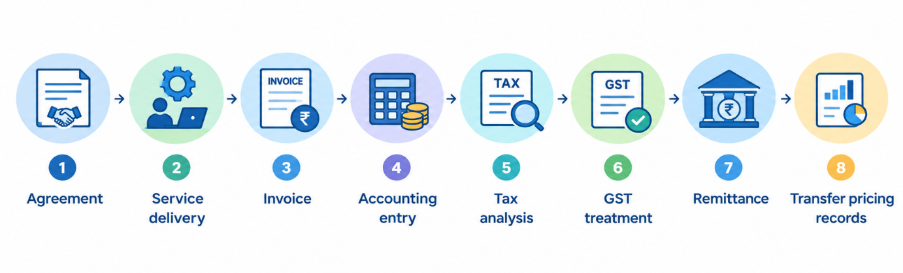
An Indian subsidiary needs to maintain records that connects the service agreement with the payment. The records may include:
- Intercompany service agreement
- Invoices and payment records
- Details of services and deliverables
- Emails, reports and other evidence of services provided
- Cost allocation calculations
- Transfer pricing analysis and benchmarking
- Tax Residency Certification and treaty documents, wherever relevant
- Withholding tax records
- GST and reverse charge records
- Documents required by the authorised dealer bank for the remittance
FEMA and RBI requirements must be considered, especially when an Indian subsidiary makes cross border payments. Payments for services are generally treated within the current-account framework, subject to the applicable FEMA rules and any restrictions.
How Much Does an Intercompany Service Agreement Costs?
There is no standard professional fee for the preparation of intercompany service agreements. The cost generally depends on the complexity of the group structure, numbers and type of services, jurisdiction involved, transfer pricing analysis, tax review, GST and FEMA considerations, and whether the agreement is being drafted, reviewed or restructured.
Get in touch with Stratrich for a professional assessment.
Conclusion
An intercompany service agreement in India is more than an internal group document. Its terms should match the services provided; the fee should have a supportable commercial and transfer pricing basis. Furthermore, the Indian subsidiary needs to be able to connect the agreement with invoices, accounting records, tax treatment, GST compliance and the underlying evidence of service delivery.
For a foreign parent and Indian subsidiary, the best approach therefore is to review the arrangements before making any payments. It is equally important to keep the documentation consistent throughout the relationship. The Income-tax, GST and FEMA positions should be considered where relevant. The transfer pricing file should explain the service and the pricing.
To review or structure an arrangement, get in touch with professionals at Stratrich. They can help you navigate through these complexities with ease.
Frequently Asked Questions (FAQs)
Not on its own. Tax officers look past the paperwork to the substance. An agreement without matching invoices, evidence of work done and a defensible price is often treated as window dressing rather than proof of a genuine transaction.
Generally No. Vague labels invite scrutiny. A clause naming the specific functions covered, such as finance oversight or HR recruitment support, gives the subsidiary something concrete to point to if the arrangement is questioned later.
The subsidiary, in most cases. Since the service is imported from outside India, reverse charge shifts the liability to the Indian entity rather than the foreign parent, regardless of how the two companies split costs commercially.
No. The fee has to hold up under an arm’s length test, usually through cost plus a mark-up or a cost allocation key. A number picked without this backing is one of the first things a transfer pricing review will flag.
Separate paperwork is generally required. Remittances to a foreign parent typically call for certification before the payment goes out, alongside the usual tax and transfer pricing documentation, since FEMA compliance runs on its own track.