


An entrepreneur is the person or group that identifies a business opportunity, takes the initiative and makes key decisions. Entrepreneurship is the broader process of turning that opportunity into a business. It covers activities such as developing the business model, arranging resources, managing risks, entering the market and adapting the venture over time. In simple terms, an entrepreneur is the person driving the opportunity, while entrepreneurship is the process of developing and running the venture.
A foreign business operating through an Indian entity may invoice a customer in another State or supply a customer located in the same State as its own GST registration. The GST treatment is different in each case. The interstate meaning in GST is not determined by whether goods physically cross a state border. The classification principally depends on the location of the supplier and the place of supply, as determined under the Integrated Goods and Services Tax Act, 2017.
The distinction determines whether the invoice generally carries IGST or CGST plus SGST/UTGST. It also affects the place of supply analysis, invoicing, input tax credit and GST reporting. For goods, the place of supply can depend on where movement ends, while services are subject to specific place of supply rules based on the nature of the services. This makes the interstate vs intrastate question particularly relevant where an Indian entity has customers, establishment or transactions across multiple states. Let’s discuss what Interstate and Intrastate means in terms of GST and the intricacies related to it.
What is the Interstate Meaning in GST?
The interstate meaning in GST is based on the statutory definition of an interstate supply. A supply is interstate where the location of a supplier and the place of supply are in different States or Union territories or between a State and Union Territory.
Section 7 of the IGST Act also specifically covers imports, exports and supplies to or by a Special Economic Zones (SEZ) developer or unit. This means that asking only where the customer is located can lead to a wrong answer. The business needs to establish the supplier location and then determine the legally prescribed place of supply.
Let’s look at an example, An Indian subsidiary located in Maharashtra supplies goods to a customer in Karnataka. If the place of supply is Karnataka, the supplier location and place of supply are in different states, making the transaction an interstate supply. Therefore, IGST is applicable, subject to the particular GST provisions governing that transaction.
A supply made by an Indian supplier where the place of supply is outside India is also treated as interstate under Section 7. However, exports are separately treated as zero-rated supplies under the IGST Act, subject to the applicable conditions.
What is Intrastate Supply Under GST
An intrastate supply arises when the location of the supplier and the place of supply are in the same State or Union territory. For a taxable intrastate supply in a state, the tax is divided between CGST and SGST while for Union Territory, the corresponding state component is UTGST.
The classification is not absolute just because both parties appear in the same State. Section 8 mentions a specific exclusion. For example, suppliers to or by an SEZ developer or units are not treated as intrastate supplies even where the supplier and recipient are situated in the same state. Imported goods before crossing the customs frontier are also excluded from the intrastate category.
For services, the same comparison applies, but the place of supply must be determined first under the relevant provisions. A service provided to a registered person will use the recipient’s location as its place of supply, subject to specific rules for particular category of services.
Planning to Enter the Indian Market?
Make informed decisions
Get a Free Consultation ↗Interstate vs Intrastate in GST
| Basis | Interstate Supply | Intrastate Supply |
|---|---|---|
| Basic meaning | Supplier location and place of supply are in different States/UTs, or another statutory case applies | Supplier location and place of supply are generally in the same State/UT |
| Location of supplier | Compared with the place of supply | Compared with the place of supply |
| Place of supply | Different State/UT, or covered by a specific interstate provision | Same State/UT, subject to statutory exclusions |
| Tax charged | IGST | CGST + SGST, or CGST + UTGST |
| Tax components | One integrated tax | Central and State/UT components |
| Typical example | Goods supplied from Maharashtra with Karnataka as the place of supply | Goods supplied within Maharashtra where Maharashtra is also the place of supply |
| SEZ treatment | Supplies to or by an SEZ developer/unit are treated as interstate | Such supplies are excluded from intrastate treatment |
| Invoice consideration | IGST and the relevant place of supply must be correctly reflected | CGST and SGST/UTGST and the relevant place of supply must be correctly reflected |
The tax invoice rules require prescribed particulars including the supplier’s GSTIN, recipient details, HSN or service accounting code, description, value and other information. Correct classification is consequently part of invoice accuracy rather than merely an accounting label.
Why GST Rates Applies to Interstate and Intrastate Supply?
The interstate or intrastate classification does not determine the underlying GST rates. The applicable rate depends on the particular goods or services, their classification and the relevant rate notifications. The official CBIC rate table shows separate CGST, SGST/UTGST and IGST rates against the relevant taxable supplies.
The distinction is in the tax components. An interstate supply carries the applicable rate as IGST. An intrastate supply carries the corresponding central and State/UT components.
Let’s look at an example,
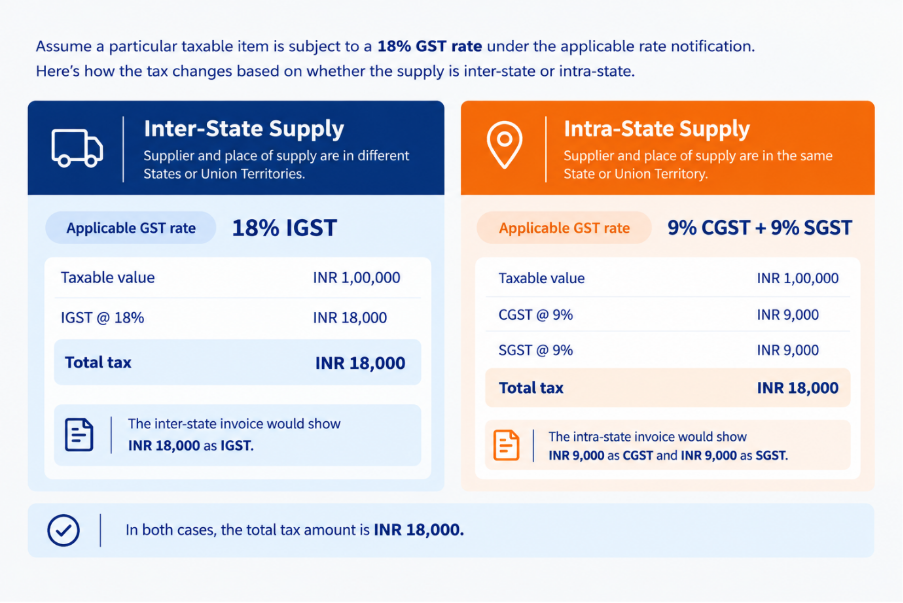
Note: This is only an illustration. 18% is not a universal GST rate, and businesses must identify the rate applicable to the specific goods or services under the current rate notifications.
How Is Applicable GST Determined?
A practical classification exercise can be approached in six stages:
1. Identify the supplier’s location
First step is identifying the State or Union Territory in which the supplier is registered under GST. The supplier’s location is then considered when determining whether the supply is interstate or intrastate.
2. Determine the place of supply
This is the critical second step. For goods involving movement, the place of supply is generally where the movement terminates for delivery, subject to the statutory rules. The place of supply is then compared with the supplier’s location to determine whether the supply is interstate or intrastate. For services, the place of supply is determined under the applicable provisions of the IGST Act based on the nature of the service and other prescribed conditions.
3. Compare the two locations
Compare the supplier’s location with the place of supply under section 7 and 8 of the IGST Act. Section 7 sets out when a supply is treated as an interstate supply, while Section 8 provides for intrastate suppliers, subject to specific exclusions and exceptions. This comparison determines the nature of the supply for GST purposes.
4. Classify the supply
Based on the comparison, classify the transactions as either an interstate or intrastate supply. If the supplier’s location and place of supply are in different State or Union territory, it is generally an interstate supply. If they are in the same State or Union territory, it is generally an intrastate supply, subject to the specific exceptions under the IGST Act.
5. Identify the applicable GST rates
Determine the correct classification of the goods or services and then refer to the applicable rate notifications.
6. Apply the correct tax to the invoice
Charge IGST for an interstate supply or CGST plus SGST/UTGST for an applicable intrastate supply, subject to the specific provisions governing the transaction.
This sequence is more reliable than deciding GST treatment solely from the customer’s billing address or whether goods have physically crossed a state border.
Why Does the Interstate or Intrastate Classification Matter?
The classification affects several practical aspects of GST compliance.
- Tax Charge: The supplier must charge the correct tax components.
- Invoice Accuracy: An invoice should reflect the correct nature of supply and associated GST particulars.
- Place of Supply Reporting: The place of supply supports the determination of whether the transaction is Interstate or Intrastate.
- Input Tax Credit: The nature of tax charged affects how eligible input tax credit is recorded and utilised under the GST framework.
- GST returns: Outward suppliers and tax liabilities must be reported correctly.
- Multi-State Operations: A business operating through establishments or registrations in different states needs to consider each transaction against the relevant GST registration and place of supply rules.
For foreign group, this becomes more significant where the Indian business has several State registration, warehouses, service establishments, or customers across different jurisdictions. GST registration and transaction analysis should be considered together rather than treating the company’s legal incorporation location as the answer for every transaction.
How Does GST Apply to Foreign Businesses Operating in India?
For an overseas group, GST analysis begins with the Indian legal and operational structure. An Indian subsidiary supplying customers in another State may make interstate supplies and charge IGST. The same subsidiary may make intrastate supplies to customers in the State where the relevant place of supply is located.
An Indian entity purchasing goods or services from another state will similarly need to consider the supplier’s location and applicable place of supply rules. Where a group operates through establishments in several States, the GST analysis becomes more detailed. This happens because the location of the relevant establishment and the registration associated with the transaction matters.
SEZ transactions require particular care. This is because supplies to or by the SEZ developers or units are treated as interstate supplies and are zero-rated, subject to the applicable legal conditions.
Cross-border arrangements require a separate layer of analysis. Imported goods and services have specific statutory treatment, while exports can qualify as zero-rated supplies when the conditions in the IGST Act are met. A foreign business should not assume that every transaction involving an overseas parent, Indian subsidiary or foreign customers is simply an interstate transaction. The legal structure, supplier location, nature of supply, place of supply and applicable provisions need to be considered together.
What is the Cost of Interstate and Intrastate GST Compliance
There is no fixed cost of Interstate and Intrastate GST Compliance. The tax exposure depends on the value of taxable suppliers, the applicable rate, exemptions and concessions, and the nature and classification of the goods or services.
The administrative burden also varies according to the number of the States involved, GST registration, transaction volume, invoice requirements, return reporting, input tax credit reconciliation and the complexity of the arrangements involving SEZ or cross-border supplies. A foreign business with operations across several states consequently can face more compliance processes than an entity making a limited number of supplies from one location.
The correct approach is to determine the tax treatment transaction by transaction and then assessing the resulting registration, invoicing, reporting and ITC requirements under the applicable law.
Conclusion
The core distinction in the intrastate and interstate meaning in GST is the relationship between the location of the supplier and the place of supply. An interstate supply attracts IGST, while an intrastate supply attracts CGST+SGST or UTGST. The underlying GST rate is not determined by this classification alone. It depends on the goods or services and the applicable rate notification.
For foreign businesses operating through Indian entities, the distinction becomes relevant where transactions involve customers in multiple States, different GST registrations, SEZs, imports or exports. Correctly determining the supplier’s location, place of supply and nature of supply before issuing the GST invoice provides the basis for appropriate tax charging and compliance. For assistance with GST classification, compliance or transaction structuring, get in touch with professionals at Stratrich consulting.
Frequently Asked Questions (FAQs)
Interstate supply generally means a supply where the location of the supplier and the place of supply are in different States, different Union Territories, or a State and a Union Territory. The IGST Act also specifically treats certain imports, exports and supplies to or from SEZ developers or SEZ units as Interstate supplies. The classification is therefore broader than simply moving goods from one State to another. For services, the applicable place of supply provisions must first be examined because different types of services can have different place of supply rules.
The main difference is the relationship between the supplier’s location and the place of supply. Where they are in different States or UTs, the supply is generally interstate and IGST applies. Where they are in the same State or UT, the supply is generally intrastate and CGST plus SGST or UTGST applies. However, the law contains specific exceptions, including supplies to or from SEZ developers or SEZ units. The classification should consequently be based on the IGST Act rather than only on the buyer’s address or physical movement of goods.
IGST, or Integrated Goods and Services Tax, is generally charged on an interstate supply. Section 5 of the IGST Act provides for the levy of IGST on interstate supplies of goods or services, subject to the provisions of the Act. The applicable IGST rate depends on the particular goods or services and the relevant rate notification. It is not a separate higher tax merely because a transaction is interstate. The same underlying GST rate applicable to a taxable supply is generally represented through IGST for an interstate transaction.
The interstate or intrastate classification does not by itself create a different underlying GST rate. For a taxable supply subject to an 18% rate, for example, an interstate transaction may carry 18% IGST, while an intrastate transaction may carry 9% CGST and 9% SGST. This is an illustration only. Actual rates vary according to the classification and applicable rate notification for the goods or services. Businesses should check the current official rate schedule before issuing invoices rather than assuming that every supply is subject to 18% GST.
Yes. Under section 7 of the IGST Act, supplies to or from an SEZ developer or SEZ unit are treated as interstate supplies. Section 16 separately provides that supplies of goods or services to an SEZ developer or SEZ unit are zero-rated supplies, subject to the applicable conditions and procedures. This means an SEZ transaction should not be classified as an ordinary intrastate supply merely because the supplier and SEZ recipient are physically located in the same State.