


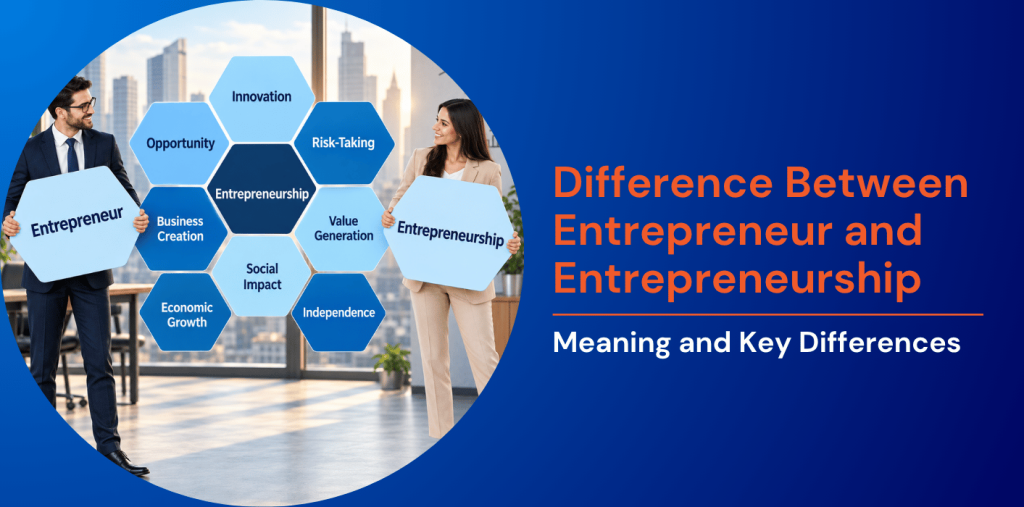
An entrepreneur is the person or group that identifies a business opportunity, takes the initiative and makes key decisions. Entrepreneurship is the broader process of turning that opportunity into a business. It covers activities such as developing the business model, arranging resources, managing risks, entering the market and adapting the venture over time. In simple terms, an entrepreneur is the person driving the opportunity, while entrepreneurship is the process of developing and running the venture.
The word “entrepreneur” describes a person and “entrepreneurship” describes what a person does, along with everyone and everything involved in doing it. An individual making the commercial decisions is not the same thing as the business structure or the process used to establish and operate it. For example, an overseas founder may identify the demand for a particular product in India and decide to establish an Indian operation. That founder will be called entrepreneur. The activities involved in assessing the opportunities, developing the business model, arranging resources, selecting an appropriate operating structure, managing risk and developing the business constitute entrepreneurship.
For any foreign business considering an Indian market entry, understanding the distinction between entrepreneurs and entrepreneurship is crucial. The concepts are connected but they should not be treated as interchangeable. Let’s understand what both the term entails in detail.
Who is an Entrepreneur?
An individual or group who identifies a business opportunity and takes an initiative to act on it is an entrepreneur. They make decisions on what the business will do, commits personal capital, time and reputation to it. They are the ones who take the responsibility to carry the consequences if that specific business venture succeeds or fails.
Ownership is not an absolute requirement. A founder may hold shares in the company, while an investor may operate through arrangements involving investors or other participants. Similarly, being a shareholder or director does not automatically mean that a person is an entrepreneur. Those terms describe specific legal and corporate relationship rather than the broader entrepreneurial role.
What is Entrepreneurship?
Entrepreneurship refers to a broader process and activities of identifying opportunities and turning them into sustainable business ventures. It includes much more than just making initial decisions related to business. It involves:
- Identifying and evaluating a business opportunity
- Developing a business model
- Assessing commercial and operational risks
- Arranging financial and human resources
- Developing products or services
- Entering a market
- Organising business operations
- Responding to changes in customers, technology or competition
- Managing and developing the venture over time
Entrepreneurship can exist before a formal company is created and continue after the business has begun operations.
Planning to Enter the Indian Market?
Make informed decisions
Get a Free Consultation ↗What is the Difference Between Entrepreneur and Entrepreneurship?
The simplest distinction between the two can simply be understood as person versus process. The below table provides clear distinction between the two.
| Basis | Entrepreneur | Entrepreneurship |
|---|---|---|
| Meaning | A person or group pursuing a business opportunity | The process of creating, developing and pursuing a business opportunity |
| Focus | Individual or founding team | Business creation and development activities |
| Role | Initiates, leads and makes decisions | Covers the activities used to turn an opportunity into a venture |
| Scope | Relates to the entrepreneur’s role or venture | Extends across opportunity identification, execution and growth |
| Decision-making | Makes or influences key business decisions | Provides the process through which decisions are developed and implemented |
| Risk | Assesses and accepts commercial responsibility for decisions | Involves identifying, assessing and managing business risks |
| Innovation | May introduce or champion new products, services or methods | Includes the process of developing and applying new ideas |
| Ownership | May own an interest in the business, but ownership is not the definition | Does not itself represent ownership |
| Objective | Pursues a particular business opportunity or venture | Encompasses the creation, development and adaptation of ventures |
| Application | Concerned with the people driving the venture | Concerned with the broader entrepreneurial activity |
How Do Entrepreneur and Entrepreneurship Work Together
The entrepreneur provides initial initiative and directions. Entrepreneurship decides what happens around that initiative. The relationship can be understood as a sequence shown in the image.
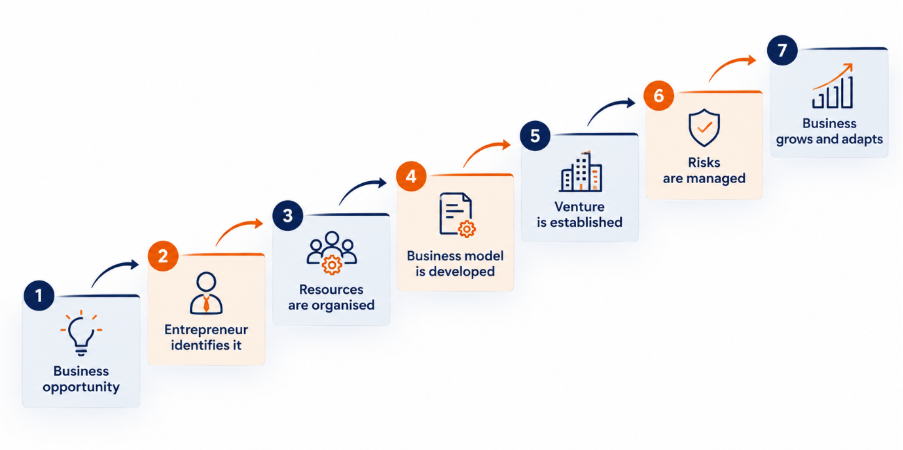
Let’s consider an overseas founder considering an Indian operation. The founder may identify a potential market, assess whether the opportunity fits the group’s strategy and decides to proceed. The subsequent work may involve determining the appropriate structure, arranging funding, recruiting personnel, understanding regulatory requirements, establishing operations and adapting to the business model to local conditions.
The entrepreneur therefore represents the human decision maker, while entrepreneurship represents the wider process of converting an opportunity into an operating and developing business.
Why Does the Difference Matter for a Foreign Business Entering India?
For an international founder, separating the person from the business structure is very important. The distinction can help separate various crucial questions like
- Who is making the commercial decisions?
- What is being established?
- How will it be funded?
- How rules apply?
- Who manages operations?
- How will the venture develop?
Confusing the layers creates serious problems. A founder is not automatically the same as a shareholder, and being a shareholder does not make someone a director with management authority. Similarly, registering a company is a compliance step within entrepreneurship, not the whole of entrepreneurship itself. A foreign business that treats registration as the finish line often underestimates the ongoing resourcing, compliance and adaptation that entrepreneurship demands after incorporation. Recognising the entrepreneur as the decision maker, and entrepreneurship as the surrounding process helps foreign businesses plan realistically.
What Determines the Cost of Starting a Business in India?
There is no single cost that applies to every business venture. The overall cost of establishing and operating a business in India depends on the proposed structure, ownership, location, sector and nature of activities.
Relevant factors can include:
- the type of business structure
- state and location requirements
- capital requirements
- applicable registrations
- sector-specific permissions or approvals
- tax and compliance requirements
- staffing and operational requirements
- accounting, reporting and administrative obligations
- requirements associated with foreign ownership or investment
For foreign businesses, the assessment may also need to consider applicable foreign investment conditions and the manner in which the overseas business will operate in India. DPIIT’s FDI policy notes that non-resident investment can be subject to sectoral caps, entry conditions and applicable sectoral, state and local laws.
The actual amount should therefore be assessed only after the proposed ownership structure, activities, location and regulatory requirements are known. Foreign businesses should obtain an updated professional assessment before committing funds to an India entry or expansion plan.
Conclusion
An entrepreneur is a person or group that takes initiative, identifies an opportunity and makes decisions about pursuing a business venture. Entrepreneurship is the wider process through which that opportunity is evaluated, resources are organised, risks are managed and the venture is established, operated and developed. Understanding the difference helps distinguish the individual founder from the enterprise and from the activities involved in creating and growing a business.
For an international founder, the distinction becomes particularly useful. It allows them to separate personal decision-making from the legal, operational and strategic structure of an Indian business. Entrepreneurs and entrepreneurship are closely connected, but they answer different questions: who is driving the opportunity, and what process is being followed to develop it. Foreign businesses planning to establish or expand their operations in India can get in touch with professionals at Stratrich for guidance based on their proposed business model, ownership structure and India entry requirements.
Frequently Asked Questions (FAQs)
No. Owning a business is a financial position. You hold a stake, maybe you inherited it or bought it later, but it doesn’t automatically mean you’re the one identifying opportunities or taking on risk. Plenty of owners never touch that side of things at all.
Yes. Two or three people spot the same gap in the market, decide to go after it together, and split the decision-making and the risk between them. The number of people involved isn’t really the point. What matters is whether they’re actually steering the thing, not just holding a title or a slice of equity.
No, it’s often the starting point. Launching is one moment. Everything after, keeping resources flowing, reacting when the market shifts, tweaking the model, bringing people on board, that’s still entrepreneurship. It doesn’t stop the day the business opens its doors.
A founder is typically whoever started a particular company, that’s fairly specific. Entrepreneur is looser. You don’t need to have founded a venture to count as one, you just need to be the person pushing a business opportunity forward. And a founder can step back later while other people carry that entrepreneurial role instead.
It does, mostly because it stops things getting muddled. Once you know who’s actually making the calls versus what legal structure is being built, it’s a lot easier to sort out who’s accountable, how funding gets arranged, and which Indian rules kick in at each stage.