




When Nik Storonsky quietly submitted paperwork to relocate from London to Dubai, the Revolut founder became part of an exodus that’s transforming Britain’s business scene.
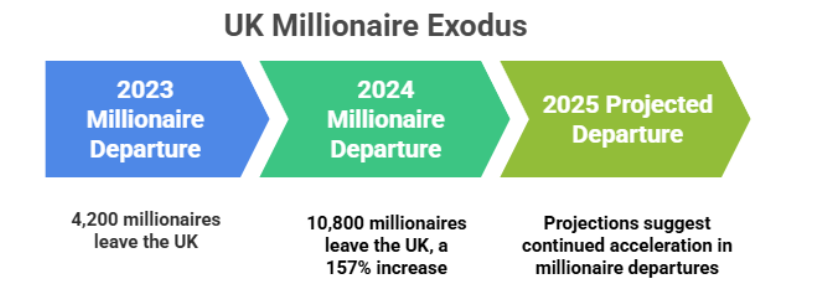
Last year alone, 10,800 millionaires left the UK, a 157% increase from the previous year. Meanwhile, the UAE welcomed 6,700 of the world’s wealthiest individuals.
For UK-based business leaders and entrepreneurs, the pressure is increasing. The “non-dom” regime has ended. Capital gains tax has risen. Corporate tax burdens have increased substantially.
Business owners now face tax bills that feel like penalties for success. Fintech and tech firms deal with regulatory processes that slow innovation rather than support it.
Britain’s wealth creators have contributed substantially to the UK economy, created thousands of jobs, and paid considerable taxes. Yet the fiscal environment grows increasingly difficult for entrepreneurship and wealth creation.
This blog explores what’s motivating companies like Revolut to expand to the Gulf, the benefits beyond taxes, the challenges few talk about, and how these shifts connect with broader global wealth migration trends.
Why are UK business owners leaving the United Kingdom?
To understand the UAE’s appeal, it is essential to recognise Britain’s push factors. The challenges forcing entrepreneurs and business leaders to consider relocation are mounting.
1. The Tax burden
Business owners are dealing with many changes as UK taxes reach their highest level in 70 years. Recent tax increases include:
- Non-dom status abolished (April 2025)
- Capital gains tax increased from 10% to 18% (lower rate) and 20% to 24% (higher rate)
- Corporation tax jumped from 19% to 25%
- Inheritance tax thresholds will remain unchanged until 2028
- National Insurance increases for employers
- Dividend tax rises across all bands
The Non-Dom Abolition Impact:
This policy change has created significant concern amongst internationally mobile business leaders. The previous system allowed non-domiciled residents to pay UK tax only on income brought into the country.
The new regime provides new arrivals with only four years of relief on foreign income. After that, worldwide income is taxed by the UK no matter where it’s earned or held.
For business owners with international investments, offshore operations, or foreign wealth abroad, this signifies a fundamental change to the setup that made London appealing as global wealth management solutions.
2. Regulatory challenges
British bureaucracy has evolved from a framework to a barrier.
Financial services challenges:
- Banking licence applications taking 12-18 months.
- Multiple regulatory bodies with overlapping jurisdictions.
- Constant policy changes create uncertainty.
- Post-Brexit regulatory changes adding complexity.
- Compliance costs are increasing, particularly for growth-stage firms.
Revolut’s experience highlights the challenge. The company took more than a year to seek full UK banking authorization. Meanwhile, approvals in other jurisdictions progressed much more quickly.
Talent acquisition challenges: For businesses requiring international expertise, Britain is making it harder to access the global talent needed to compete internationally:
- Sponsor license requirements have become stricter.
- Minimum salary thresholds keep rising.
- Immigration health surcharge now £1,035 per person annually.
- Skilled worker visa routes becoming more restrictive
- Limited pathways for entrepreneurs without significant capital
3. Economic stagnation
The economic data present concerning figures about UK economic performance:
- GDP growth forecast: approximately 1.0% in 2025.
- For over ten years, productivity growth has remained weak. Business investment levels are below historical averages, and overall business confidence is consistently low. Additionally, infrastructure investment has been underfunded.
Compare this to the UAE’s 4.1% projected growth, and the contrast becomes clear for businesses evaluating where to base operations.
4. Rising business costs
The operational situation for UK businesses has deteriorated due to increased Business Burden:
- Record-high corporation tax
- Rising business rates in commercial centres
- Increased employer national insurance contributions
- Elevated energy costs
- Commercial rent increases in London
- Wage inflation pressures
- Growing regulatory compliance costs
Companies face higher costs combined with increased tax liabilities, making it difficult to stay competitive.
5. Political environment
The political climate has changed with wealth creation and business success now met with more doubt than praise. The sentiment has shifted, with the rhetoric of “Tax the rich” dominating policy discussions. Entrepreneurial success is now viewed with suspicion, and business leaders are increasingly seen as part of the problem rather than the solution.
This atmosphere of policy instability hampers long-term planning and results in limited recognition of the importance of risk-taking, job creation, and economic contribution.
6. Infrastructure decline
Businesses face higher taxes as London’s infrastructure advantage diminishes from operational challenges:
- Regular transport strikes are disrupting business operations
- Public services are declining in quality
- Commercial crime rates are rising
- Infrastructure maintenance is falling behind
- Transport systems are overcrowded
- NHS pressures are affecting the workforce
How many millionaires have moved from the UK to UAE?
The statistics are clear as UAE demonstrates genuine momentum and strategic position in global wealth migration:
| UK Exodus | UAE Attraction |
|---|---|
| 10,800 millionaires departed in 2024 | 6,700 millionaires arrived in 2024 |
| Second-largest loser globally (after China) | 9,800 projected for 2025 |
| 3,790 company directors relocated abroad | £140 billion in property transactions (2023) |
| 40% increase year-on-year | 120 family offices managing £970 billion |
Revolut’s move reflects broader industry trends and the UAE’s increasing appeal for global wealth management solutions. The UAE’s fintech market is growing at 12.5% annually, with transaction values expected to reach £65 billion by 2028. Over 61% of UAE fintech companies have chosen Dubai as their headquarters.
The fintech opportunity in the UAE:
- 12.5% annual growth rate
- 128.5% increase in active fintech companies (2011-2024)
- 89% of UAE consumers use digital-first banking
- £65 billion projected transaction value by 2028
The UAE’s population sits below 11 million, yet it ranks in the top 15 countries by GDP per capita. This represents a developed, tech-forward economy.
Why are fintech companies like Revolut moving to the UAE?
Tax optimisation attracts businesses initially. Growth opportunity keeps them there.
Strategic Positioning
Dubai sits at the crossroads of Europe, Asia, and Africa. Port Jebel Ali ranks as the world’s 12th-largest port, located on major global shipping routes.
Time Zone Advantage:
- 08:00 Dubai = 05:00 London (morning overlap)
- 08:00 Dubai = 11:00 Singapore (afternoon connectivity)
- Effective business hours spanning three continents
Market Growth Comparison
The gap in economic growth is significant:
| Region | GDP Growth (2025 Forecast) |
|---|---|
| UAE | 4.1% |
| Euro Area | 0.8% |
| UK | ~1.0% |
Capital flows towards growth markets. Talent follows capital.
Investment and Infrastructure
Foreign nationals hold about 43% of Dubai’s total residential property value. The market shows steady momentum: 2024 Investment Summary.:
- £19 billion foreign property growth (2020-2022)
- Indians: 20% of transactions
- British investors: 12% of transactions
- Dubai & Abu Dhabi: highest rental yields globally
Tourism reached records in 2024, with Dubai welcoming 18.7 million overnight visitors—a 9% year-on-year increase. This reflects world-class connectivity and reliable infrastructure critical for business operations.
Regulatory Innovation
The Central Bank published Open Finance Regulations in April 2024, mandating licensed financial institutions to apply for open banking licences. Dubai established its Virtual Assets Regulatory Authority for cryptocurrency and digital assets, with a comprehensive regulation rather than prohibition. The UAE is building tomorrow’s financial infrastructure today.
How do the taxes for business owners differ between the UK and UAE?
The tax difference is significant. This sharp contrast is a central driver of global wealth migration. For a business owner selling a company for £10 million:
- UK: Potentially £2 million+ in capital gains tax
- UAE: Full proceeds retained
| Category | UK (≈ £500k Annual Income) | UAE Tax Reality |
|---|---|---|
| Personal Income Tax | ~£210,000 (Income Tax + NI) | 0% |
| Capital Gains Tax | 24% (higher-rate assets) | 0% |
| Inheritance Tax | 40% | 0% |
| Corporation Tax | 25% | 9% (above ~£82k profit) 0% (in qualifying Free Zones) |
The real cost of policy change:
The Adam Smith Institute’s projections show:
- £111 billion potential loss to UK by 2035
- 44,415 jobs at risk by 2030
- £2.4 billion Treasury shortfall if 50% of non-doms relocate
The government projected the changes would raise £2.7 billion annually by 2028-29. Early data suggests the opposite is happening.
What are the regulatory benefits of moving a business to UAE?
Taxation grabs headlines, but regulation influences daily operations. This makes the Emirate especially attractive for business leaders. Beyond tax, regulation is a major factor for entrepreneurs entering global wealth migration flows or seeking streamlined global wealth management solutions.
Golden Visa Programme: The UAE’s residency scheme offers flexibility:
Investment routes:
- £410,000 in property
- £2 million in business investment
- Specialist talent categories
Key benefits:
- 5–10-year renewable residency
- No sponsor requirement
- Extended time outside the UAE permitted
- Family inclusion options
- Fast-track processing
Residency doesn’t depend on a single employer or require annual renewal procedures.
Transparent Business Regulations: The UAE offers clear, business-friendly rules with fast-tracked licensing and regulatory approvals in Free Zones and mainland sectors.
Stable Legal Environment Under UAE Labor Law: Compliance-focused yet supportive of business growth, minimizing the risk of heavy penalties related to UAE Labour Law punishment and penalties.
No Currency Restrictions: Simplifies cross-border capital flows in a global business context.
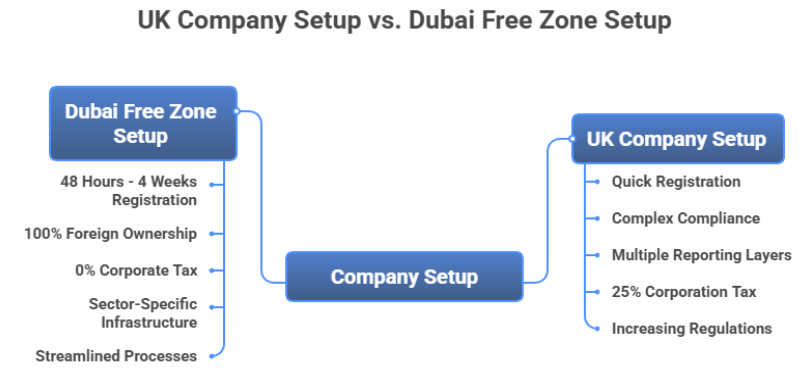
Free Zone Flexibility: 100% foreign ownership, full profit repatriation, and industry-specific infrastructure provided to optimise operational efficiency.
Strong IP Protection and Confidentiality Laws: Attracting innovation-driven sectors and startups.
How fast can you set up a company in the UAE’s Free Zone?
The UAE offers streamlined regulatory pathways designed to facilitate business establishment. Free Zone benefits include:
- Complete operational independence
- No local partner requirements
- Full profit repatriation
- No currency restrictions
- Industry-tailored facilities
Revolut spent over a year in regulatory review for its full UK banking licence. In the UAE, it received in-principal approval from the Central Bank considerably faster.
Popular Free Zones by sector:
| Sectors | Free Zones |
|---|---|
| Finance | Dubai International Financial Centre (DIFC) |
| Technology | Dubai Internet City, Dubai Silicon Oasis |
| Media & Creative | Dubai Media City |
| General Trading | Jebel Ali Free Zone (JAFZA) |
| Commodities | Dubai Multi Commodities Centre (DMCC) |
Is moving your business to UAE the right decision?
| Dubai Makes Strategic Sense For | Dubai Presents Challenges For |
| Businesses facing substantial UK tax exposure | Businesses requiring deep EU market integration |
| Companies targeting Middle Eastern or Asian markets | Companies with primarily UK-focused clients |
| Fintech and technology firms seeking regulatory efficiency | Startups requiring extensive early-stage venture funding |
| Investment firms prioritising capital preservation | Operations requiring large specialist talent pools |
| Operations comfortable with expatriate structure | Businesses where physical UK presence is essential |
Tax Residence Requirements
Important: Property ownership in Dubai alone doesn’t establish non-UK tax residence.
HMRC applies statutory residence tests considering:
- Days spent in UK (typically under 16 for clear non-residence)
- Ties to UK (family, accommodation, work, 90-day rule)
- Where business and personal life are genuinely centred
Professional tax and legal advice across both jurisdictions is essential for compliance and optimisation.
Due diligence requirements:
- Extended Dubai visits across different seasons
- Consultations with businesses that have relocated
- Comprehensive financial modelling including all costs
- Specialist advice from UK and UAE tax/legal experts
- Research specific free zone vs. mainland setup
- Assessment of talent availability
- Evaluation of banking and financial services access
- Analysis of client and market accessibility from Dubai
What does the UK business exodus to the UAE mean for the future?
This phenomenon reflects fundamental concerns about the UK’s trajectory as a global business hub. Tax increases, regulatory complexity, and economic stagnation are forcing business leaders to reconsider their positioning.
The Trend:
- For some businesses, this represents an opportunity to position for global growth whilst optimising financial structures. For others, it’s a response to policies that appear hostile to wealth creation.
- When established companies like Revolut relocate headquarters and leadership, it signals confidence in the destination’s long-term viability.
- Whether the UK will adapt policies to stem this outflow remains uncertain.
- What has become clear: for the first time in generations, London faces genuine competition as Europe and the Middle East’s primary financial hub.
Conclusion
Understanding global wealth migration trends and evaluating the right global wealth management solutions are essential before making a decision. It ultimately comes down to your business goals, operational needs, and appetite for change. The UAE undeniably offers powerful advantages, world-class infrastructure, tax efficiency, and a thriving financial ecosystem, but it also comes with trade-offs that need to be weighed carefully.
Yes, there are many success stories of companies flourishing after moving to Dubai. But there are also businesses that struggled because they made the leap without the right preparation or guidance. Wealth migration to the UAE is about far more than tax optimisation, it’s about positioning yourself where growth, stability, and opportunity intersect. For some businesses, that ideal environment is Dubai. For others, it may still be London, or another global hub entirely. What matters most is making a decision grounded in data, strategy, and clarity.
The question isn’t whether companies are moving to the UAE; the trend is unmistakable. The real question is whether it makes sense for your business.
And that answer requires expert insight, structured evaluation, and a deep understanding of both the opportunities and the challenges. If you’re exploring whether a move to the UAE could unlock real strategic value, Stratrich can help you make that decision with confidence.
Contact our advisory team today to discuss the best path for your business, whether that involves Dubai or another jurisdiction.