

Introduction
Dubai, where luxury defines lifestyles, serves as a canvas for cutting-edge interior design trends blending opulence with innovation. From superyacht-inspired villas to smart high-rises, spaces reflect prestige through breathtaking finishes, sustainable materials, and immersive tech integrations.
This surge in demand for pristine, showroom-quality environments fuels growth for professional interior design and execution services.
According to Mordor Intelligence report, Dubai holds 52.33% of the UAE’s interior design market share and is growing at a CAGR of 7.33% from 2025-2030, making it the fastest-expanding regional hub.
Many designers eyeing the Emirates often face a common challenge in navigating jurisdictions regulations, costs, and licensing. This gap between the desire and launch can lead to months of uncertainty.
Whether you’re considering starting a consultancy studio in Dubai Design District or launching a full contracting firm to handle fit outs, the journey becomes easier when you have clear guidance. This blog provides step-by-step guidance on choosing the right licenses and opening a corporate bank account to turn ambitions into reality.
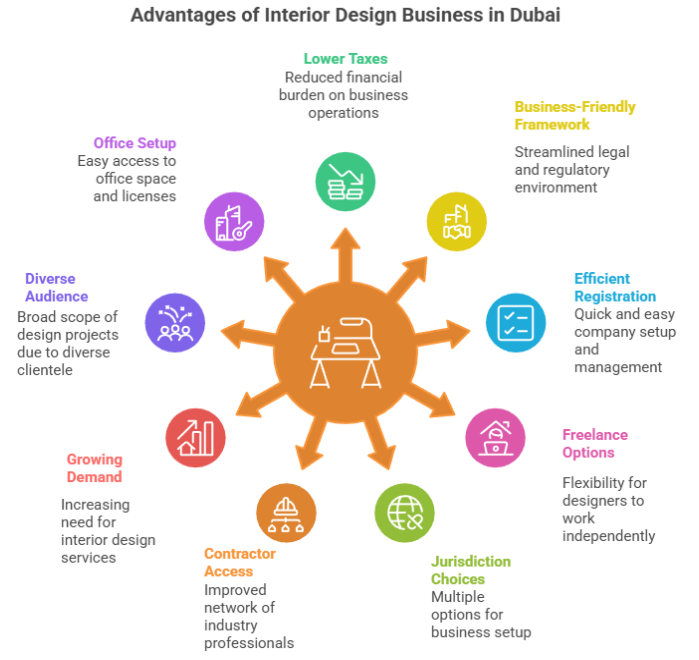
Why are designers choosing Dubai for starting their business?
Dubai is the biggest part of the UAE Interior Design Market. The latest studies show the market is expected to hit $2.14 billion by 2030, but there are many reasons beyond those numbers why so many designers want to come here.
There is constant activity here; many new buildings being constructed (homes and offices), extensive renovation of offices, ongoing government support for new projects, and events are being organised to build connections with potential clients.
New property handovers happen constantly
The first quarter of 2025 recorded 45,474 residential transactions, amounting to AED 142.7 billion, with 56% of off-plan sales including design specification terms several months prior to delivery. There is a growing need for turnkey solutions within 90-day delivery windows, offering immediate income streams to well-established companies.
The commercial sector adds another layer
Commercial sector expands office supply, converting 30% of workstations to social hubs. Dubai’s Real Estate Sector Strategy 2033 boosts transactions; Creative Economy Strategy doubles creative GDP. These design-focussed transformations directly expand market opportunities.
Government plans and events create instant connections
Real Estate Strategy 2033 boost deal volume, while Creative Economy fuels design growth. Events like INDEX Dubai, Downtown Design, and Dubai Design Week were organised attracting approximately 150,000 people annually and fostering partnerships that might take years to develop elsewhere.
Tourism and hospitality
The total monthly revenue projection for the Hospitality Industry will exceed USD 100 billion worldwide. For example, the following luxury hotels now offer their products in Dubai: Aman Dubai, Janu Dubai (2027), Rosewood Dubai (2029) and have committed AED 50 to AED 200 million each for their interiors. The Wynn Resort in Ras Al Khaimah will generate additional demand by expanding beyond Dubai.
Overall, the ongoing goal of attracting 40 million visitors annually by 2031 will drive a continuous stream of hotel development projects across the UAE.
Dubai’s geography
According to 2025 forecasts, Dubai’s share in the United Arab Emirates’ total interior design market is projected at approximately 52%, and it is expected to grow at an annual rate of 7.2% through 2031. A significant driver of this growth will be real estate transactions that exceeded $38 billion in early 2025, and an expanding tourism industry, with more than $100 billion in planned future investment.
Dubai’s 6,500 km Walk Master Plan and Green Spine corridor have generated consistent demand for interior design and furnishings for commercial and public spaces. Also, advances in 3D printing technology are enabling innovative facade designs that were cost-prohibitive only a few years ago. The newly developed building codes in Dubai are designed to enhance the safety and environmental sustainability of new buildings while also expediting the approval process for local companies seeking to use them.
Tax friendly jurisdiction
Dubai’s favourable tax framework, such as the absence of capital gains tax, friendly regulations for cryptocurrencies attracts various investors.
The absence of income tax for eligible businesses and 100% foreign ownership in both mainland and Free Zones eliminates obstacles.
Planning to Do Business in the UAE?
Get Our Strategic Market Entry Guide
Download Free Guide ↗What are the licenses required for setting up an interior company in Dubai?
The license requirement for starting an interior design company in Dubai varies by jurisdiction, as it also determines market access, operational costs, and growth potential. The selection of a license must align with the company’s scope of services (design-only vs. fit-out/contracting) and long-term business goals.
Mainland license
If you are planning to set up in the mainland, a mainland license allows unrestricted operations across the UAE. Firms can bid on government tenders, work directly with property owners, and execute projects without trading restrictions.
To obtain the license, the requirements include a physical office space with Ejari registration, Dubai Municipality approvals for contracting activities, and Society of Engineers (SOE) membership for qualified engineers when submitting technical drawings.
The activity code has two main types:
- Interior Design Engineering Consultancy (7421110) for planning and visualisation.
- Interior decoration contracting (454009) for physical work.
Costs range from AED 20,000 to AED 30,000, based on office location and size. Annual license renewal costs about AED 10,000 to AED 15,000.
Free Zone license
Dubai Design District (D3) has established itself as a centre for the creative industries hosts over 1,100 design companies. The D3 offers a Free Zone license that grants 100% foreign ownership, enables a simplified setup within 5 to 7 working days and allows an exemption from tax obligations on income and corporate activities.
However, there are trade-offs associated with this business model: any company that wishes to operate in the Free Zone must adhere to restrictions on trading with mainland clients (e.g., no direct trading is allowed, although consulting with mainland clients provides an ability to work with the client’s contractor). Most companies operating in D3 provide consulting services to mainland clients and contract out the actual work to mainland businesses.
Initial setup costs in D3 for flexi-desk packages with 1 to 2 visas is estimated at AED 20,000 to 25,000. Annual costs for private office space, which offers a higher number of visas, are estimated at AED 40,000 to 100,000.
| Aspect | Mainland | Dubai Design District (d3) |
|---|---|---|
| Market Access | Full UAE access/ tenders | Limited to Free Zone / international markets (agents needed) |
| Foreign Ownership | 100% permitted | 100% guaranteed |
| Setup Timeline | 7-14 working days | 5-7 working days |
| Initial Cost | AED 22,000-35,000 | AED 22,000-28,000 |
| Physical Office | Mandatory (Ejari required) | Flexi-desk available |
What documents and qualifications do the process require?
The following are the essential documents required for applying for an interior design business license in Dubai:
- All shareholders must have copies of their passports, UAE residence visas or entry stamps, residential addresses verified, and No Objection Certificates from current sponsors if applicable in the UAE.
- Business documentation includes proposed trade names (prepare 2-3 options), business plan outlining services offered, Memorandum of Association, and initial approval certificate from Department of Economy and Tourism or chosen Free Zone authority.
- For contracting licenses specifically, authorities require professional qualifications in interior design, portfolio showcasing previous work, Society of Engineers registration for qualified engineers, and Dubai Municipality approvals for technical activities.
- Office documentation needs tenancy contract from landlord, Ejari registration certificate, and office inspection clearance where applicable.
Professional document requirements
Although formal degrees are not strictly required for consultancy licenses, having experience helps a lot. Certifications in interior design, space planning, or architectural design show credibility when submitting technical drawings to Dubai Municipality for approval.
Contracting work needs a qualified engineer with SOE credentials. If that engineer leaves, permit submissions stop until a new one registers, which can delay projects.
What are the steps for setting up an interior designing company in Dubai?
The setup follows a structured process, typically completed within 2-4 weeks with proper preparation.
Step 1: Select your company’s activities
Clarify whether operating as a design consultancy (planning and visualisation only), a contracting firm (physical execution and installation), or a commercial trading firm (furniture import and sales). Each category requires different license classifications and authority approvals.
Step 2: Reserve the trade name
Submit two to three name options to the Department of Economy and Tourism for the mainland or Free Zone authority. Names must reflect professional services, avoid religious or political references, do not infringe existing trademarks, and ideally match available domain names for online presence.
Approval for trade name usually takes 1-2 working days once submitted correctly.
Step 3: Select the location for your office
Mainland requires physical office space verified through the Ejari registration system. Free Zones offer flexi-desk packages (supporting 1-2 visas), shared offices (3-5 visas), or private offices (6+ visas based on square metres).
Office size directly determines visa allocation for mainland setups, making this decision crucial for staffing plans.
Step 4: Submit license application
Apply through the DET portal for the mainland or the Free Zone authority website. Upload initial approval forms, shareholder documents, business activity descriptions, and office lease agreement.
Processing takes 4-7 working days for Free Zones, 7-14 days for the mainland, depending on activity complexity.
Step 5: Obtain the trade license
After approval, pay outstanding license fees and collect the official trade license. This document permits legal operations, staff hiring, and formal client contracts.
Step 6: Open the corporate bank account
Submit your trade license, Memorandum of Association, and shareholder documents to UAE banks. Minimum balance requirements range from AED 25,000 to 150,000, depending on the bank selected and account type.
Banks prefer meeting shareholders in- person. So, make sure you visit them in-person even if preliminary applications are handled online.
Step 7: Process Visas
Investor and employee visas can be obtained from the General Directorate of Residency and Foreigners Affairs. Visas for companies operating in the mainland are issued based on the size of the office. For Free Zones, the number of visas will be specified in advance in the business license you buy.
All visa applications require the applicant to have a valid medical fitness certificate and complete the Emirates ID application.
What is the cost to setup an interior designing company in Dubai?
Budget planning requires understanding both one-time and recurring expenses. Costs vary based on jurisdiction, office selection, and visa requirements. Initial investment breakdown includes:
| Category | Description | Cost (AED) |
|---|---|---|
| Trade License | Mainland: AED 12,000-20,000 d3/Free Zone: AED 12,405-15,010/segment Initial approval: AED 245-1,500 | 12,000-20,000 (mainland) 12,405+ (d3) |
| Office Premises | Mainland (e.g., Business Bay): AED 30,000-80,000/year d3 flexi-desk: AED 12,000-18,000/year Private office: AED 40,000+ | 12,000-80,000/year |
| Ejari Registration | Mandatory tenancy contract registration | 220 |
| Bank Account | Corporate account opening | 1,000-2,000 |
| Visa Processing | Per person (entry permit, residency, Emirates ID) | 3,000-6,000/person |
| Consultant Fees | PRO/professional services for setup | 3,000-5,000 |
Total First-Year Investment: AED 20,000 to 60,000 depending on choices made across these categories.
Recurring annual costs that you should not forget:
| Category | Description | Estimated Cost (AED) |
|---|---|---|
| License Renewal | Yearly for mainland or Free Zone | 10,000-15,000 |
| Office Lease | Continues per initial agreement | As per contract (12,000-80,000) |
| Memberships & Insurance | Professional associations (e.g., design guilds) + liability coverage | 2,000-5,000 |
Case Study: How a design firm built a successful business in Dubai
Understanding what makes a business successful is really important because it helps entrepreneurs have ideas about what they can achieve and how they can do it. This company that decorates interiors has some lessons for people in the UK who want to start a business, in Dubai.
From Damascus to Dubai Design District
The founders of this company originally started the practice in Damascus in 2001. They saw that Dubai was doing well with new businesses and companies, so they moved the practice to Dubai to be in the middle of the design industry in that region. The design industry is a significant part of Dubai, and the founders wanted their practice to be included in it.
The company started out by doing things the traditional way. They focused on doing quality work rather than just trying to do a lot of work. They built relationships with their clients instead of trying to get many clients as they could. With lot of different ideas, the company get bigger even though they were new to the market. The market was already full of companies that had been around, for a long time.
Strategic Business Development
The company started by doing work for restaurants and stores. They did jobs to get their name out there before taking on bigger projects. The company has created impressive projects including a restaurant, bar in a luxury hotel, Japanese eatery, and branded spaces in a large mall.
By 2021, the firm had grown enough to start a division, hire a principal architect, and move to a larger office space while adding more team members. They combined interior services, which is called vertical integration, and this created advantages for the firm’s clients who wanted design and building solutions that worked well together.
Current Position and Growth
The company is now working in the United Arab Emirates and Saudi Arabia. It has been doing this for over 15 years. The company does work on hotels, stores, offices and homes. People around the world know about the company because it does such great work. The company has even been nominated for some important awards for interior design because of its work on hospitality, retail, commercial and residential projects.
The way they make money is by charging fees for design services, project management, and executing the work to fit out a space. What clients say about them shows that they complete jobs on time and are good at managing projects, which is really important if you want to be seen as a good company in a competitive place like Dubai.
Key Takeaways for New Entrants
The company’s journey shows us important things that a company in the United Kingdom should know when they want to work in Dubai.
- Start strategically: Beginning with commercial and hospitality work builds portfolio credibility faster than targeting luxury villas initially.
- Focus on relationships: When you have good relationships with your clients in Dubai, they are more likely to tell their friends about you. This works better than trying to advertise to a lot of people. Quality relationships with clients make it easier to get clients through referrals, in Dubai’s market, where people trust the opinions of their friends and family.
- Scale methodically: Growing from consultancy to full design-build services follows a natural progression in demand.
- Specialise initially: The company-built expertise in restaurant design before diversifying, establishing clear positioning.
- Invest in local presence: A physical Dubai office signals a commitment to regional clients and facilitates relationship-building.
Conclusion
Dubai’s interior design boom offers huge potential; follow the steps outlined in the blog for a compliant, profitable entry. To launch your interior design firm in Dubai, start by defining your core services, such as consultancy, full fit-outs, or both.
Next, choose your location: a Free Zone for quick access to the creative ecosystem or the mainland for broader market reach, all of which now allow full foreign ownership with no income tax hurdles. Secure a local office early to build client trust, master key regulations like BIM and sustainability perks, and network at major design events.
Partner with Stratrich Consulting experts for smooth approvals, as Dubai’s growth rewards strategic starters with long-term potential.