


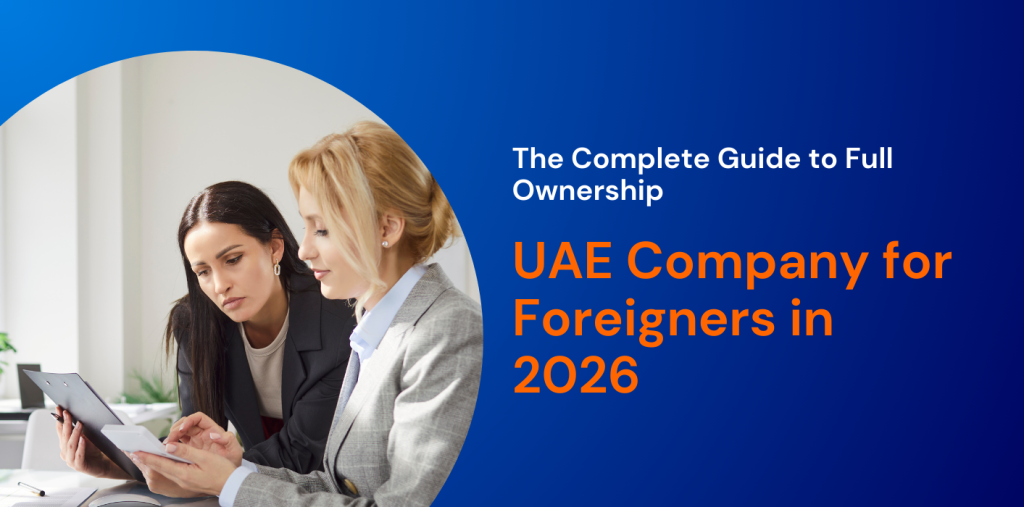
The confusion around foreign ownership in the UAE stops many entrepreneurs from expanding into one of the world’s fastest-growing markets. There are multiple questions that flood online forums that indicate doubt and apprehension for first time investors. These questions range from requiring local sponsors, complete ownership of companies, and guidelines on profit holding for local partners.
Unfortunately for business owners, these concerns have real financial consequences. Delayed market entry means missed opportunities in a region that attracts FDI to the tune of USD 45.6 only in 2024. UK business owners must understand the ownership framework to prevent competitors from taking market share and to establish fully controlled operations in the Emirates.
This guide covers the foreign ownership rules for 2026, including sectors that permit full control, strategic restrictions, and the setup processes used by thousands of international entrepreneurs.
What changed in UAE’s foreign ownership laws?
Federal Decree-Law No. 26 of 2020 reformed mainland business structures in the UAE. It abolished the 51/49 ownership rule. Foreign investors previously chose limited shares on the mainland or Free Zones, depending on location-based trading restrictions.
The 2025 regulatory environment operates through three distinct classification systems:
- Positive List Activities: The Department of Economic Development published approval for over 1,000 economic activities where complete foreign ownership applies automatically. These covers 122 designated sectors, including manufacturing, healthcare, technology services, retail trade, and professional consultancy. Dubai’s Department of Economy and Tourism confirmed that commercial licenses for these activities no longer require local sponsor arrangements.
- Negative List Restrictions: The UAE safeguards key sectors through Federal Decree-Law No. 19 of 2018. Foreign involvement in oil and gas exploration, brand agencies, weapons manufacturing, and telecom backbone is limited to 49% at most, or entirely prohibited for national defence.
- Strategic Impact Activities: The Cabinet Resolution No. 55 of 2021 lists the sensitive sectors that need further regulatory supervision. Banking, insurance, money exchange operations, and military-related activities fall under this classification.
Foreign investors can potentially secure 100% ownership in these areas, but they must obtain sector-specific approval from relevant authorities including the Central Bank, Ministry of Defence, or telecommunications regulators.
*Note: The requirement for a Local Service Agent (distinct from a shareholder sponsor) applies only to professional licenses in certain Emirates, carrying no ownership rights.
Which sectors allow full foreign control?
A list of approved business activities provides a wide range of commercial opportunities aligned with the UAE’s economic diversification strategy. It’s no coincidence that these industries also happened to receive the highest levels of foreign direct investment in 2024. Most of these investments were incepted through the greenfield projects.
- Technology and IT Services: Software development, cybersecurity consulting, data analytics, Artificial Intelligence application development, and digital transformation services (11.5% of total greenfield foreign direct investment).
- Healthcare and Wellness: Purchase and rental from private hospitals, specialty clinics, diagnostic laboratories, distributors and wholesalers of pharmaceutical products, and telemedicine.
- Manufacturing and Production: Food processing, assembly of electronic items, textile production, packaging solutions, and manufacturing of industrial equipment.
- Retail and E-commerce: Buying and trading in goods, key online marketplace operations, luxury good retail sales, electronic good retail sales, and fashion retail sales.
- Professional Services: Legal advice (as allowed under the bar association rules), accountancy firms, management consultancy, marketing professional companies, and professional human resource management companies.
- Hospitality and Tourism: Travel agencies, tour operators, hotel management companies, restaurant businesses and event planning businesses.
- Renewable Energy: Solar energy projects, wind energy projects, and developmental work on sustainable technologies (9.3% of total greenfield foreign direct investment).
Planning to Do Business in the UAE?
Get Our Strategic Market Entry Guide
Download Free Guide ↗What restrictions remain for foreign investors?
Understanding boundaries is crucial for compliance and strategic planning. The Ministry of Economy has decreed a Negative List that enforces strict limitations for foreign investors:
| Restricted Sector | Foreign Ownership Cap | Regulatory Authority |
|---|---|---|
| Oil & Gas Exploration | 0% | Ministry of Energy |
| Commercial Agency | 0% | Ministry of Economy |
| Defence Manufacturing | Requires approval | Ministry of Defence |
| Banking Services | Requires approval | Central Bank of UAE |
| Insurance Operations | Requires approval | Insurance Authority |
| Telecommunications Infrastructure | Requires approval | Telecom Regulatory Authority |
Violations carry severe consequences. The Ministry of Economy has the authority to order company liquidation or license cancellation for entities established without proper approval or exceeding permitted foreign ownership stakes. Penalties range from substantial fines to imprisonment for intentional regulatory violations.
The concept of “nominee arrangements” (where foreign investors use UAE nationals as front owners) remains explicitly illegal. Cabinet resolutions warn that such structures can lead to investigation and legal action. Additionally, the economic substance regulations introduced alongside corporate tax mandate that businesses must conduct real operations aligned with their registered activities.
Activities with strategic impact require guidance tailored to each sector. A fintech startup seeking banking services integration must engage the Central Bank early in the formation process. Healthcare facilities require approval from the Dubai Health Authority or equivalent emirate-level regulator. Educational institutions coordinate with the Knowledge and Human Development Authority.
What benefits come with 100% foreign ownership?
The elimination of mandatory local partnership delivers tangible operational advantages:
- Complete Profit Retention: Foreign owners retain 100% of generated profits without mandatory distribution to local sponsors. Historical arrangements often required substantial monthly payments to local partners despite their non-participation in operations.
- Autonomous Decision-Making: Board composition, strategic direction, operational policies, and financial management remain under full investor control. No requirement exists for UAE national representation on boards unless specified by strategic impact sector regulations.
- Direct Market Access: Emirates allow participation in government tenders, creating potential for billions of dollars annually through the infrastructure projects, public sector procurement and contracts at the emirate level.
- Simplified Compliance: By removing partnership structures, foreign investment arrangements will no longer have an extensive number of side agreements required to be prepared as part of a foreign investment. This will also eliminate the complications caused by differing profit share agreements and the potential for lengthy disputes among partners.
- Enhanced Financing Options: 100% ownership opens the doors to international financing, venture capital investment, and banking facilities in a better way. Financial institutions are more likely to extend credit when ownership structures seem transparent and controllable.
In 2024, the total value of trade between the United Kingdom and United Arab Emirates was £24.3 Billion, an increase of 11.1% from the previous year. Over the last four quarters of data through the end of Q2 2025, the United Kingdom exported goods to the UAE worth £15.8 Billion (up 13.3%).
The zero personal income taxes and presence of a 9% tax on corporate profits over AED 375,000, as well as no capital gain taxes, provides incredible inducements to financially conscious businessmen. offers significant incentives to financially conscious entrepreneurs.
The UAE’s ideal geographical position (the intersection of Europe, Asia, and Africa) provides easy access to 4 billion consumers that can be reached by a flight in 4 hours or less and continues to encourage infrastructure investment. In 2024, record levels of passengers at the national airports were reached, further enhancing cargo exports through ports.
Conclusion
The UAE attracted USD 45.6 billion in foreign investment during 2024, representing 37% of all Middle Eastern capital flows. This success results directly from regulatory reforms that allow 100% foreign ownership across more than 1,000 approved business activities on the mainland.
UK entrepreneurs now have an unprecedented opportunity to establish fully controlled operations without the need for a local partnership. It requires understanding approved activities, adhering to strategic sector restrictions, following the structured DED approval process, and maintaining strict compliance standards. With proper preparation, foreign investors can establish a mainland presence within 2-4 weeks.