




In the UAE, corporate governance and risk management now focus on ensuring regulatory compliance, shifting from merely following guidance to facing real penalties. This change brings financial risks for various organisations.
For instance, enforcement actions include AED 200 million fine for AML breaches and AED 22.7 million across 228 real estate cases, highlighting their seriousness. Between 2020 and 2025, the Central Bank fined over AED 630 million, affecting both large and small businesses.
Risks include losing licenses, restrictions on activities, reputational damage, and legal liabilities. Your ability to maintain compliance can even influence licensing, especially when proper tests are involved.
Managing all this involves understanding the regulations, implementing controls, monitoring performance, and liaising with regulators, which can demand significant resources. That’s where regulatory advisory services in UAE become valuable. They assist organisations in building proactive compliance frameworks to minimise risks and safeguard growth.
What are regulatory advisory services in UAE?
Advisory services are professional services that help you understand and maintain regulatory compliance with applicable laws and regulations. They are designed to understand the key laws of your business, ensure compliance, and keep up to date with any upcoming changes.
It is not merely about fulfilling checklists. Successful advisors help you put systems in place to ensure you stay compliant without disrupting your business. They understand the new regulation, prepare any necessary documentation for the government authorities, and coordinate with the government.
The scope of their services varies according to your industry. A financial institution in the Dubai International Financial Centre operates under different regulations than a manufacturing entity in Jebel Ali or a real estate agency on the mainland. Each region within the UAE has its own regulatory bodies and obligations.
In the UAE, regulatory advisory services address corporate tax, VAT, anti-money laundering, employment law, data protection, environmental reporting, and sector-specific regulations.
What are the differences between regulatory advisory services in UAE and other professional services?
Regulatory advisory services differ from other professional services, such as accounting, financial reporting, and tax compliance, which are typically handled by accountants. This also has legal advisory and representation, which falls under lawyers. The role of a regulatory adviser is to manage regulatory compliance and mitigate regulatory risk.
The difference lies in their approach; while accountants focus on historical financial data and lawyers handle legal disputes, regulatory advisers actively work on compliance. They use legal knowledge, industry knowledge, and operational knowledge for creating sustainable compliance systems.
Similarly, even though an accountant completes corporate tax returns, the regulatory adviser plans the entire corporate tax compliance strategy, including determining residence, documentation, and ensuring substance requirements are met to obtain preferential rates.
What types of regulatory advisory services are available in the UAE?
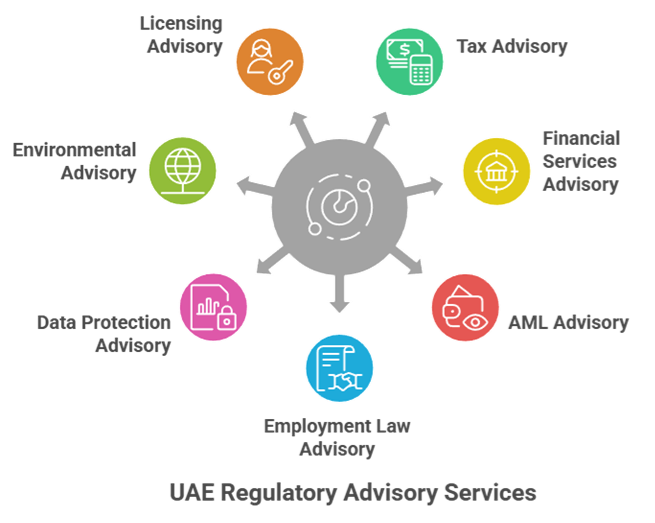
The regulatory advisory services domain in the UAE has several areas, including:
Tax advisory includes corporate tax compliance, VAT, and transfer pricing. Corporate tax was introduced in 2023, while e-invoicing became mandatory in 2026. Therefore, tax advisory has gained much importance in the UAE.
Financial services regulatory advisory is aimed at banks, investment firms, and virtual asset businesses. Providing services in the licensing of firms by the Central Bank, Dubai Financial Services Authority, and Securities and Commodities Authority.
Advisory on anti-money laundering helps companies comply with AML requirements of Federal Decree-Law Number 10 of 2025 for several non-financial companies, for example, the real estate and precious metal trade.
Employment law advisories relate to compliance issues like employment contracts, visa restrictions, and wage protection systems under UAE labour laws.
Data protection advisory helps in the compliance of the UAE’s data protection law, which comes into full enforcement by 2025.
Advisory for environment and ESG, the Federal Climate Law (Federal Decree-Law No. 11 of 2024), which requires businesses to measure and report greenhouse gas emissions from May 30, 2025.
Why do businesses in the UAE need regulatory advisory services?
The UAE regulatory regime has shifted from a lenient approach to an enforcement regime, presenting its own set of challenges.
Multi-Jurisdictional Complexities: The UAE has different regulatory frameworks. Financial Free Zones like DIFC and ADGM are under English common law. The mainland operates under civil law and has both federal and emirate law regulators. Each free zone has its unique regulatory system. This makes the regulations for the business vastly different.
The rate at which regulations are evolving is also rising. New regulations are still being introduced, and corporate taxation has imposed significant regulations, and the Federal Climate Law regulates emissions reporting.
Severe Penalties: The fines for corporate tax violations begin at AED 10,000, for VAT the fines are up to AED 20,000.
The AML fines are up to AED 5 million and for labour law violations, the fines are between AED 100,000 and AED 1 million. While the fines for environmental law violations are between AED 50,000 and AED 2 million.
SME resource constraints: Over 94% of UAE businesses are SMEs, contributing 60% to 63.5% of non-oil GDP. Most SMEs lack dedicated compliance departments and rely on general staff to manage regulatory requirements.
Sector-specific requirements: Different industries face distinct frameworks. Financial services deal with prudential requirements. Healthcare providers navigate health authority licensing. Real estate agencies manage transaction regulations and AML obligations.
Get UAE Financial Services Guide
Banking Reform, FinTech Ecosystem
Download Free Guide ↗What are the benefits of regulatory advisory services in UAE?
A regulatory advisory practice derives value across a range of dimensions.
Risk Mitigation: Risk mitigation requires the adviser to track regulatory breaches in advance. This may be achieved through compliance gap analysis. It saves direct costs such as the amount of the fine and indirect costs such as the cost of investigation.
Operational efficiency: A good compliance program has a smooth integration of processes. Advisers use this advantage by automating processes, rationalising documentation, and eliminating redundancy, cutting the resource allocation to compliance activities.
Strategic Enablement: Regulatory requirements play an essential role in influencing business development and expansion. Advisers assist businesses in realising the implication of these requirements in relation to their strategic development.
Relationship management for regulation: Advisers deal with authorities such as license applications and responses to audits. The expertise of the advisers also helps handle situations efficiently.
How do businesses select appropriate regulatory advisory services?
Selecting regulatory advisory services requires evaluating several factors.
Scope of services: Identify which regulatory domains require support. A fintech company needs financial services expertise and AML guidance. While a manufacturing business requires environmental compliance and employment law support.
Industry expertise: Advisers with experience in the relevant industry understand sector-specific regulations and effective solutions, reducing implementation time.
Jurisdictional knowledge: Advisers must show understanding of the relevant regulatory authorities and requirements for each operating location.
Service model: Some businesses require ongoing advisory relationships, while others need support for specific projects. The model should match their needs and budget.
When should businesses use regulatory advisory services?
Businesses should engage regulatory advisory services during key regulatory challenges in the UAE.
Business Formation: The regulatory decisions during the setup of a business in the UAE are crucial. Choosing an incorrect jurisdiction or license type indicates unnecessary regulatory pressure. This could have been avoided if experts had been involved before establishing the business.
Changes in regulations: In situations of new regulations, business organizations are required to make assessments. In addition, compliance must be executed before the deadline.
Business expansion: When the firm expands by moving into another market or by diversifying the products it sells, additional regulatory requirements need to be factored in, and this is another catalyst for the role of the adviser.
Notable regulatory notices: Receiving such inquiries from the authorities may be an indication of potential compliance problems.
Compliance Incidents: The existence of any violation or audit issue serves as an indication that frameworks can be enhanced by identifying root causes.
How do advisory services in UAE assist with anti-money laundering compliance?
AML compliance is now rigorously enforced. The UAE introduced Federal Decree-Law No. 10 of 2025 to enhance the measures against money laundering, terrorist financing, and proliferation financing.
The Ministry of Economy categorises 26 types of AML violations. Failing to properly handle high-risk customers can result in penalties of AED 200,000 or more.
Real estate enforcement has become more stringent. Notably, 99% of suspicious property deals involved cash payments. The Ministry issued AED 22.7 million in fines across 228 violations. One exchange house faced a fine of AED 200 million.
Regulatory advisers help you build AML frameworks, including risk assessments, know-your-customer processes, transaction monitoring, and inspection preparation. For real estate agencies and precious metals dealers, advisers turn complex regulations into procedures your team can implement.
Conclusion
The role of UAE regulatory advisory services has grown from “nice-to-have” support into “must-have” infrastructure for businesses. The growing complexity of regulations, active enforcement, and rising penalties for non-compliance have created risks that most businesses can no longer manage on their own.
For businesses operating across the UAE’s multi-jurisdictional landscape, with its dynamic regulatory landscape and increasing enforcement focus, regulatory advisory services are a key investment in business resilience and sustainability. Now the question is no longer how to access the added value of regulatory advisers to a business’s operations.
These regulatory advisory services in the UAE not only add value by helping organisations avoid non-compliance, but also in helping them do so efficiently. Thereby allowing organisations to strategically plan and utilize their resources in generating wealth rather than in understanding what the law says.