

In 2026, Dubai’s startup scene has entered a new phase. The city hosts more than 3,500 startups with a combined value exceeding USD 28 billion. This ecosystem has well-functioning infrastructure, access to cash, and a well-organised government support system. What’s more it is shifting from digital adoption to advanced AI infrastructure, sustainability, and cross-border digital services.
If you’re an entrepreneur planning to start a business in the UAE, this blog provides insights to help you seize opportunities and follow trends that aren’t available anywhere else on this scale in Dubai.
What are the opportunities led by government for economic transformation?
Most cities promise support for startups, Dubai takes this one step further by turning government entities into initial customers, transforming policies into a source of profit.
This done through programmes targeted towards startups through a comprehensive and pro-business model. This seeks to establish Dubai as a centre for innovation in Artificial Intelligence, Web3, FinTech, and Sustainability.
The main initiatives that provide opportunities for startups in 2026 by the UAE government include:
Dubai Economic Agenda (D33)
The D33 by Sheikh Mohammed bin Rashid Al Maktoum is the economic roadmap designed to double the city’s GDP and foreign trade over the next decade. For Startups, D33 defines Dubai as a premier global launchpad for high growth companies. It is designed to generate AED 32 trillion in overall economic activity, 30 unicorns, and 400 SMEs that will scale and grow around the world. Government agencies are actively seeking startups to support their operations and provide a much-needed initial revenue stream. D33 reduce the barriers for innovators:
- Sandbox Dubai (Testing ground): It allows startups to experiment with new technologies within a supportive regulatory environment tailored for AI, fintech, and other fields.
- Streamlined Dubai Unified License: The UAE provides companies with a distinct commercial identity. This makes the licensing procedure easier and more efficient throughout Dubai.
- Access to capital and investors: Dubai Chamber of Digital Economy runs events and programs, which supported over 1,200 digital startups in 2024. This helps to link entrepreneurs with investors in Dubai.
- Dubai Founders HQ: This initiative unites founders, investors, and corporate partners, and help startups to scale by providing accelerator programs and mentorship.
- 0% tax and 100% foreign ownership: UAE creates a low barrier, high-freedom environment with no personal income tax and full foreign ownership rights.
- Specialised Hubs: These provide develops focus areas in AI, healthcare, fintech, SaaS, and green energy, supported by specific Free Zones dedicated to these sectors.
Dubai Future Accelerator Program
Dubai Future Accelerator program is a 9-week program that pairs international startups, SMEs, and technology companies with Dubai government entities and private sector partners.
This is seen in the Roads and Transport Authority developing a traffic AI system from conceptualization to deployment in 18 months. Government becomes your reference customer, providing revenue and validation that opens commercial opportunities.
Government backed funding
Dubai doesn’t stop at broad support; it offers targeted programs:
- The Dubai Future District Fund (DFDF) supports these initiatives in the early-stage AI and Web3 technology.
- Mohammed bin Rashid Innovation Fund (MBRIF) is a federal program, which offers funding assistance to innovation startups.
- The Sharjah Entrepreneurship Festival (SEF) is one of the biggest entrepreneurship festivals of the UAE and provides applied masterclasses to founders and startups across the Emirate of Sharjah. Sharjah Entrepreneurship Centre (Sheraa) also provide an allocation of AED 100 million for startups.
- VC funding is around USD 3 billion annually with 493 active funds investing in the region. Furthermore, over 300 startups have been funded by Hub71 with a total of USD 1.9 billion.
Government support for startups is accompanied by GCC growth targets, prompting founders to think regionally from day one. This mindset builds resilience and helps startups tap into a market of millions of people across the Gulf.
Planning to Do Business in the UAE?
Get Our Strategic Market Entry Guide
Download Free Guide ↗How is artificial intelligence being utilised in the UAE for startups?
Artificial Intelligence is being implemented in Dubai to support startups through specialised government support programmes, targeted infrastructure, and regulatory sandboxes. AI has been recognised as one of the important components of the “smart city” strategy in Dubai, with the UAE’s National Strategy for Artificial Intelligence 2031 and the Dubai Universal Blueprint for AI (DUB.AI) providing the framework for AI development in the country.
Dubai has been moving from pilot projects to integrating AI, particularly autonomous agents, into its critical infrastructure.
- UAE committed over 100-billion-dollar investment to AI investments. The UAE’s AI market reaches 1.5 billion dollars by 2026, growing at 25% annually. Some forecasts suggest AI driven economy is projected to contribute 96 billion dollars to GDP by 2030.
- In January 2026, Dubai opened Baidu Apollo Go’s first control centre outside China. Commercial autonomous taxi operations begin Q1 2026, expanding to 1,000 vehicles.
- As part of the city goal of 25% driverless travel by 2030, Pony.ai and WeRide have signed agreements on autonomous pilot programmes, which will commence operations this year.
- Glydways is an electric vehicle-based autonomous vehicle network. It was officially announced in the World Governments Summit 2026 and is to start this year in Bluewaters. Trains are fixed to travel on a particular route and can carry 10,000 passengers/hour with a speed of 50km/h.
- Financial institutions in DIFC are using AI to help detect fraud and ensure compliance. Meanwhile, healthcare providers are implementing predictive diagnostics to improve hour with a speed of 50km/h.
By mid-2026, the regulatory rules around AI ethics are expected to be clearer and more solidified. Companies that develop solutions which are easy to audit and compliant will be rewarded.
What makes Islamic fintech a growth opportunity for startups?
The global Islamic fintech market projected to reach 179 billion dollars by 2026, growing at 17.9% annually. Impressively, ten of the 30 most notable Islamic fintech companies globally operate from the UAE. Tabby secured 160 million dollars, while Mal raised 230 million dollars.
Beehive secured MENA’s first Shariah-compliant peer-to-peer lending license in 2017, facilitating USD 350 million in SME financing. Success comes from building compliance into product from the beginning. DIFC FinTech Hive connects startups with more than 20 to 30 partner banks and institutions for mentorship, supporting early partnerships, including with Shariah scholars for Islamic fintech development.
The opportunity extends beyond the UAE. The GCC region, together with Muslim communities in Southeast Asia and Africa, comprises billions of people who favor Sharia-compliant services. Dubai serves as both the testing ground and regulatory hub.
Where do Free Zones add value for startup?
Dubai operates 30+ Free Zones specialising in specific sectors. The value of the Free Zone extends beyond tax advantages, zones provide infrastructure, regulatory fast-tracking, and ecosystem connections accelerating time to market.
Hub71 offers AED 500,000 in incentives for startups. Portfolio companies like Derq raised USD 21 million following participation DIFC FinTech Hive offers Innovation Licenses for 90% reduction.
In January 2026, Sheikh Mohammed bin Rashid announced an AED 12.8 billion expansion of Dubai Silicon Oasis. District IO has 6,500 companies in smart transportation, robotics, and AI.
Free Zone selection for startups requires matching activities to specialisations. As the DMCC excels for commodities and blockchain, while JAFZA offers lowest-cost licences from AED 5,000 and DIFC provides institutional finance access. Most zones complete registration process within a week.
Which infrastructure projects create opportunities for startups?
The UAE’s massive investments in infrastructure are creating significant opportunities for startups, mainly in technology -driven sectors. Large-scale infrastructure integrates technology from the design phase, creating immediate opportunities rather than waiting for retrofit years later. Key projects include the following:
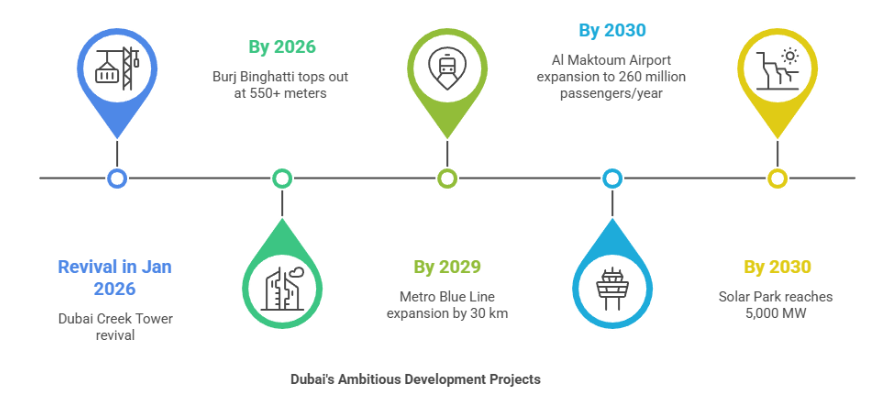
- Al Maktoum International Airport expansion (USD 36 billion) aims to handle 260 million passengers annually by 2030.
- Dubai Creek Tower received revival in January 2026, with tenders issuing within three months.
- Dubai Square integrates AI-enabled navigation across 2.6 million square metres.
- Dubai Metro Blue Line adds 30 kilometres by 2029.
- Burj Binghatti completes Q2 2026 at 550+ metres. While Mohammed bin Rashid Al Maktoum Solar Park targets 5,000 megawatts by 2030.
Project tenders will be issued throughout 2026, favouring companies with established track records.
Conclusion
Dubai offers an environment for entrepreneurs who are strategic about launching their startups in the market. The coming together of investment opportunities in artificial intelligence, growth of Islamic fintech, and government-backed infrastructure has created an environment where execution is favoured over speculation. The megaprojects that will be launched during 2026 are not only long-term prospects; they are active opportunities that require immediate action. Dubai provides infrastructure that speeds up company-building for entrepreneurs who are ready to develop regional capabilities right away and interact with government partners in a significant way.
The question is whether your business aligns with regional expansion requirements. For this, the answer is consulting a business expert such as Stratrich Consulting, quickly enough to capture, before competition intensifies.