



One of the first things you’ll notice when you start a business in the UAE is that there is more than one authority overseeing operations. There are several regulatory authorities in the UAE, each one responsible for a different aspect of business operations. Overlooking any of these authorities will lead to compliance issues. But if you understand their roles, your business will run smoothly and without issues.
This blog lists the key regulatory authorities in the UAE, what each one does, and what businesses need to know about them when they plan to start a business in the UAE.
How do regulatory authorities in UAE work and why should it matter to your business?
The UAE uses a dual regulatory system, involving both federal and emirate regulations that directly influence how you set up, license, and operate your business.
The UAE is composed of seven emirates with local government authorities that oversee operations of businesses within their jurisdiction. Additionally, the country also has federal regulators that provide nationwide laws and regulations applicable across the country.
It is important to note that businesses must comply with local and national laws, depending on the type of operation conducted within the mainland, Free Zones, or throughout the nation.
However, there are some questions you must consider answering before anything else, in order to find out which regulatory authorities apply to your business in the UAE:
- What sector is your business in?
- Which emirate are you operating from?
- Are you on the mainland or inside a Free Zone?
Once you have those answers, the regulatory picture becomes much clearer.
1. Ministry of Economy – Federal Commercial Oversight
The Ministry of Economy and Tourism is the federal agency responsible for regulating the entire business environment in the United Arab Emirates. Its duties include the development of business laws, business policy, intellectual property rights, competition, and the national tourism strategy.
When does the Ministry of Economy directly affect your business?
- If you are undergoing a merger or acquisition process, then the Ministry will apply Federal Decree-Law No. 36 of 2023 on Regulating Competition to evaluate whether it will impact fairness in the market.
- If you have trademarks, patents, and copyrights in UAE, then they will be registered under the IP system.
- If your sector falls under the UAE’s list of strategic economic activities, banking, insurance, defence, or telecoms, additional licensing conditions apply through the Ministry.
For foreign investors, the Ministry is also the body that manages the framework allowing 100% foreign ownership across most business activities. Outside of the strategic sectors list, this ownership structure is now available to most businesses.
2. Department of Economic Development (DED) – Business Licensing at Emirate Level
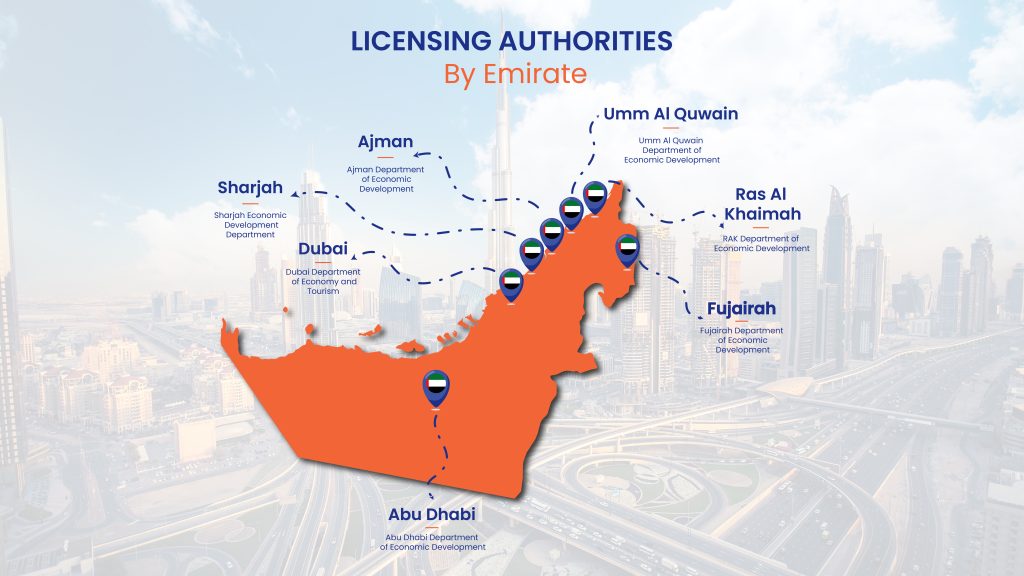
The DED in each emirate is where your business gets its trade license. It is usually the first government body you deal with when setting up, and it remains the authority you return to for renewals, activity changes, and amendments. Each emirate has its own DED.
One common oversight in business is assuming the DED license is the final step. In regulated industries such as health care, education, food, or law, it is also mandatory to obtain the authority’s approval. Both types of approvals are necessary for operating your business in the UAE.
3. Ministry of Human Resources and Emiratisation (MOHRE) – Employment and Workforce Compliance
Every business employing staff on the UAE mainland must be registered with MOHRE. This includes work permits, contracts, wage monitoring, and Emiratisation compliance.
Wage Protection System (WPS)
All salary payments have to go through the Wage Protection System, which is an online system that monitors if salaries are being paid correctly. Businesses that fall behind on payments risk work permit bans and suspension of MOHRE services, which effectively stop you from hiring.
Emiratisation Targets
The requirements vary by company size, as confirmed on the official UAE government portal:
| Company Size | Requirement | Penalty for non-compliance |
|---|---|---|
| 50+ employees | 2% annual increase in UAE nationals in skilled roles | AED 6,000 per month per shortfall, increasing by AED 1,000 each year |
| 20-49 employees (14 sectors) | 1 UAE national by end of 2024, another by end of 2025 | AED 96,000 penalty for missing 2024 target; AED 108,000 penalty for missing 2025 target |
4. Federal Tax Authority (FTA) – Tax Registration and Compliance
The FTA is responsible for managing all taxes that are payable by businesses in the UAE. This includes three main taxes:
VAT at 5% – All business establishments with an annual turnover of more than AED 1 million need to register for VAT in the UAE.
Excise Tax – This is applicable to specific products.
Corporate Tax at 9% – This applies to income above AED 375,000 and is effective for financial years starting on or after 1st June 2023.
All of these registrations need to be completed through the FTA’s EmaraTax. No manual processes will be followed. The deadline dates have to be adhered to, and failure to do so means that there will be monetary consequences.
Get UAE Financial Services Guide
Banking Reform, FinTech Ecosystem
Download Free Guide ↗5. Central Bank of the UAE (CBUAE) – Financial Services and Banking Regulation
The Central Bank of the UAE oversees banking, insurance, and payment services on the mainland. It recently updated its laws under Federal Decree-Law No. 6 of 2025.
To offer any financial services in the UAE, you need to get a CBUAE license. Without it, you can’t legally provide services like credit, insurance, or even simple bank accounts.
For businesses that aren’t in the financial sector, the CBUAE still plays a role. It ensures that the laws regarding Anti-money Laundering (AML) in the UAE and Combating the Financing of Terrorism (CFT) are strictly followed, especially by DNFBPs.
Since the UAE was removed from the FATF grey list, banks must follow stricter Know Your Customer (KYC) checks and anti-money laundering rules. These are set by the CBUAE.
When you open a corporate account or transfer significant amounts of money, these checks will be done by your bank. Keeping your corporate documents in order will help speed up the process.
6. Securities and Commodities Authority (SCA) – Capital Markets on the Mainland
The SCA is the UAE federal authority regulating capital markets, and non-banking financial sector (listed companies, securities brokers, and investment firms) operating on the mainland and not in financial Free Zones.
If your business is related to securities, investment management, or commodities trading on the mainland, the SCA is the authority that licenses and regulates your business. It works alongside the CBUAE but covers the investments, securities and capital markets sector on the mainland.
The SCA acts as the federal regulator for:
- Securities Trading involves securities brokerage, stock exchanges (such as ADX and DFM), clearing houses, and custodians.
- Investment Management includes asset managers, investment funds, portfolio managers, and financial analysts.
- Commodities Trading covers commodity brokers, futures, and options trading.
- Financial Consulting & Promotion pertains to Category 5 licenses for advice, deal arrangements, and financial product marketing.
- Virtual Assets are regulated by the SCA (since 2023) as the federal authority for VASPs in the onshore UAE, excluding Free Zones.
7. Dubai Financial Services Authority (DFSA) and Financial Services Regulatory Authority (FSRA)
These two regulators govern financial services within the UAE’s main financial Free Zones. They are completely separate from the CBUAE and SCA. Both oversee banking, asset management, and fintech sectors, with the FSRA enforcing its rules within the ADGM.
| Regulator | Free Zone | Legal Framework |
|---|---|---|
| Dubai Financial Services Authority | Dubai International Financial Centre | Common law |
| Financial Services Regulatory Authority | Abu Dhabi Global Market | English common law |
The Dubai Financial Services Authority regulates more than 837 entities within the Dubai International Financial Centre, based on the latest available data (2024). The framework followed by this authority is based on the UK’s Financial Services and Markets Act 2000.
Both Free Zones have a system of common law that differs from UAE civil law and therefore provide a home for international financial institutions.
If you are deciding between the mainland, DIFC, and ADGM for a financial services business, each comes with different licensing requirements and market access rules. It is a decision worth taking proper advice on.
| Category | DFSA | FSRA |
|---|---|---|
| Regulator | Dubai Financial Services Authority | Financial Services Regulatory Authority |
| Location | Dubai International Financial Centre (DIFC) | Abu Dhabi Global Market (ADGM) |
| Mandate | Regulates banking, asset management, insurance, Islamic finance, and securities | Oversees banking and investment services |
| Key Responsibilities | Ensures AML and CTF compliance | Sets rules aligned with global standards to manage risk |
| Regulatory Focus | Promotes transparency, integrity, and efficiency | Regulates insurance, funds, and market systems |
Sector-Specific Regulatory Authorities in the UAE
Alongside the listed regulatory authorities in the UAE, many industries have their own dedicated regulatory bodies. These entities license sector professionals, establish operating standards, and conduct inspections.
| Authority | Sector | Role |
|---|---|---|
| Telecommunications and Digital Government Regulatory Authority (TDRA) | Telecoms and digital services | Licensing and regulating all telecom and internet services |
| Dubai Health Authority (DHA) / Department of Health – Abu Dhabi (DOH) | Healthcare | Licensing healthcare facilities and professionals |
| Ministry of Climate Change and Environment (MOCCAE) | Environment | Environmental permits, controlled material imports |
| General Civil Aviation Authority (GCAA) | Aviation | Regulating aviation operations and services |
If your business falls into any of these sectors, you need approval from the relevant authority before you trade, not after. The DED license alone is not enough.
Free Zone Authorities – Regulation Within Designated Zones
Each of the UAE’s 40+ Free Zones has its own regulatory authority. This body handles licensing, visa quotas, lease agreements, and local compliance for businesses within its zone.
Some of the most active Free Zone authorities include Jebel Ali Free Authority, Dubai Multi Commodities Centre, Dubai International Financial Centre, Abu Dhabi Global Market and Sharjah Airport International Free Zone.
Free Zones offer 100% foreign ownership, full repatriation of profits, and simplified customs procedures. But two limitations are worth keeping clearly in mind.
- First, Free Zone companies cannot sell directly to customers on the UAE mainland without a separate mainland license or a formal distribution arrangement. Many businesses set up in a Free Zone, assuming they can serve mainland clients freely – they cannot.
- Second, Emiratisation requirements currently do not apply to Free Zone companies, as confirmed on the official UAE government portal. This may change as the regulatory environment continues to evolve.
Federal obligations – including tax registration and AML compliance – still apply to Free Zone businesses in most cases.
Conclusion
The regulatory authorities in the UAE are well-organised and becoming more digital, with each having online portals, available laws, and easy-to-follow guidelines for businesses. The biggest issue for businesses is not the complexity of the system but the misunderstanding that everything can be covered by one license or registration.
Typically, your DED license, sector approval, MOHRE registration, and FTA obligations related to corporate tax and VAT registration in the UAE are separate requirements operating concurrently. It’s crucial to identify which UAE regulatory authorities apply to your business early on. Review these requirements whenever your activities change.
Additionally, if you operate within a regulated industry, it’s advisable to seek proper advice from business consultant such as Stratrich Consulting before beginning trading, as this will save you both time and money in the long run.