


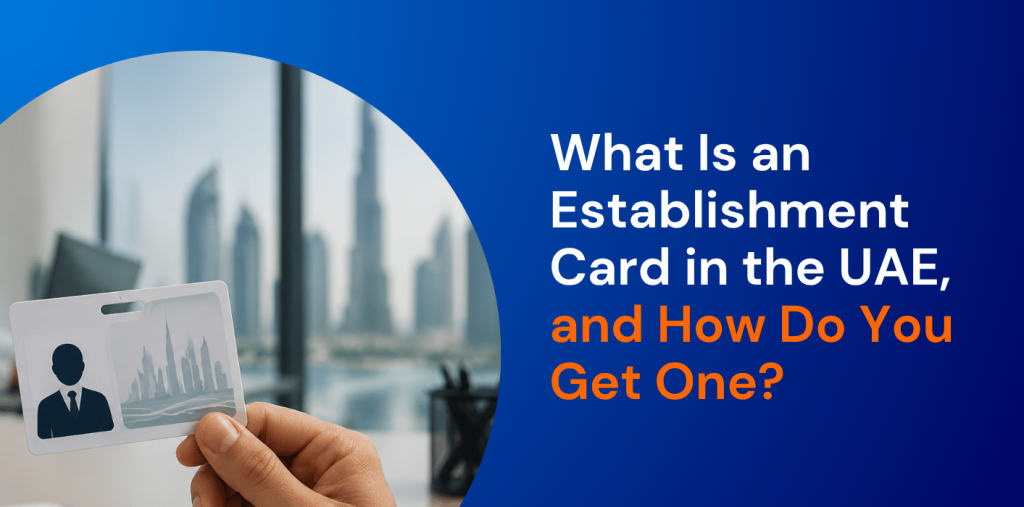
An establishment card is basically your company’s identity card with the UAE government. It links your trade license to your immigration system and to the labour ministry. Without it you cannot legally hire employees or sponsor their employee visas or apply for work permit. You’ll essentially need two cards: an immigration establishment card, issued by GDRFA/ICP and a MOHRE labour establishment card. Processing usually takes 1–5 working days, and both cards need annual renewal alongside your trade license, or you’ll face fines and a freeze on all visa services.
An Establishment Card in the UAE is an official record that registers your business with the UAE’s immigration and labour authorities. Let us think of it as a bridge between a trade license, a document that lets you operate legally and your ability to operate people. An establishment card is, essentially an electronic record that stores a company’s key details like, its trade name, license number, partners and authorised signatories. It allows businesses to sponsor their employees for visas and access government immigration services.
The Establishment card, however, does not refer to one single document. There’s an immigration establishment card issued by ICP (the Federal Authority for Identity, Citizenship, Customs & Port Security) or GDRFA (the General Directorate of Residency and Foreigners Affairs) in Dubai, which lets you apply for entry permits and visas, and there’s a separate labour card issued by Ministry of Human Resources Emiratisation (MOHRE), which lets you register workers for labour contracts and work permits. You need both to hire legally.
Why Do You Need an Establishment Card in Dubai (and the Rest of the UAE)?
The answer to this is very simple. You cannot hire employees without an establishment card. When a new company is licensed in the UAE, it must open a labour file with MOHRE or an immigration file with ICP or GDRFA before it can sponsor a single employee.
The Establishment Card is an important document because:
- It’s mandatory for visa sponsorship. Whether you’re hiring your first employee or bringing your own family over on a residency visa tied to your company, the establishment card has to be active.
- It’s required for investor and partner visas. Even if you’re a single-owner consultancy, you need this card to obtain your own residency visa under your company.
- It unlocks visa quotas. Once MOHRE issues your establishment code, that code is required for all subsequent labour transactions, including applying for new work permits, issuing labour contracts, and requesting visa quotas.
Immigration Establishment Card vs MOHRE Labour Card. What’s the Difference?
People often use “establishment card” and “labour card” interchangeably, but they are not the same thing. The establishment card belongs to the company, while the other belongs to the employee. An Establishment Card identifies and authorises the business, while a Labour Card in the UAE (or Work Permit) authorises the employee. One enables the company to sponsor workers; the other allows those workers to be legally employed.
What does the immigration establishment card do?
The immigration card is issued by the GDRFA in Dubai and by the ICP in the other emirates. It is your company’s immigration file. The record that lets you apply entry permits and residency visas for your staff and your partners.
What does the MOHRE establishment card do?
The MOHRE Labour card is your labour file. It allows your company to register worker for labour contracts and work permits and it is what generates the “establishment code” or the “company code” that you use for every future MOHRE transactions like, new hires, renewals, contract changes and more.
The difference between the immigration card and the MOHRE establishment card is a common confusion among new entrepreneurs in the UAE. Here’s a closer look at the key differences between the two.
Planning to Do Business in the UAE?
Get Our Strategic Market Entry Guide
Download Free Guide ↗| Feature | Establishment Card | Labour Card or Work Permit |
|---|---|---|
| Who does it belong to? | The Company | An individual employee |
| What is its purpose? | Registers the business with the UAE immigration authorities and enables visa sponsorship. | Authorises an employee to legally work for a specific employer in the UAE. |
| Who issues it? | The relevant immigration authority (ICP/GDRFA) or the respective Free Zone authority. | MOHRE for Mainland companies; many Free Zones issue their own employment/work permit approvals through the Free Zone authority. |
| Who applies for it? | The business owner, authorised signatory, PRO, or business setup consultant. | The employer or authorised representative on behalf of the employee. |
| Who is it linked to? | The company’s trade license | The employee’s employment contract and sponsoring employer |
| When is it required to? | Before sponsoring employees, shareholders, or dependants and before opening an immigration file. | Before an employee can legally work and obtain a residence visa (requirements vary slightly across Free Zones). |
| What is the validity? | Generally valid for one year and renewed alongside or separately from the company’s immigration records, depending on the authority. | Usually remains valid for the duration of the employee’s employment and residence visa, subject to renewals. |
| Can employee apply themselves? | No. | No. Applications must be submitted by the employer or an authorised representative. |
| Can a company hire employees without it? | No. An Establishment Card is required before a company can sponsor employees or begin the employment visa process. | No. Every employee must have a valid work authorisation before commencing employment. |
A frequently asked question among entrepreneurs setting up their business in the UAE is. “Do we need both the cards?”
Yes. Both cards are mandatory for companies operating in the UAE, if they are applying for visas or work permits and one doesn’t substitute for the other. Your immigration card gets you the visa; your MOHRE card gets you the work permit and labour contract. A new hire needs both processes completed before they can legally start work.
Mainland vs Free Zone: How Does the Establishment Card Process Differ?
The process and the cost can look very different depending on the jurisdiction that your company is licensed at. Here is a closer comparison between the two:
How does it work for mainland companies?
A mainland company is licensed through the Department of Economy and Tourism, DET, in Dubai, or the equivalent in other emirates. In the process you’ll deal with two separate government bodies:
- GDRFA (or ICP) for the immigration establishment card
- MOHRE for the labour establishment card
Mainland companies require more paperwork, but it offers more flexibility. A mainland company can sponsor employees directly and their staff can work anywhere in the UAE.
How does it work for free zone companies?
Free zones (like DMCC, IFZA, JAFZA, or any of the dozens of others across the UAE) run things differently. In a free zone, the card is sponsored by the free zone authority itself rather than by GDRFA or ICP directly, and staff are generally only allowed to work within the free zone unless a special permission is granted to them. The application usually goes through the free zone’s own member portal rather than a federal government site.
A major advantage of a free zone is its convenience. Many free zones bundle the establishment card into your company set up package, so that you don’t have to juggle through multiple portals.
What downplays the convenience of the free zone is the cost. Free zone establishment cards tend to run noticeably higher than mainland ones and your employees’ work location is restricted unless you sort out additional approvals
How Do You Get an Establishment Card in the UAE? A Step-by-Step Process
Here is what the new company establishment card process looks like. While the exact process varies depending on your licensing authority, the overall journey is largely the same.
Step 1: Do you have a valid trade license first?
This is the most important box to be checked out before you can apply for Establishment Card. Your business must have a valid UAE trade license. It is directly linked to your company license and serves as your business’s official immigration record. Whether your company is licensed by a Mainland authority or a Free Zone, your trade license must be active before the application can begin. The Establishment Card is essentially the “immigration profile” created for that specific license.
Step 2: How do you register with immigration (GDRFA/ICP)?
Your company must be registered with the UAE immigration system before an Establishment Card can be issued.
Mainland: Mainland companies can complete this process through the relevant immigration authorities such as ICP or GDRFA or DED online services.
Free Zone: Submit the application through the respective Free Zone authority, that manages your immigration services directly on behalf of the business.
Step 3: How do you register with MOHRE?
If you have a business set up in a mainland and it is not already registered on the official MOHRE website, you need to first create a new employer account by entering you trade license number, business details and contact information. After the completion of your registration proceed to the “Establishment Services” section, select “New Establishment Card,” and fill in the required information.
For a Free zone company set up, the labour registrations are handled internally rather than through MOHRE.
Step 4: What documents do you need to upload?
Although documentation requirements vary slightly between jurisdictions and their respective authorities, you’ll generally be asked to provide
- Valid trade license
- Passport copies of owners/partners
- Memorandum of Association (MOA), where applicable
- Office tenancy contract (Ejari, for Dubai mainland)
- Passport-size photos of signatories
Step 5: How do you pay the fee and submit?
Once all the documents have been uploaded, the next step is to pay the applicable government fee and submit the application.
For mainland companies the payment can be made through the MOHRE portal using a credit card or debit card or also in person at the MOHRE service centre or an authorised Tasheel centre. On the immigration side, GDRFA/ICP fees are usually paid directly through their Smart Services portal or an Amer Centre in Dubai.
For companies registered in the free zone, the applications are submitted through their respective portal or the service centre.
Step 6: What happens after you submit?
Once your application is submitted and payment is confirmed, the relevant authority centre will review the details, and in many cases, approval comes through within 1 to 3 working days. You’ll receive a notification via email or SMS and can download your Establishment Card directly from the portal.
Can someone else handle this for you?
Yes. Many first-time business owners choose professionals who specialize in government paperwork, to handle the whole process end-to-end. At Stratrich Consulting we handle the entire process so that you can focus on running your business.
If you’d prefer to apply in person or aren’t comfortable with the online process, you can visit any MOHRE-authorised Tasheel service centre, which handles all MOHRE-related documentation on behalf of businesses and individuals or your Free Zone authority’s service desk, depending on the jurisdiction your company has been registered in.
How Much Does an Establishment Card Cost in the UAE?
The immigration establishment card fees vary with every emirate. It vastly depends on the authority and whether you’re established in a mainland or free zone. The official portal of your registering authority will give you an estimate of the establishment fee.
The base fee for issuing an establishment card is AED 200, in addition to value-added tax (5% VAT). On top of that, expect the following extra charges:
- Knowledge Dirham: AED 10
- Innovation Dirham: AED 10
- Urgent fee (if you need faster processing): AED 100
- Amer centre fee: if you submit your application through an Amer Centre rather than online, an additional AED 100 is added
How Long Does It Take to Get an Establishment Card?
The GDRA processes the establishment card applications within 48 hours a MOHRE confirms a processing time of two working days, given all your documents and conditions are complete at submission. Other estimates put the range a little wider, at 2 to 5 business days, with urgent applications sometimes cleared within 24 hours. The biggest factor that can slow down your process may be incomplete or mismatched documents. So, make sure you double -check names, license numbers and dates match exactly across every document before you submit.
How Long is an Establishment Card Valid, and How Do You Renew It?
In Dubai mainland, the establishment card is valid for one year and needs to be renewed annually along with your trade license. In some free zones, however, and some other emirates, it can last up to two or three years.
What’s the process for renewal of an establishment card in Dubai?
The renewal of an establishment card follows a similar path to the original application, with a few checks built in:
- Ensure your trade license is still valid. You will not be able to renew the establishment card if your trade license has expired.
- Access the GDRFA Smart Services portal or visit an Amer Centre, and select “Renewal of Establishment Card.”
- Make sure that no changes have been made to your partners or your office address. If there have been changes, you will likely be required to update your file first and follow an offline process.
- On the MOHRE side, renewal involves paying the application fee, renewal fee and subscription fee, as specified by the relevant authority.
- Note that the issuance or renewal fee itself is AED 100 per year, with the charges above layered on top depending on how and where you submit.
What happens if you don’t renew on time?
This is where things get expensive fast. If you don’t renew on time in Dubai, you could get fined for each month it’s late, and immigration authorities will block all your staff from getting new visas or renewing their current ones until you update your card. On the compliance side more broadly, companies that fail to register or allow their establishment card to expire may face administrative fines and restrictions on their trade license renewal meaning the problem can snowball into your entire business license being at risk.
What Are the Most Common Mistakes Businesses Make with Establishment Cards?
There are certain patterns that show up repeatedly with new business owners or entrepreneurs.
- Letting the trade license lapse without realizing the establishment card is tied to it. In order to renew your establishment card, you need to renew your license first, otherwise, your establishment card renewal gets stuck.
- Assuming one card covers everything. You need both the immigration card and the MOHRE card.
- Missing the renewal window. Since fines accrue monthly, a late renewal can get expensive fast, and it can freeze every other visa transaction your company needs.
- Forgetting the E-Signature Card. Without it, authorised signatories can’t complete digital transactions on MOHRE’s portal, which quietly stalls hiring paperwork.
- Not accounting for free zone restrictions. If your free zone company’s staff needs to work outside the zone, you may need extra approvals don’t assume a free zone card gives you the same flexibility as a mainland one.
Final Thoughts
Getting an Establishment Card in the UAE isn’t complicated once you know the sequence: valid trade license first, then immigration registration (GDRFA/ICP), then MOHRE labour registration. If you fail to get an establishment card, or get a lapsed one, it can freeze your ability to hire, sponsor, or even renew your own trade license.
If the process feels like a lot to juggle alongside actually running your business, our team of experts at Stratrich Consulting can take the paperwork off your plate.