



Running a company in a UAE Free Zone involves more than renewing your trade license every year. In 2026, businesses are expected to maintain proper accounting records, meet corporate tax and VAT obligations (where applicable), renew licenses and visas on time, maintain Ultimate Beneficial Owner (UBO) information, and comply with any audit requirements imposed by their Free Zone authority. This guide walks you through the compliance checklist for your UAE free zone company.
UAE is a springboard for growth for entrepreneurs and business owners looking to set up their business. By now, we’re all familiar with the basics- its strategic location, business-friendly regulations, streamlined company formation process, and attractive tax advantages. But as easy going and friendly as it sounds, it is important to keep in check with all the compliance requirements of the country.
Any negligence towards the compliance can trigger penalties, affect your banking relationships, delay in free zone trade license renewal, and in some cases, also affect the company’s eligibility for the UAE’s 0% corporate tax regime available to Qualifying Free Zone Businesses.
But the good news is that all the annual compliances are easy to manage when you have a clear understanding of what and when things need to be done. This blog will help you understand the UAE annual regulatory compliance checklist and explain technical terms in easy language and highlight practical steps so that your business stays on track.
Read further to have an idea about the essential annual compliance checklist for UAE Free Zone companies’ annual compliance.
Why is annual compliance important for your Free Zone company?
Annual compliance, to put it simply, is to complete all the legal, financial and regulatory obligations required. So that your business can continue to operate smoothly and legally.
An annual compliance audit makes sure that your business:
- Maintains proper financial records
- Pays taxes correctly (wherever applicable)
- Keeps company information updated
- Meets the requirements of its Free Zone authority
- Remains eligible for regulatory and tax benefits
As the UAE continues to strengthen its corporate governance and tax framework, regulators increasingly expect businesses to maintain proper documentation rather than only complying during license renewal.
Navigating UAE Tax Regulations?
Get Our UAE Tax Compendium
Download Free Guide ↗What does your Free Zone company need to do every year?
The checklist below summarises the key annual obligations.
| Compliance Requirement | Why it Matters | Typical Frequency |
|---|---|---|
| Trade license renewal | Keeps the business legally operational | Annual |
| Accounting & bookkeeping | Supports tax filings and audits | Throughout the year |
| Financial statements | Shows business financial performance | Annual |
| Audit (where required) | Required by many Free Zones | Annual |
| Corporate Tax filing | Required under UAE Corporate Tax rules | Annual |
| VAT filing (if registered) | Mandatory for VAT-registered businesses | Quarterly |
| UBO record updates | Maintains ownership transparency | As required / Annual confirmation |
| Visa renewals | Keeps employees and owners legally employed | Every 2 years |
| Record retention | Supports regulatory inspections | Ongoing |
What is the Compliance Checklist for UAE?
A comprehensive UAE free zone compliance checklist starts by asking the right questions:
Is renewing your trade license enough for your business in UAE Free Zone?
No. Renewing your trade license is only one part of the compliance. Most Free Zone companies require businesses to satisfy several other requirements before their renewal, such as:
- Maintaining valid office facilities (where applicable)
- Paying renewal fees
- Keeping shareholder information updated
- Submitting audited financial statements, where required
- Clearing outstanding compliance issues
Missing your free zone trade license renewal deadlines can interrupt your business operations and delay visa processing.
Why should bookkeeping be maintained throughout the year?
Bookkeeping is the process of recording every financial transaction that your business makes. It includes your sales, purchases, supplier payments, customer receipts, payroll, and bank transactions. Accurate bookkeeping will help your business:
- Prepare accurate financial statements
- Complete your Corporate Tax filings
- File VAT returns correctly
- Respond to audits
- Monitor profitability
If you postpone your bookkeeping until the year-end, you might spend more time correcting errors than preparing reports.
What financial statements should your company prepare?
A financial statement is a formal report that summarizes your company’s financial activities over a specified accounting period. It helps you create a better picture of how your business performed during the given financial year. Financial Statements are often asked for, by the regulatory authorities for Corporate Tax compliance, annual audit for UAE free zone, license renewals, and discussions with banks or investors. The main reports in your financial statements should include the following.
- Profit and Loss Statement: A P&L statement or an Income statement shows whether your business made a profit or incurred a loss during the financial year. It usually includes revenue earned from your business activities, operating expenses such as rent, salaries, and utilities, cost of goods sold, and net profit or loss.
- Balance Sheet: A balance sheet provides a snapshot of your company’s financial position at a given point in time. It includes your assets, liabilities, and equity.
- Cash Flow Statement: A cash flow statement tracks the movement of your cash, categorising your cash flows into Operating Activities, Investing Activities, and Financing Activities.
These reports are generally prepared using International Financial Reporting Standards (IFRS), a globally recognised accounting framework that promotes consistent financial reporting. Preparing these statements will help your business comply with the UAE Corporate Tax requirements, support annual audits, and demonstrate financial health to banks, investors, and other shareholders.
Is an audit mandatory for all companies in the UAE Free Zones?
An audit is generally not mandatory for all companies in the UAE Free Zone. It is important that you confirm the latest rules with your respective Free Zone authority as the requirements differ across jurisdictions and business activities.
An audit provides confidence that your financial records accurately reflect your company’s financial position. They are generally made mandatory because of reasons like license renewal, corporate governance, corporate tax documentation, investor confidence, and banking requirements.
Here is a table representing some common Free Zones and their annual audit requirements.
| Free Zone | Audit Requirement |
|---|---|
| Dubai Multi Commodities Centre (DMCC) | Generally mandatory—audited financial statements must be submitted annually. |
| Jebel Ali Free Zone (JAFZA) | Generally required for most companies. |
| Dubai Airport Free Zone (DAFZA) | Generally requires audited financial statements. |
| Abu Dhabi Global Market (ADGM) | Most companies must prepare audited financial statements, although certain exemptions may apply. |
| Dubai International Financial Centre (DIFC) | Generally requires audited financial statements. |
| Sharjah Media City (Shams) | An audit may not be mandatory for all businesses; requirements depend on the company and current regulations. |
| IFZA | No Audit requirements if the company’s revenues are below AED 2 million. |
Even if an audit is not mandatorily required for your specific free zone, you may still require to maintain proper bookkeeping, accounting records, and financial statements for corporate tax compliance.
What Corporate Tax obligations apply to your business in 2026?
A common misconception that continues to persist among business owners is that 0% corporate tax implies that there will be no compliance requirements. Corporate tax is one of the most important tax obligations for business owners in the UAE Free Zone.
Even if your company qualifies for corporate tax exemption, you should make sure that your Free Zone Company:
- Registers for Corporate Tax within 90 days of license issuance
- Maintain proper accounting records
- File Corporate Tax returns timely
- Keep supporting documentation
What is a Qualifying Free Zone Person?
A Free Zone business needs to meet the specific requirements, that allow them to benefit from the UAE’s preferential 0% Corporate tax on qualifying income. These are called a Qualifying Free Zone Person (QFZP). Maintaining this status requires an ongoing compliance and not a one-time qualification.
The requirements to maintain the status usually include:
- Maintaining adequate business substance within UAE
- Earning qualifying income
- Meeting the transfer pricing rules wherever applicable
- Preparing audited financial statements wherever required
- Keeping proper accounting records.
If there is any negligence found in satisfying these conditions, it may affect your eligibility for a preferential tax statement.
Does your company need to file VAT returns?
VAT (Value Added Tax) is a consumption tax charged on most goods and services in the UAE. Simply being registered with a Free Zone Company does not exempt you from filing your VAT returns.
VAT registration may be mandatory if your business’s taxable supplies and imports exceed AED 375,000 in the previous 12 months or are expected to exceed this threshold in the next 30 days and voluntary if your taxable supplies or taxable expenses exceed AED 187,500, allowing eligible businesses to recover input VAT on business purchases.
VAT-registered businesses must:
- Issue compliant tax invoices
- Keep VAT records
- File returns on time
- Pay any VAT due
Returns are generally filed monthly or quarterly, depending on the company’s assigned tax period.
Why is UBO compliance important for your business?
The Ultimate Beneficial Owner or the UBO of a company is the individual who controls or owns an asset or the business. Generally, in most jurisdictions the minimum UBO threshold is 25% ownership.
As a business owner in a Free Zone in UAE, you must ensure that:
- You maintain and up-to-date UBO register accurately
- Update the relevant Free Zone or Licensing Authority
- Retain supporting documents related to shareholders and beneficial owners
- Provide UBO information accurately if required during regulatory review or license renewals.
It is important for you to stay compliant regarding your UBO because it is a legal requirement. Failing to update your business’ UBO may attract heavy fines and administrative penalties. Keeping your Ultimate Beneficial Owner filing information updated helps improve corporate transparency and supports anti-money laundering regulations.
What records should you keep as a business owner?
One of the most effective ways to ensure UAE company compliance requirements in 2026 is to maintain accurate records. Retaining records that support the financial and regulatory filings of your business will ensure that you are fully prepared in case your business is to be reviewed by the Federal Tax Authority or your Free Zone Authority.
The Financial Records usually include the following:
- Accounting records, including your general ledger, journal entries, and trial balance.
- Sales and purchase invoices, along with receipts and credit notes.
- Bank statements and payment records.
- Payroll records, including salary payments and employee benefits.
- Corporate Tax and VAT filings, where applicable.
- Financial statements, such as your Profit and Loss Statement, Balance Sheet, and Cash Flow Statement.
- Audit reports, if your company is required to undergo an annual audit.
- Contracts and agreements with customers, suppliers, and service providers.
- Corporate documents, including your trade license, Memorandum of Association (MOA), shareholder register, and Ultimate Beneficial Owner (UBO) Register.
Maintaining a healthy record of your finances will not only keep you ahead in the legal obligations it will also give you a clearer picture of the financial health of your business.
What are the common compliance mistakes businesses make?
The most common compliance issues arise not because the regulations are intentionally neglected. It arises because the deadlines are overlooked, financial and business records are incomplete, or major compliance obligations are misunderstood.
Some of the most common mistakes companies in UAE Free Zone make include:
- Delaying bookkeeping until year-end. If you leave your bookkeeping until the very end, it can lead to inaccurate financial statements, rushed tax filings, and costly errors that are difficult to correct later.
- Missing license renewal deadlines. If you delay in renewing your trade license it can completely disrupt your business operations and result in penalties.
- Filing incorrect VAT returns. If your business is registered for VAT with the FTA, it is very important that you file returns and pay any VAT due by the deadline that is prescribed. Any delay or inaccuracies in the filing can result in penalties
- Not maintaining supporting documents. Failing to maintain any supporting document for business like invoices, receipts, contract or bank records will create a hassle in filing for your tax returns or respond to regulatory reviews.
- Assuming Free Zone companies have no tax obligations. While the Free Zones do offer a 0% corporate tax to businesses who reach their annual threshold, it is still important for them to register for corporate tax, file for annual tax returns and maintain proper accounting records.
- Forgetting to update shareholder or UBO information. Any changes in the shareholders, directors or UBO of your company must be informed to regulatory authorities within the given time period to avoid any monetary penalties.
- Waiting until the audit deadline to organise records. Some Free Zones require their companies to submit their audited financial statements. Any delay in the process can result a delay in license renewals.
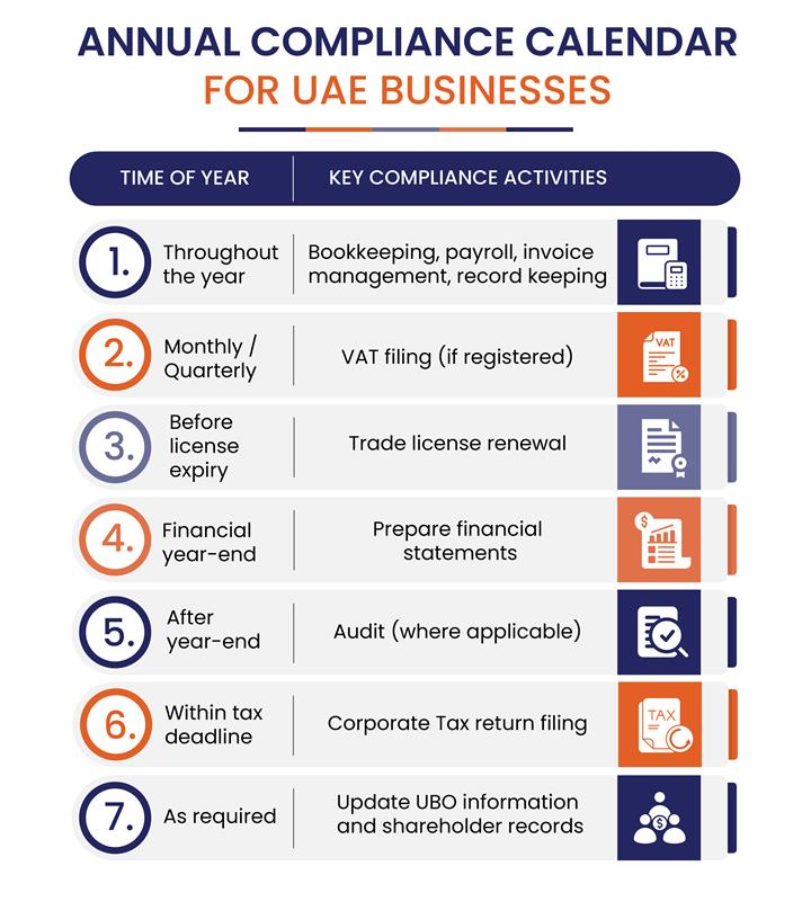
A simple annual compliance calendar can help businesses avoid most of these issues.
What are the best practices I can follow to stay compliant?
Staying compliant with the regulatory requirements for your business doesn’t have to be overwhelming. The key is to just treat annual compliance as an ongoing part of your business rather than a once-a-year exercise. By putting just a few simple steps into process, you will reduce the risk of errors, avoid penalties and save your valuable time.
Here are some of the best practices that can help your business stay compliant throughout the year:
- Maintain your bookkeeping regularly. Recording transactions on a weekly or monthly basis makes it easier to prepare financial statements, reconcile accounts, and complete tax filings accurately.
- Create a compliance calendar. Keep track of important dates such as trade license renewals, visa expiries, VAT filing deadlines, Corporate Tax return deadlines, and audit submissions to avoid missing key obligations.
- Keep your business records organised. Store invoices, contracts, bank statements, payroll records, and tax documents securely—preferably in digital format with regular backups.
- Review your compliance obligations periodically. Regulations can change, so it’s a good idea to review your responsibilities at least once every quarter to ensure your business remains compliant.
- Monitor changes to company information. Update your Free Zone authority promptly if there are changes to shareholders, directors, business activities, or your Ultimate Beneficial Owner (UBO).
- Prepare for audits well in advance. If your company requires an annual audit, don’t wait until the deadline. Maintaining accurate financial records throughout the year will make the audit process smoother and less time-consuming.
- Work with experienced professionals. Accountants, tax advisors, and compliance specialists can help ensure your financial records, tax filings, and regulatory obligations are handled correctly, allowing you to focus on growing your business.
- Stay informed about regulatory updates. The UAE’s tax and compliance framework continues to evolve. Keeping up to date with new regulations and guidance from the relevant authorities can help you avoid unexpected compliance issues.
Final thoughts
Annual compliance, even though the name suggests it, should not be an annual exercise. It should be an ongoing process. Continuous checking of your business records and financial statements will help, protect your company’s legal standing, financial health and access to valuable tax incentives.
By maintaining accurate financial records, meeting the deadlines while filing for returns and understanding the compliance requirements of your specific free zone will avoid any unnecessary penalties and hassle. It will help you focus on your growth with greater confidence.
Regulatory compliance doesn’t have to be a constant source of stress. At Stratrich Consulting, we help businesses stay on top of their bookkeeping, annual audits, corporate tax filings, VAT obligations, and Free Zone license renewals through a proactive, year-round compliance strategy. With our experts managing your compliance requirements, you can focus on scaling your business with confidence.