



The UAE is experiencing rapid growth in artificial intelligence (AI), which is advancing globally and transforming various industries, economies, and daily life. With a 97% AI adoption rate across government entities and over 450,000 programmers nationwide, the Emirates presents AI business opportunities ready to invest in this market.
Key trends fuelling this innovation and disruption include agentic AI, physical AI, and sovereign AI. These trends are not only reshaping traditional markets but also opening new business opportunities in the Middle East, especially in the UAE, which is emerging as a global leader in AI adoption and innovation.
According to recent reports, the UAE’s AI market reached USD 7.82 billion in 2025 and is projected to hit USD 46.33 billion by 2030. These numbers are not just predictions; there are already numerous investments coming into the country. In 2024 and 2025 alone, over AED 543 billion was invested in artificial intelligence.
The following blog outlines the business opportunities in AI in the UAE and the growing number of partnerships and opportunities throughout the region.
Emerging AI business opportunities in various sectors within the UAE
The UAE is quickly growing in new AI business opportunities. This is because of the UAE Artificial Intelligence Strategy 2031, which aims to use AI to boost the country’s economy.
As the UAE moves toward building a “smart city” and a diverse, knowledge-based economy, sectors such as healthcare, finance, logistics, and sustainability are seeing many opportunities to leverage AI.
Below are new AI business opportunities across different sectors in the UAE.
1. Healthcare AI
The UAE healthcare industry offers a highly lucrative emerging opportunity for AI-based business operations. According to the reports, the AI-based health care industry has reached USD 39 million in 2024; it is estimated to reach USD 337 million by 2033.
Furthermore, the yearly adoption rate stands at 34.6%, with hospitals and clinics actively purchasing and installing these systems.
The UAE government has set a national priority on the application of AI in the medical care sector. In May 2025, a strategic partnership was formed between Oracle, Cleveland Clinic, and G422 on an AI-based global platform for delivering medical care. After this two months later, M42 and GE Healthcare announced a collaboration to advance AI-enabled diagnostic solutions across the Emirates. These represent the operational deployment at scale.
Where are the business opportunities in AI in the healthcare sector?
Diagnostic imaging systems have moved beyond proof-of-concept stages. Major hospitals in Dubai and Abu Dhabi are now integrating AI solutions for the analysis of radiology and pathology. The platform for the United Healthcare System in Dubai, the Network & Analysis Backbone for Integrated Dubai Health (NABIDH), currently stores data for 9.5 million patients and has an interconnect network of 1,500 health facilities.
Telemedicine models with artificial intelligence capabilities to analyse patient data have gained significant traction. The UAE has platforms such as Malaffi, which provides the infrastructure for these systems to access patients’ data and ensure continuity of care. The telemedicine sector in GCC is projected to expand at a compound annual growth rate of 19.1% between 2025 and 2033.
Businesses are finding many practical applications to purchase, including:
- AI-powered radiology systems that automate scan analysis and flag problems
- Predictive analytics for managing patient flow and resource distribution
- Remote monitoring systems using real-time vital sign analysis
- Natural language processing tools for clinical documentation and billing
In fact, recent surveys show that 66% of physicians in the UAE have adopted AI for at least one-use case this year, compared to 38% last year. This rapid adoption creates demand for training, integration services, and ongoing support-what might be described as secondary revenue streams beyond the initial software sale.
2. Financial Services
Dubai’s financial institutions show a 49% AI deployment rate, significantly higher than the global average of 35%. The UAE fintech sector is another sector with enormous commercial demand, as it was worth USD 46.67 billion in 2025 and is set to reach USD 90.06 billion in 2031.
There was a significant rise in the adoption of AI technology at Dubai International Finance Centre companies, wherein the percentage increased from 33% in 2024 to 52% in 2025, with a 166% Year-Over-Year increase in Generative AI.
What practical applications are driving purchases in the UAE?
Emirates NBD’s virtual assistant “Eva” handles over 1 million monthly customer interactions, demonstrating the scale at which AI customer service operates in UAE banking. But the real spending happens in less visible areas:
Risk Management and Fraud Detection: Financial institutions report 40-60% improvement in credit risk prediction accuracy using AI systems. Real-time transaction monitoring that identifies suspicious patterns has become a regulatory necessity.
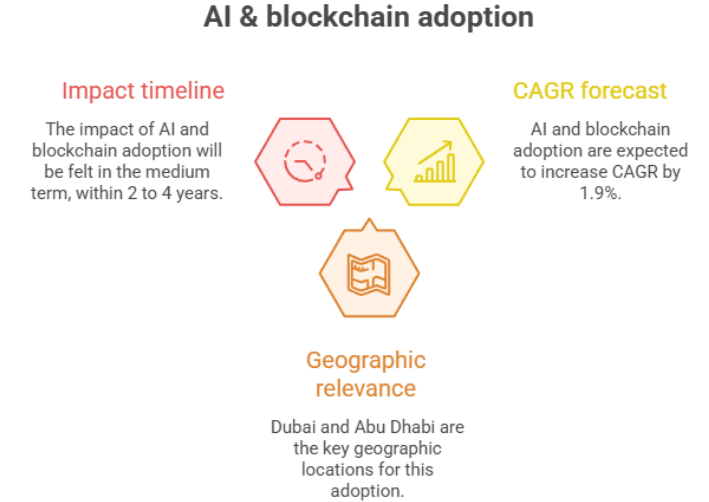
Regulatory Compliance: With the UAE working on blockchain projects to handle half of its federal transactions by 2030, tools that automate compliance, such as anti-money laundering and identity verification, offer a steady source of income.
Credit Assessment for Underserved Markets: Alternative data analysis enables risk assessment for populations without extensive credit histories. This addresses a genuine market need in a country with a substantial expatriate population.
| Sector | Current Adoption Rate | Primary Use Cases | Annual Growth Rate |
|---|---|---|---|
| Banking | 49% | Fraud detection, customer service | 12.56% |
| Insurance | 52% (DIFC firms) | Claims processing, risk assessment | 38.5% |
| Fintech | 75% (projected 2026) | Payment processing, compliance | 46.47% |
3. Supply Chain and Logistics
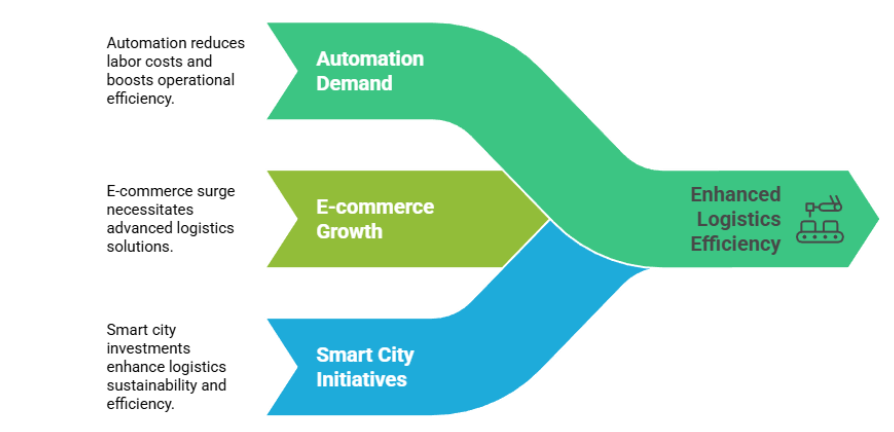
The Emirate positions itself as a regional trade gateway, creating a natural demand for logistics intelligence. The companies have also invested AED 5 billion in automation technology in order to attain the projected 30% increase in operational efficiency.
Dubai and Abu Dhabi lead in this space, based on location advantages and developed infrastructure. The government is investing AED 30 billion in logistics infrastructure, creating business opportunities for AI solutions that optimise operations and reduce costs.
What are the real-world developments and results?
The adoption of AI in UAE supply chains has resulted in tangible results. Reports show an average decrease of 13.9% in fuel consumption, 17.3% in energy usage, and 259.4 kg in monthly CO2 emissions among organisations implementing AI logistics solutions.
DHL’s UAE operations achieve an order accuracy rate exceeding 94% and process over 96% of requests, utilising an advanced AI-powered supply chain and parcel tracking system. According to some reports, an enterprise in the UAE achieved delivery time reductions of over 20 minutes per shipment using real-time route optimisation systems.
The UAE’s smart warehouse marketing is driven by:
- Automated storage and retrieval systems
- AI-powered inventory management reduces stockouts by upto 30%
- Real-time monitoring system for supply chain visibility
- Robotics and automation equipment reducing labour costs
The UAE and South Korea lead globally in supply chain AI adoption at 58%, outpacing the United States, United Kingdom, and China. This reflects actual operational deployment across port operations, warehouse management, and last-mile delivery.
Planning to Do Business in the UAE?
Get Our Strategic Market Entry Guide
Download Free Guide ↗4. Smart City and Government Services
Government entities provide ample contract opportunities, with 97% AI usage across federal departments, representing the highest rate globally. A national study identified 91 advanced AI use cases across healthcare, financial, educational, and security sectors. With 44% of government entities rely on high-performance computing systems.
Current government AI deployments in the UAE
The UAE has implemented the world’s first smart legislative ecosystem using AI to analyse laws, assess legislation impact, and develop public policies. The government introduced a smart human resources assistant offering 108 services across workflows, serving more than 50,000 employees and saving thousands of working hours annually.
Specific opportunities include:
- The traffic management system analyses the patterns of flow and timing of the traffic signals
- Utilities applying predictive analytics in demand forecast and grid management
- Companies that apply predictive analytics for demand forecasting and grid management
- Public safety use cases such as surveillance analytics, emergency response coordination
- Smart energy optimisation systems for energy-efficient infrastructures in cities
Dubai’s Roads and Transport Authority, Dubai Electricity and Water Authority, has successfully maximised energy savings of more than 24% by incorporating AI. This proves that there are monetary benefits to be reaped in going green
5. Education Technology
The UAE recognises that AI adoption requires workforce development, creating demand for educational technology. Hamdan Smart University’s “An AI Agent for Every Faculty Member” initiative achieved a 95% reduction in workload and 40% increase in students’ academic achievement, demonstrating the potential of personalised learning platforms.
The market opportunities include:
- Adaptive learning platforms tracking progress and identifying gaps
- Corporate training programmes for upskilling employees to work with automated systems
- Language learning tools with speech recognition supporting the UAE’s multilingual environment
- AI-powered assessment and competency tracking systems
With over 450,000 programmers in the UAE and continued expansion of AI-focused education programmes, the demand for training and certification tools continues to grow.
What AI business opportunities are present in Hub 71 and Free Zones?
The UAE’s innovation hub, Hub71 in Abu Dhabi, has become a centre for AI startups. For example, the 17th batch of startups raised USD 223 million, with over 80% of these projects focusing on AI applications. It’s also worth noting that UAE startups have raised a total of USD 2.17 billion (AED 8.02 billion) as of 2024.
The Hub’s Access Programme offers up to AED 500,000 of incentive funding, which can be both cash and in-kind. Top performers also attract a further AED 1 million of follow-on funding.
Currently, Abu Dhabi hosts 673 AI companies, reflecting a 61% increase compared to the previous year, up to June 2024. In the first half of 2025 alone, 150 new AI companies were established.
| Free Zone | Focus Areas | Key Benefits | Estimated business setup cost |
|---|---|---|---|
| Hub 71 (Abu Dhabi) | AI, deep tech | UP to AED 1.5 M support, investor network | Variable based on programme |
| Dubai Internet City | Technology, media | Innovation centres, incubators | AED 15,000+ |
| Dubai Silicon Oasis | Technology startups | Integrated ecosystem, cost-effective | AED 10,000+ |
| DIFC | Fintech, financial services | Regulatory sandbox, AED 367M Fin Tech Fund | AED 35,000+ Government Funding and Programmes |
Regional Context and Market Timing
The MENA region also highlights the UAE’s strong position. In the first half of 2025, the region experienced a 134% increase in funding for AI companies compared to 2024. Nearly 20% of all startup transactions there now include an AI component.
In the first half of 2025, the amount of money raised by AI companies in UAE was over 125 million through 35 plus transactions, more than 60% growth compared to previous year, positioning Dubai as the leading destination for funding of AI companies in MENA region.
Government Funding and Programmes
The Abu Dhabi Investment Office and Mohammed Bin Rashid Innovation Fund provide equity, grants, rebates, as well as co-investing, and are focused on innovation, economic growth, and many other things. This year, the Dubai Future Accelerators received 688 applications for their 7th cohort program, and according to the latest numbers, 65% of the members start-ups signed partnership agreements with the government.
In5 Innovation Centres have helped create 1,000+ start-ups in this region since 2013, and companies have now received funding, grants, and partnerships worth more than AED 7.8 billion.
Conclusion
The UAE’s market in 2026 reflects current business opportunities in AI, with a market value of USD 7.39 billion, 97% government adoption, and AED 543 billion in active investments, the numbers prove serious commitment. Healthcare, finance, logistics, and government sectors are purchasing solutions now, not testing concepts.
Successful business start in Artificial Intelligence, requires solving specific problems with measurable returns, understanding local regulations, and using available support like Hub71’s funding and DIFC’s programmes. For businesses with proven technology and realistic expectations, the UAE offers one of the world’s most accessible AI markets where deployment happens at scale.