

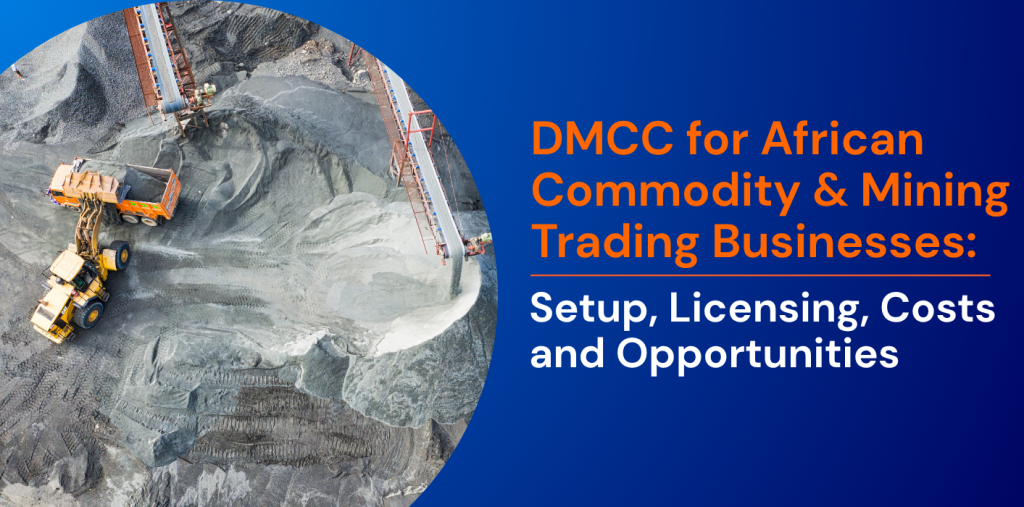
African commodity markets are attracting growing international attention, but accessing global buyers, trade finance, logistics infrastructure, and established commodity markets remain a key challenge for many businesses. For companies involved in minerals, metals, agricultural products, precious stones, energy products, or other raw materials, a Dubai-based trading structure offers a route into international markets.
You have a reliable mining partner in Ghana, a buyer in Asia and a shipment ready to move. Then the questions begin. Which license is right? How is your income taxed? What proof of origin will the bank expect for your gold? Many African commodity and mining traders feel this pressure at the start.
The good news is that a clear path exists. DMCC Africa commodity trading is built around this exact need. Dubai Multi Commodities Centre (DMCC) gives African traders a licensed, well-regulated base with strong trade links to Africa, Asia and Europe. This guide covers the benefits, tax position, compliance rules, costs and setup steps, so you move forward with confidence.
So, how does the model work, what does it cost, and what should African commodity businesses consider before setting up?
Planning to Do Business in the UAE?
Get Our Strategic Market Entry Guide
Download Free Guide ↗Why is DMCC relevant for African commodity trading businesses?
Africa has significant reserves of minerals, metals, agricultural products, and other natural resources. The commercial opportunity is not limited to production. International commodity businesses also require reliable trading, financing, storage, logistics, and distribution networks.
Dubai sits between major markets in Africa, Asia, Europe, and the Middle East. DMCC adds a specialised commodities ecosystem to this geographic advantage.
Is there a growing institutional connection between DMCC and African commodity markets?
In July 2026, DMCC signed a Memorandum of Understanding with the Botswana Stock Exchange Group to establish a Dubai-Gaborone sister-hub trading corridor. The initiative covers Botswana-origin commodities including diamonds, copper, coal, soda ash, critical minerals, beef, and agricultural products. It also includes areas such as trade finance, logistics, vaulting and digital infrastructure.
This provides a concrete example of how Dubai’s commodity infrastructure is being connected with African production markets.
In 2026, DMCC reported that the UAE retained second place in its Commodity Trade Index. The same report identified growing trade corridors connecting the Middle East, Asia, Africa, and Latin America.
This is relevant for African businesses looking to build international trading relationships without moving their underlying production operations out of Africa.
What types of African commodities can be traded through DMCC?
DMCC supports several commodity ecosystems. These include:
| Commodity segment | Examples |
|---|---|
| Precious metals | Gold, silver and other precious metals |
| Base metals | Copper, aluminium and other industrial metals |
| Critical minerals | Cobalt, lithium, graphite and other strategic minerals |
| Precious stones | Diamonds and coloured gemstones |
| Agriculture commodities | Food and agriculture products |
| Energy | Oil, gas and related energy commodities |
| Other raw materials | Products permitted under relevant trading authority |
DMCC’s commodity ecosystem specifically covers gold, base metals, precious stones, agricultural produce and energy, among other areas.
The appropriate license activity depends on the actual commodity and business model. Regulated products and activities also require additional approvals where applicable.
How does the Dubai-Africa commodity corridor benefit traders?
A commodity business needs more than a buyer and a seller. It also needs a commercial infrastructure that supports movement of goods, payments, documentation, financing, storage, and re-export.
Dubai provides access to established logistics and customs infrastructure. DMCC is also positioned close to major transport routes connecting Africa with Asian and European markets. Dubai Customs operates sea, air and inland customs centres, including facilities serving Jebel Ali and DMCC.
For free-zone businesses, goods imported into a free zone and stored for re-export receive customs treatment that differs from goods entering the UAE mainland market. UAE government guidance confirms that goods stored in free zones for re-export are not subject to customs duty until they enter the mainland customs territory.
This creates a practical structure for businesses that use Dubai as a trading and redistribution point rather than as their final sales market.
What does a DMCC commodity trading company actually do?
The business model depends on whether the company is acting as a trader, distributor, broker, importer, exporter, or a combination of these activities.
An African commodity business could use its DMCC company to:
- Source commodities from African suppliers
- Enter into international purchase and sale contracts
- Sell African-origin commodities to international buyers
- Re-export commodities through Dubai
- Coordinate international logistics
- Maintain relationships with global buyers
- Arrange commodity financing
- Hold eligible commodities in approved storage facilities
- Use Dubai as a regional trading and invoicing hub
The DMCC company does not automatically replace the African operating or mining entity. For example, a mining company in Africa could remain responsible for extraction and local operations while its DMCC entity handles international trading and sales.
This separation creates a clearer structure between production in Africa and international commodity trading from Dubai.
How do you set up a commodity trading company in DMCC?
The setup process starts with identifying the exact commodity and business activity.
DMCC’s company formation process includes selecting the business activity and legal structure, submitting the application, completing the required documentation, securing the office solution, and receiving the electronic license. DMCC states that its standard setup process takes around 10 working days once the required process is completed.
Step 1: Select the commodity and business activity
The company first needs to identify what it intends to trade. This determines the relevant license category and any additional approvals.
Step 2: Select the legal structure
The founders choose the appropriate DMCC structure based on ownership, shareholders, group structure and operational requirements.
Step 3: Submit the incorporation documents
Shareholder, director and company documents are submitted for review.
Step 4: Obtain initial approval
DMCC reviews the application and supporting documentation.
Step 5: Secure the office solution
The company selects the appropriate DMCC office solution based on its operational and licensing requirements.
Step 6: Complete licensing
After completing the required formalities and payments, the company receives its DMCC license.
Step 7: Set up banking and operational systems
The business then works on corporate banking, accounting, tax registration, customs registration, logistics arrangements and compliance procedures.
What type of DMCC license does a commodity trading business need?
There is no single license that automatically covers every commodity business. The appropriate license depends on the activities selected.
For businesses trading several commodity categories, DMCC also offers a General Trading License. DMCC’s current schedule lists the annual General Trading License at AED 50,265. The license covers activities except oil and gas activities and regulated activities requiring third-party approvals.
For a business focused on a specific commodity, a standard trading activity could provide a more targeted structure. The activity selection should therefore be completed before incorporating the company.
What if the business trades gold or precious metals?
Gold and precious metals require particular attention. DMCC provides a dedicated gold ecosystem with infrastructure such as precious metals vaults, Tradeflow and access to the Dubai Gold and Commodities Exchange. However, the federal authorities regulate the UAE gold sector rather than DMCC itself.
Businesses dealing in gold from African sources should therefore build responsible sourcing and supply-chain due diligence into their operating model from the beginning.
What are the DMCC company setup costs for African commodity traders?
The final cost depends on the selected license, activities, office arrangement, visas and business requirements.
| Cost component | Current DMCC charge |
|---|---|
| Application fee | AED 1,035 |
| New company registration – standard activities | AED 9,020 |
| New company registration – General Trading | AED 29,000 |
| Standard trading/service license renewal | AED 20,265 annually |
| General Trading License | AED 50,265 annually |
| Establishment Card | AED 1,825 annually |
| License activity amendment/addition | AED 1,515 |
| Preparation of standard Articles | AED 2,020 |
| Non-standard Articles | AED 3,000 |
What additional costs should businesses budget for?
A complete budget should also account for:
- Office or flexi-office costs
- Establishment card
- Residence visas
- Medical examination
- Emirates ID
- Health insurance
- Corporate bank account requirements
- Accounting and bookkeeping
- Corporate tax compliance
- Audit requirements
- Customs registration
- Logistics
- Warehousing or secure storage
- Commodity inspection
- Insurance
- Compliance and due diligence
- Professional advisory fees
The cost structure is therefore different for a small trading company and a large commodity operation handling substantial inventory.
How does DMCC support commodity financing?
Commodity businesses often need working capital between purchasing the commodity and receiving payment from the final buyer.
DMCC Tradeflow provides infrastructure for registering ownership and possession of commodities stored in approved UAE facilities. It also supports inventory financing and other commodity finance structures.
For eligible commodities, inventory can be recorded through the platform and used within financing arrangements.
Tradeflow also supports Shariah-compliant structures such as Commodity Murabaha and Salam.
This is particularly relevant for businesses that hold physical commodities in Dubai before selling them to international buyers.
How important is warehousing and secure storage?
The storage model depends on the commodity.
A business dealing in gold, diamonds or other high-value commodities requires a different storage arrangement from an agricultural commodity trader.
DMCC’s gold ecosystem includes the DMCC Vault, operated by Brink’s Global Services, while Tradeflow provides digital infrastructure for recording ownership of commodities held in approved UAE facilities.
For African commodity traders, the right storage structure should be planned alongside the trading model rather than after incorporation.
What compliance requirements apply to African commodity traders?
Commodity trading involves significant cross-border documentation.
A robust compliance framework should cover:
- Customer identification
- Supplier due diligence
- Beneficial ownership verification
- Sanctions screening
- Source-of-funds checks
- Source-of-commodity checks
- Country-of-origin documentation
- Contract documentation
- Invoice verification
- Shipping documentation
- Customs records
- Payment monitoring
- Record keeping
- Risk assessment
This becomes especially important when dealing with minerals and precious metals.
The Central Bank of the UAE’s current AML/CFT guidance identifies gold, precious metals and minerals as sectors exposed to trade-based money laundering and related risks.
What additional requirements apply to African gold trading?
Gold requires a stronger due diligence framework because the UAE has specific responsible-sourcing requirements.
The UAE’s regulatory framework for responsible sourcing requires relevant entities in the gold supply chain and precious metals dealers to establish management systems, identify and assess supply-chain risks, and implement strategies to address identified risks. Gold refining and recycling activities have additional independent audit and reporting requirements.
For an African gold trader, this means the business should maintain a clear trail covering:
- Supplier
- Mine/Source
- Country of origin
- Documentation
- Shipment
- UAE entry
- Storage/ Refinery
- Buyer
Strong documentation supports both regulatory compliance and commercial credibility.
How does DMCC support critical minerals from Africa?
Critical minerals are becoming increasingly important to industries such as renewable energy, electric vehicles, semiconductors and advanced technology.
African countries hold significant resources across several mineral categories. This creates opportunities for trading companies that connect African producers with international buyers.
DMCC has also identified critical minerals as an emerging area of strategic importance and has explored infrastructure around trading, financing, verification and supply-chain transparency.
For businesses trading copper, cobalt, lithium, graphite and other strategic minerals, Dubai provides a location for building international commercial relationships around African supply.
What role does Dubai play in re-exporting African commodities?
A DMCC company can use Dubai as an international trading and re-export base.
The UAE free-zone framework supports the export and re-export of goods to international markets, subject to applicable customs and regulatory requirements. Goods entering the UAE mainland follow a different customs treatment.
Dubai Customs also provides facilities designed to support re-export activity from free zones and customs warehouses.
This structure suits a business that purchases commodities from Africa and sells them onward to buyers in Asia, Europe, the Middle East or other international markets.
How does UAE Corporate Tax apply to a DMCC commodity trading company?
DMCC operates within the UAE Corporate Tax framework.
A DMCC company that qualifies as a Qualifying Free Zone Person is subject to:
- 0% Corporate Tax on Qualifying Income
- 9% Corporate Tax on Taxable Income that does not qualify for the 0% treatment
The 0% treatment is not an automatic exemption for every free-zone company. The company must satisfy the applicable conditions and determine whether its income falls within the qualifying categories.
Trading in Qualifying Commodities is included among the qualifying activities under the Free Zone Corporate Tax framework. The precise treatment depends on the company’s activities, transactions and compliance with the applicable conditions.
Businesses should therefore structure their accounting, contracts and transactions with Corporate Tax requirements in mind from the beginning.
What banking considerations should African commodity businesses plan for?
A commodity trading company needs a banking structure that supports international transactions.
Banks typically require detailed information about:
- Shareholders
- Beneficial owners
- Business activities
- Expected transaction volumes
- Countries of operation
- Supplier information
- Customer information
- Source of funds
- Source of commodities
- Contracts
- Invoices
- Logistics arrangements
A company dealing with African-origin commodities should have its commercial documentation ready before approaching banks.
This includes supplier agreements, buyer contracts, corporate profiles, business plans, commodity flow charts and expected transaction details.
What should African businesses prepare before setting up in DMCC?
A clear business plan makes the setup process more efficient.
Businesses should prepare the following:
| Area | Information to prepare |
|---|---|
| Commodity | Exact products to be traded |
| Supply | African countries and suppliers |
| Customers | Target international markets and buyers |
| Trading Model | Buy-sell, brokerage, distribution or re-export |
| Logistics | Shipping routes and storage model |
| Finance | Working capital and trade finance requirements |
| Ownership | Shareholders and beneficial owners |
| Compliance | KYC, AML and responsible sourcing procedures |
| Banking | Expected transaction volumes and currencies |
| Tax | Corporate Tax and VAT position |
| Licensing | Activities and third-party approvals |
This planning is particularly important for commodity businesses because licensing, banking, customs and compliance are closely connected.
Why should African mining businesses consider a Dubai trading structure?
A mining company and a trading company perform different commercial functions.
The mining company focuses on extraction, production and local operations. A Dubai trading company focuses on international buyers, contracts, financing, logistics and distribution.
A DMCC structure therefore provides a possible way to separate these functions.
The exact legal and tax structure depends on the ownership relationship, transfer pricing, source country regulations and commercial arrangements.
What makes DMCC relevant to the future of Africa-Dubai commodity trade?
Commodity trade is moving beyond simple physical movement of goods.
International buyers increasingly require traceability, reliable documentation, financing, supply-chain visibility and responsible sourcing.
DMCC is developing infrastructure around these requirements.
Its commodity ecosystem combines trading infrastructure with financing, storage, logistics and specialised commodity platforms.
The 2026 DMCC-Botswana partnership also demonstrates a more direct approach to connecting African commodity-producing markets with Dubai’s international trading ecosystem.
For African commodity businesses, this creates an opportunity to build a Dubai presence while maintaining production and sourcing relationships across Africa.
What are the key considerations before setting up a DMCC commodity trading company?
Before proceeding, businesses should evaluate five areas:
- Commodity and license – Confirm the exact activity and required approvals.
- Supply chain – Map the movement of commodities from Africa to the final buyer.
- Compliance – Establish KYC, AML, sanctions and responsible sourcing controls.
- Finance – Determine banking and working-capital requirements.
- Tax and accounting – Structure transactions and records in line with UAE Corporate Tax and VAT requirements.
The setup should be designed around the trading model rather than simply selecting the lowest-cost license package.
Conclusion
For African commodity and mining businesses, Dubai provides more than a location for registering an international company. It provides access to a mature ecosystem covering commodity trading, logistics, storage, financing and international business connections.
DMCC is specifically designed around commodity-focused businesses. Its ecosystems cover precious metals, diamonds, base metals, agricultural products, energy and other commodities. Its trade-finance and storage infrastructure also supports businesses dealing with physical commodities.
The right structure starts with the commodity, supply chain and trading model. Licensing, banking, customs, tax and compliance requirements should then be built around that model.
For African mining companies, exporters and commodity traders looking to establish a Dubai-based international trading operation, Stratrich Consulting can support the company formation, licensing, tax, accounting and compliance process from setup through ongoing operations.
Looking to establish your African commodity trading business in Dubai?
Speak with Stratrich Consulting to understand the appropriate DMCC structure, licensing requirements, setup costs and compliance requirements for your commodity trading model.
Frequently Asked Questions (FAQs)
Yes. DMCC permits international investors to establish companies with 100% business ownership. The company must select the appropriate activity and satisfy DMCC’s incorporation and licensing requirements.
DMCC supports commodity ecosystems covering gold, precious metals, diamonds, base metals, agricultural products, energy and other commodities. The exact permitted activity depends on the commodity and applicable regulations.
A qualifying DMCC company can receive a 0% Corporate Tax rate on Qualifying Income if it satisfies the requirements of the UAE Free Zone Corporate Tax regime. Income that does not qualify is subject to the applicable UAE Corporate Tax rules.
Gold businesses need appropriate supply-chain due diligence, risk assessment and management controls. Businesses involved in gold refining and recycling have additional independent audit and reporting requirements.
Yes. Free-zone businesses are able to export and re-export goods to international markets subject to applicable customs procedures and product-specific requirements. Goods entering the UAE mainland follow the relevant customs clearance process.