



The UAE remains a strong e-commerce launchpad given its central location, world class ports, airports, 100% foreign ownership on the mainland, 0% corporate tax for qualifying free zone persons. For most international sellers, a free zone beats a mainland unless they are targeting UAE consumers directly or need a government contract. The business set up is simple. It involves choosing a jurisdiction, naming the entity, gathering documents, and opening a bank account.
If you are looking to expand your e-commerce business globally, there is good chance the UAE must have already come up in conversation. It is easy to see why. Between its free zones, its tax advantages, and a location within reach of three continents, the UAE has become one of the more compelling launchpads for brands looking for real room to grow.
A UAE e-commerce business setup includes a certain set of compliances and regulations that help your business run smoothly. These are: VAT thresholds, customs documentation, and a fulfilment landscape that operates quite differently from what many brands are used to. If you get these wrong early, the first year becomes about damage control rather than growth.
This guide takes the practical route rather than the sales pitch. It walks through how to choose the free zone that fits your business, how VAT and customs work in practice once you’re shipping product, and what a functioning fulfilment operation looks like once orders start arriving.
Why global e-commerce brands choose the UAE?
Let us start with geography. The UAE sits roughly between Europe, Asia, and Africa. A significant share of the world’s population is within a manageable flight, which changes how a brand thinks about warehousing, delivery timelines, and where its next market might realistically be.
The infrastructure backs this up. Jebel Ali Port moved 15.5 million TEUs of cargo in 2024, its highest volume since 2015, and Dubai International Airport had its own record year, welcoming over 92 million passengers. Successive rounds of government investment have gone into making sure goods and people move through the UAE quickly and predictably, something any brand that has waited on a delayed shipment will appreciate.
The regulatory environment has also become more accommodating. Mainland companies no longer require a local Emirati partner holding majority ownership, a shift that began rolling out in mid-2021 and was formally consolidated under the updated Commercial Companies Law in 2022. Free zone companies, meanwhile, can still operate at 0% corporate tax if they qualify, and there are no restrictions on moving profits back out of the country.
Currency stability is a smaller detail, but one worth noting. The dirham is pegged to the US dollar, which removes the exchange-rate risk that complicates operations in many other emerging markets. For a brand already managing customs duties and shipping costs, one fewer variable to plan around carries real weight.
Free Zone vs Mainland. Which is the right choice for your E-commerce setup in the UAE?
This decision shapes everything that follows. A poorly planned UAE ecommerce business setup can cost six figures to restructure later.
| Free Zone | Mainland |
|---|---|
| Selling to customers outside the UAE, Running wholesale or B2B operations | The target market is UAE consumers, especially through physical stores and local operations |
| Running B2C e-commerce while keeping setup costs relatively low | Opening physical retail locations as part of an omnichannel strategy (combining e-commerce with physical retail stores) |
| Importing and exporting regularly | Businesses that need unrestricted onshore expansion and retail presence |
Most international sellers choose Free Zones. The savings and flexibility outweigh mainland benefits for companies focused on regional or global sales rather than just UAE customers.
Which Free Zone best suits your E-commerce company in the UAE?
1. Dubai CommerCity: It is specifically designed for the operational activities of registering e-commerce companies in the UAE. The entire 200,000 sq. m. area is dedicated to the online retail sector. The state-of-the-art warehouses are directly linked to the customs regimes. Most of the cargo benefits from customs clearance in less than a day.
- Setup costs: AED 18,000-35,000 annually
- Timeline: 5-7 working days
- Best for: Brands needing integrated warehousing and fast customs clearance
2. IFZA (International Free Zone Authority): The budget friendly option that still delivers quality. Everything happens remotely, no need to fly to Dubai for paperwork. Virtual offices keep overhead minimal.
- Setup costs: AED 12,900 (no visa) to AED 19,000 (with visa and Emirates ID)
- Timeline: 3-5 working days
- Best for: Startups testing the market and DTC brands running lean operations
3. DMCC (Dubai Multi Commodities Centre): The established choice for companies wanting credibility. Banks approve accounts faster. Investors recognise the name. Multi-activity licences let businesses run several operations under one registration.
- Setup costs: AED 30,000-60,000 annually
- Timeline: 2-3 weeks
- Ideal for: Brands that are established and rely on capital raising ventures and businesses that are looking for strong banking relationships.
4. Ajman Free Zone: Ajman offers one of the most cost-effective entry points into the UAE, situated around 30 minutes from Dubai. It is one of the UAE’s oldest free zones and hosts over 9,000 businesses from more than 165 countries. A standard flexi desk package comes with 2-3 visa allocations, while private executive officers support around 5 visas as a standard
- Setup costs: AED 5,565+ annually
- Timeline: 1-3 working days
- Best for: Cost friendly options for freelancers and general trading companies
| Your Priority | Recommended Free Zone | Key Advantage |
|---|---|---|
| Speed to market | IFZA | Company setup in 3-5 days with fully remote process |
| Lowest cost | Ajman Free Zone | Entry packages starting from AED 5,565 |
| Warehousing integration | Dubai CommerCity | Built-in fulfilment and logistics centres |
| Banking and credibility | DMCC | Strong international reputation and bank acceptance |
| Regional distribution | JAFZA | Direct access to Jebel Ali Port for exports |
How to register e-commerce company in the UAE?
The registration process for a UAE e-commerce company involves following steps:
1. Choosing the Right License.
Commercial licences cover product sales, both importing and selling. Professional licences work for service businesses. Most online retailers need commercial licences with e-commerce activities specified.
Dubai CommerCity offers dedicated ecommerce licences that explicitly include dropshipping and digital retail. This clarity prevents issues during bank account applications or VAT registration.
2. Company name and structure
The names of the company must end with FZE (Free Zone Establishment) for businesses with one owner and FZCO (Free Zone Company) or FZ LLC (Free Zone LLC) for businesses with 2-5 owners. The free zone authority approves names within 1–2 days.
3. Documents Required for UAE Company Registration.
Standard requirements across all zones:
- Passport copies (valid minimum six months)
- Proof of address from home country
- Photograph of the investor following prescribed immigration guidelines
- Some zones require embassy attestation. This applies for subsidiaries only.
Some zones require embassy attestation. IFZA and Dubai CommerCity accept digital copies, speeding up processing.
4. Opening a UAE Business Bank Account
This step trips up most newcomers. UAE banks remain cautious with new companies.
Emirates NBD, Mashreq, and RAK Bank work with free zone businesses regularly. Expect 1-2 weeks for approval after submitting:
- Trade licence
- Shareholder passports and Emirates ID
- Lease agreement
- Company’s MoA with Power of Attorney assigned to the Authorised Signatory
- Business plan with revenue projections
- Some free zones provide a bank letter to expedite the process
Alternative banks like Wio Bank and CBD Now approve accounts faster but offer fewer international banking features. Choose based on whether the business needs multi-currency accounts and international wire capabilities.
Also Read: How to Set Up an E-Commerce Business in Dubai: Step-by-Step Guide for Entrepreneurs
Entering the UAE eCommerce Market?
Get Our UAE ECommerce Guide
Download Free Guide ↗What is the timeline for UAE e commerce business setup?
| Range | Free Zones | Timeline for license | Timeline for opening a bank account | Total time |
|---|---|---|---|---|
| Budget setup | IFZA/SHAMS | 1 week | 2 weeks | 3 weeks |
| Mid range setup | Dubai CommerCity | 1-2 weeks | 2-3 weeks | 4-5 weeks |
| Premium setup | DMCC | 1-2 weeks | 1-2 weeks | 4-5 weeks |
*Note: Add one weeks if visa processing is needed.
What is the shipping strategy for international ecommerce sellers?
International e-commerce sellers need a clear plan for shipping, customs, and delivery to the UAE.
Getting Products Into the UAE
1. Sea Freight from Asia
- Transit time: 18-25 days from China, costs 80% less than air
- Works for: Bulk shipments, seasonal stock, low-value-per-kilo products
2. Air Freight Options
- Transit time: 3-5 days from anywhere, costs 5x more than sea
- Works for: Fashion launches, electronics, urgent restocking, high-value items
UAE Customs Clearance Reality
Every import needs four documents:
- Commercial invoice showing product value
- Packing list with exact contents
- Certificate of origin (attested by Chamber of Commerce, legalised by UAE Embassy)
- HS codes for every product
Incorrect HS codes are the top cause of customs clearance delays.
UAE Duty-Free Import Threshold Change
In January 2023, Dubai customs briefly lowered the duty-free threshold. The threshold for tax-free waivers on imports via courier was reduced from AED 970 to AED 300. But that change did not last long. It was suspended two months later and effective March 1, 2023, the threshold was reinstated to AED 970 again, where it remains today.
Calculation example:
Product value: AED 10,000
Shipping and insurance: AED 500
CIF total: AED 10,500
Customs duty (5%): AED 525
Import VAT (5% of AED 11,025): AED 551
Total taxes: AED 1,076
Import Duty Rates by Category
| Product Type | Import (Customs) Duty | VAT Rate | Excise Duty |
| Electronics, Clothing, household goods | 5% | 5% | – |
| Books and educational materials | 0% | 5% | – |
| Food and Beverages (general) | 5%; staples (meat, seafood, fruit, veg, grains) are at 0% | 5% | – |
| Tobacco products | 100% | 5% | 100% |
| Alcohol | 50% | 5% | – |
| Carbonated Beverages | 5% (standard rate) | 5% | From 1 Jan 2026, no longer a flat 50% excise. A sugar-based volumetric model applies. |
Last-Mile Delivery Expectations
UAE customers treat next-day delivery as a baseline expectation, and same-day delivery is becoming standard in Dubai and Abu Dhabi. Quick commerce (sub-30-minute delivery) was already valued at USD 162 million in 2024.
Delivery preferences:

*NOTE: Fulfilment partners must handle cash collection and remittance if offering COD. Not all 3PLs do this well, ask about their COD reconciliation process before signing contracts.
Local Warehouse vs Cross-Border Shipping
| Keep stock overseas when: | Stock locally when: |
|---|---|
| Testing product-market fit | Order volume exceeds 50 units monthly |
| Selling high-ticket items with low order frequency | Competing on delivery speed |
| Offering heavily customised products | Return rates matter (easier to handle locally) |
| Managing cash flow (pay duties once, not per shipment) |
VAT explained for UAE e-commerce businesses
The UAE charges 5% VAT on most products and services. Registration becomes mandatory once annual turnover crosses AED 375,000. Early registration during your UAE e-commerce business setup helps reclaim input VAT on setup costs, inventory, and equipment, improving cash flow.
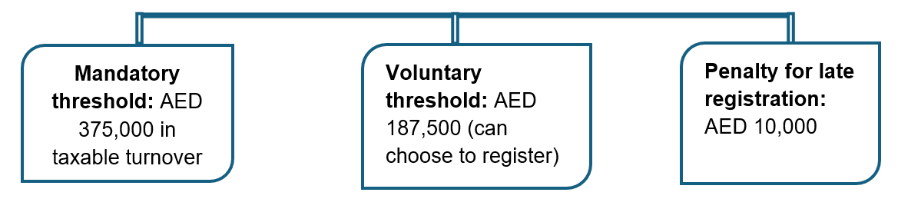
Note: Mandatory threshold (must register within 30 days).
Voluntary registration makes sense when:
- Spending heavily on setup costs, inventory, or equipment (recover 5% VAT on these)
- Selling to VAT-registered businesses who need proper invoices
- Planning to cross mandatory threshold within 12 months
How VAT works for online sellers in the UAE?
On sales inside the UAE: Charge 5% VAT to customers, collect it, file returns quarterly, and send the difference between collected VAT and paid VAT to Federal Tax Authority.
On imports: Pay 5% VAT at customs based on (product value + shipping + customs duty). Reclaim this through quarterly VAT returns if registered.
On marketplace sales: Amazon and Noon handle VAT collection for most sellers. Confirm this in the seller agreement,some categories require self-billing.
On Export Sales: Goods exported outside the UAE are generally charge 0% VAT provided the goods physically leave the UAE within 90 days and proper documentation is maintained.
What is changing in the UAE E-Invoicing mandate in 2026?
Cabinet Decision No. 100/ 2024 phases in mandatory electronic invoicing. E-invoicing systems need integration with accounting software, inventory management, and sales platforms.
Filing and Penalties
- Returns due: 28 days after quarter ends
- Late filing penalty: AED 1,000 (doubles to AED 2,000 for repeat offences)
- Late payment penalty: 2% of amount owed plus 4% monthly interest
- Record retention: Five years minimum (seven years for corporate tax records)
Common Registration Mistakes
Brands get tripped up by:
- Thinking the threshold resets each calendar year (it’s a rolling 12-month calculation)
- Not registering when one large order pushes total past AED 375,000
- Mixing up zero-rated items (exports) with exempt items (financial services)
- Poor record-keeping that fails audits
What is the fulfilment options for e commerce business in the UAE?
Warehousing with value-added services is growing fastest at 10% annually. Here are the main fulfilment models available to e-commerce businesses operating in the UAE:
Third-Party Fulfilment
- Storage: AED 50-150 per cubic metre monthly
- Pick and pack: AED 5-12 per order
- Delivery: AED 8-20 per order (local UAE)
- Returns processing: AED 10-15 per return
Total cost scales with volume, pay only for what’s used.
Returns Management Planning
Fashion and electronics see return rates hitting 30%. Plan for this before launch:
- Clear return policy (30 days is standard)
- Inspection process for returned items
- Restocking procedures
- Refund timelines (7-14 days typical)
Reverse logistics partnership
Fulfilment partners vary widely in returns handling. Some charge per return, others include it in base fees.
What suits your business, In house fulfilment or 3PL partner?
Choose in-house fulfilment when:
- Shipping more than 500 orders monthly
- Products need special handling or custom packaging
- Brand experience demands complete control
- Margins support the overhead
Choose 3PL partners when:
- Testing the market with under 200 orders monthly
- Scaling rapidly and need flexibility
- Capital is limited
- Focus should stay on marketing and product
What are the best-practice setup for global ecommerce brands
Start with UAE setup for global ecommerce brands in free zones offering infrastructure matching business needs. Dubai CommerCity works for brands needing integrated warehousing. IFZA suits lean operations. It does not offer warehousing, and goods cannot be stored at an IFZA office, so businesses will need to partner with a third-party logistics (3PL) provider for fulfilment. DMCC serves companies prioritising banking relationships and investor credibility.
Register for VAT early, even before hitting mandatory thresholds. The input VAT recovery on setup costs, initial inventory, and equipment purchases provides immediate cash flow benefits. Early registration also establishes proper accounting systems before complexity builds.
Run hybrid fulfilment during market entry. Stock fast-moving products locally for next-day delivery. Keep long-tail inventory overseas, shipping direct when orders come in. This balances delivery speed against inventory risk.
Choose logistics partners with proven international seller experience. Providers that are skilled in customs documentation, multi-currency invoicing, and cross-border compliance prevent expensive errors from occurring. Analyse the situation considering the technological integration, service level guarantees, GCC expansion capacity, and clear pricing without the presence of hidden fees.
Right from the start, develop the capability to operate in multiple markets. The integration of platforms that support multiple currencies, Arabic, and regional payment methods allows customers to easily enter the Saudi, Kuwaiti, and other GCC markets without having to build the technology foundations.
Conclusion
UAE’s 11.11 million online shoppers, mobile-first purchasing behaviour, and the infrastructure that connects billions of consumers in the region make it a very efficient access point to the Middle Eastern market.
Success requires three foundations working together: strategic UAE e-commerce business setup, matching operational needs, complete VAT compliance including preparation for 2026-2027 e-invoicing mandates, and fulfilment partnerships delivering next-day capability while supporting regional scaling.
Brands approaching UAE entry with deliberate operational planning, not rushed market entry, position themselves for sustainable growth in this dynamic market.
Ready to establish compliant UAE operations? Connect with licensed free zone specialists and experienced logistics providers who understand ecommerce setup UAE requirements for international sellers, ensuring proper structure, tax registration, and scalable fulfilment from launch.