




15 July 2026 marks UK-India Comprehensive Economic and Trade Agreement coming into force. This significant milestone aims to boost bilateral trade and partnerships between the two countries. A key component of CETA is the odd 64% UK tariff lines that will enter India duty-free henceforth. This number is expected to rise to 85% over the next decade with staged cuts taking effect. For UK businesses that are looking to tap into the Indian marketplace, CETA opens new opportunities not seen in decades
The scale of the agreement is gargantuan by all measure. The UK Department for Business and Trade’s impact assessment released its forecast and impact opportunity for the economy (see table below).
| The CETA opportunity | Figure |
|---|---|
| UK–India bilateral trade (2024 baseline) | £43 billion |
| Additional annual bilateral trade by 2040 | £25.5 billion |
| Annual UK GDP uplift by 2040 | £4.8 billion |
| Annual UK wage uplift by 2040 | £2.2 billion |
| UK exporter tariff savings, first year | £400 million |
Source: UK Department for Business and Trade, UK–India CETA impact assessment (24 July 2025); House of Commons Business and Trade Committee.
However, the real question is whether the trade deal will have a profound impact on UK business in the now. While a lot of commentary is surrounded on the “99% duty-free” figure, it must be kept in mind that most of it applies to Indian goods entering the UK. For products moving to India, the answers are a bit more nuanced and requires certain immediate actions like checking tariff lines and verifying whether corporate structures are aligned with duty reduction provisions.
While the process of UK businesses traditionally doing business directly in India i.e. UK company to Indian subsidiary or distributor, has been “simple”, it is expensive by all measure. It requires either reporting profits in the UK with 25% corporation tax or reporting it in India. This involves complying by India’s corporate tax laws. Businesses also have to contend with transfer pricing scrutiny on the way in and dividend withholding on the way out.
Planning to Do Business in the UAE?
Get Our Strategic Market Entry Guide
Download Free Guide ↗Where does the profit go:
| Where the profit go | Corporate tax rate |
|---|---|
| UK company | 25% |
| Indian subsidiary (domestic company) | 22% to 30% |
| Indian permanent establishment of a foreign company | about 38% effective |
| UAE Free Zone hub, standard | 9% |
| UAE Free Zone hub, qualifying income (QFZP) | 0% |
UK: main corporation tax rate. India: Income-tax Act, 2025 (effective 1 April 2026). UAE: Federal Decree-Law No. 47 of 2022.
For businesses limiting themselves to the two options, there is a third way. It essentially involves pairing CETA’s duty savings with the UAE’s 0% free zone rate. However, in order to makes the set up legal, it requires expertise on the ins and outs on cross-border taxation and trade. When not done right, it can potentially collapse the moment an auditor goes over your books.
Central to the tri-country business set up process is the concept of the triangle structure.
How does the trade triangle work
The idea behind the trade triangle is to place a UAE Designated Free Zone entity between your UK company and your Indian buyer, as the trading principal.
- The commercial flow: the UAE entity buys the goods from the UK company and sells them to the Indian buyer. It takes legal title, carries the trading risk, and issues the commercial invoice.
- The physical flow: nothing changes. The goods ship straight from the UK to India and never touch Dubai. Your logistics, lead times and freight costs stay exactly as they are.
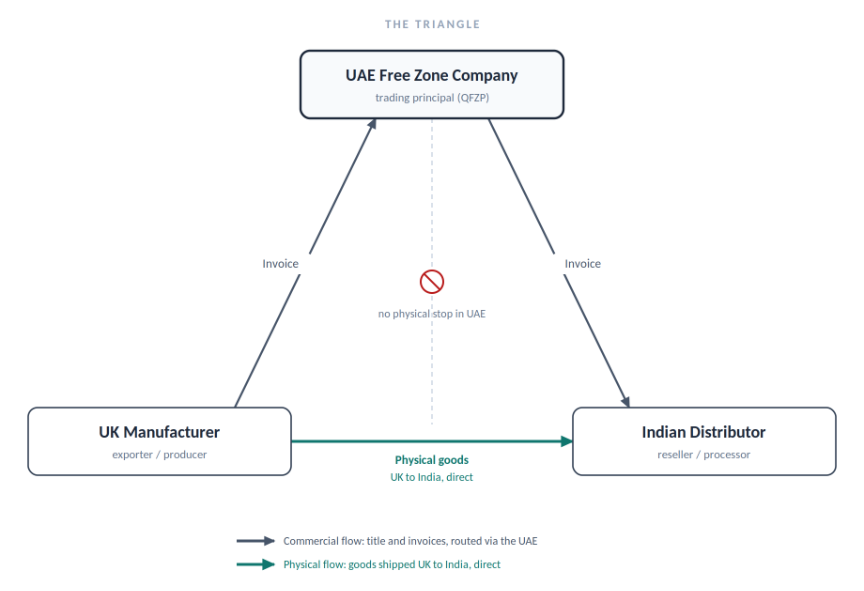
Figure 1. The Triangle in practice: title and invoices pass through the UAE hub, while the goods ship straight from the UK to India.
The UAE entity earns the trading margin. Under the UAE’s Qualifying Free Zone Person (QFZP) regime, as clarified by Ministerial Decision No. 229 of 2025, the “distribution of goods or materials in or from a Designated Zone” can be qualifying income taxed at 0%. Sceptics tend to challenge one point here: the goods do not need to touch the UAE.
The Federal Tax Authority’s own Free Zone Persons guide confirms that goods must physically enter a Designated Zone only when they are distributed to customers inside the UAE. For third-country-to-third-country trades like UK to India, direct shipment is fine. However, there are two conditions that must be met:
- The distribution function has to be run from the zone, with genuine people, assets and spend behind it
- The Indian buyer has to be a reseller or processor of the goods rather than the end user.
Potential errors in the triangle: company ownership in the UAE
If you, a UK resident, own the Dubai entity outright, HMRC’s Controlled Foreign Company rules (Part 9A, TIOPA 2010) apply. Because the UAE’s 0–9% rate sits far below the UK benchmark, the trading profit is attributed straight back to the UK at 25% unless the entity has genuine overseas substance.
This is usually where an adviser suggests a workaround: put the shares in the name of a brother, a friend, a nominee. However, this does not work. The CFC control tests attribute the rights of connected and associated persons, close relatives included, straight back to you. Keep the power to enjoy the income and the Transfer of Assets Abroad rules tax you personally. Run the company from your office in Manchester and it is UK tax-resident whoever’s name sits on the share register.
On top of that, the UAE’s beneficial-ownership register is exchanged under the Common Reporting Standard, so HMRC can see the arrangement in full from its own desk.
The structure works only when the UAE entity is independent. In fact, it should also have a real third-party trading partner or joint venture, with its own capital at risk, its own management making decisions in Dubai, and a reason to exist beyond your tax bill. This has a lasting impact and should by no means be ignored by the entity.
The first question HMRC or an Indian Transfer Pricing Officer will ask is a simple one: why would an independent UK manufacturer hand part of its margin to this intermediary? If the honest answer is market access, credit risk on Indian receivables, regional consolidation, working-capital financing or inventory risk, you have a structure. However, if the answer turns out to be “tax”, you have a problem.
Case study example: what the numbers look like
To understand the triangle better, let’s take a look at a case study. A UK machinery maker sells £10 million a year into India at a 30% gross margin. The figures below are illustrative, but the ground realities are on point.
- Straight line: £3 million of margin taxed at 25% in the UK, which is £750,000 of tax.
- Triangle structure: the UK company sells to the UAE hub at an arm’s-length price that leaves, say, a £1.8 million manufacturing return in the UK (taxed at 25%, so £450,000). The UAE hub earns £1.2 million for the functions it performs, such as market development, credit risk and consolidation, taxed at 0% as a QFZP.
Same goods, same customers, and roughly £300,000 a year retained, lawfully, because the profit is in line with the functions. Notice what the example does not do: it does not strip the UK margin to zero. Arm’s length impacts on both sides. A UK company that hands its entire profit to a middleman will not survive the first audit, in any of the three countries.
The same example by the number:
| Per year | Straight line | Triangle |
|---|---|---|
| Sales into India | £10.0M | £10.0M |
| Gross margin (30%) | £3.0M | £3.0M |
| Profit taxed in the UK | £3.0M | £1.8M |
| Profit in the UAE hub | n/a | £1.2M |
| UK tax at 25% | £750,000 | £450,000 |
| UAE tax (QFZP) | n/a | £0 |
| Tax saved vs the straight line | n/a | about £300,000 |
Illustrative only. Arm’s-length pricing, not a fixed split, decides how the margin divides.
The Three Upsides
1. Preferential duty in India via third-party invoicing
You might assume that involving a UAE entity diminishes your CETA benefits. The fact is that it doesn’t. Article 3.15(5) says India cannot refuse preference solely because the invoice was issued in a non-party country, or by someone other than the exporter. Article 3.14 protects origin where goods ship directly from the UK to India or transit a third country under customs control without entering its market.
Two practical rules keep you safe:
- The origin declaration (Annex 3B) must be completed by the UK exporter or producer, never by the UAE invoicing entity
- The UK exporter needs its one-time HMRC Origin Registration in place before the first shipment
Note: The duty benefit then follows your tariff line’s staging schedule, so check your line in India’s CETA schedule before you price the saving. IGST on import still applies on the assessable value, though the Indian importer can credit it.
2. 0% corporate tax on the trading margin
- Adequate substance in the Designated Zone
- Audited financial statements (Ministerial Decision No. 84 of 2025,
- Intercompany pricing that satisfies the UAE’s own transfer pricing rules under Federal Decree-Law No. 47 of 2022
- Non-qualifying revenue kept below the de minimis threshold, which is the lower of 5% of total revenue or AED 5 million
3. Staying outside the UK CFC net
Where the UAE entity is independent in law and in fact, it is not a UK Controlled Foreign Company, and its margin sits outside the CFC charge. Two caveats come with that. First, the Diverted Profits Tax has been folded into corporation tax as a charge on “unassessed transfer pricing profits” for accounting periods beginning on or after 1 January 2026. It keeps both of the old DPT gateways, so contrived arrangements remain in HMRC’s sights alongside the transfer pricing rules in Part 4 of TIOPA 2010. Second, the UK company still has to retain an arm’s-length return for its own manufacturing functions, assets and risks.
The Compliance Shield: Five Things That Get Tested
Tax authorities in all three jurisdictions scrutinize heavily, and “paper independence” will not survive an audit. These are the five pressure points to watch out for.
1. Indian customs valuation
The Special Valuation Branch investigates related-party imports under Rule 2(2) of the Customs Valuation (Determination of Value of Imported Goods) Rules, 2007. Even with an unrelated UAE invoicing party, the proper officer can reject the declared value under Rule 12 and probe the “circumstances of sale” where the UK–India relationship appears to have influenced the price.
Top tip: Keep contemporaneous evidence that the landed price is genuine market value.
2. India’s deemed international transaction rules
While you might think an independent UAE seller keeps you out of Indian transfer pricing, but this is not entirely true. Under Section 163(2) of the Income-tax Act, 2025 (effective 1 April 2026; formerly Section 92B(2) of the 1961 Act), if a prior agreement exists between your UK parent and your Indian subsidiary, interposing an unrelated third party still makes it a deemed international transaction, and full Indian TP documentation follows.
3. GAAR and the Tiger Global lesson
India’s General Anti-Avoidance Rules can override treaties and disregard intermediaries that lack commercial substance. The Supreme Court’s Tiger Global ruling of 15 January 2026, which reversed the Delhi High Court, confirmed that a Tax Residency Certificate is not conclusive proof of treaty entitlement. Substance over form is now the operating doctrine.
Top tip: Your UAE entity needs a real commercial rationale and real operational autonomy, and it has to assume and manage market risk in practice.
4. Permanent establishment: the one people miss
If your Indian subsidiary’s staff habitually negotiate or conclude the UAE entity’s contracts, India can assert a dependent-agent permanent establishment under Article 5 of the India–UAE treaty and tax the UAE margin in India, at rates for foreign companies that push the effective burden towards 38%.
In a recent court order involving Hyatt International (July 2025), the Supreme Court found that a UAE entity had a fixed-place PE in India based on the operational control its people exercised on the ground. There were no exclusive premises and no single employee crossing the stay threshold, and it made no difference. If the hub is operated, in substance, by people sitting in India, India will tax it. The same logic applies in the UK; if UK-based staff do the hub’s selling.
The working rule: contract authority and real decision-making must sit where the profit sits. Get the sign-off matrix right on day one.
5. Keeping the 0% rate
Breach the de minimis threshold and you lose QFZP status from the start of that tax period and for the four that follow, which is five periods at 9% on the whole book.
From 2026 there is also a filing obligation with a hard deadline. FTA Decision No. 6 of 2026 (issued 2 June 2026, applying to tax periods starting on or after 1 January 2026) requires every free zone distributor to file an agreed-upon procedures report, prepared by its auditor under ISRS 4400, proving that its customers are resellers or processors. It falls due within 30 days of the corporate tax return deadline. Miss it and you don’t get a penalty; you get a deemed failure of the distribution condition, which costs you the 0% for five periods. A missed filing now costs as much as fake substance.
Two practical notes for the Triangle.
- First, the Decision’s import checks apply only to goods the hub brings into the UAE, which is official confirmation that direct UK-to-India shipment sits within the regime.
- Second, the auditor’s sample is weighted towards your highest-value customers, and a trading hub usually has only a handful of them, so your Indian buyer will be tested each year.
Top tip: Collect their reseller declaration, trade licence copy and resale-pattern invoices from day one and refresh them every tax period.
One scoping note: if your group’s consolidated revenue reaches €750 million, the UAE’s 15% Domestic Minimum Top-up Tax applies regardless of QFZP status. The structure is aimed at SME and mid-market groups, which is what most UK manufacturers are.
In quick summary, six exposures decide whether the structure holds:
| Risk | Where it bites | If it lands |
|---|---|---|
| Controlled Foreign Company | UK | UAE margin taxed in the UK at 25% |
| Transfer pricing adjustment | UK and India | Profit reallocated, plus tax and penalties |
| GAAR / substance over form | India | Intermediary disregarded, treaty relief denied |
| Permanent establishment | India | UAE margin taxed in India, up to about 38% |
| Customs valuation | India | Declared import value rejected, duty reassessed |
| Loss of QFZP status | UAE | 0% lost for five tax periods (9% applies) |
The Independence Checklist
“Independent” is not a word you write into a contract; it’s a set of facts you can evidence. Before the first shipment, you should be able to tick every one of these:
- Ownership: shareholders unconnected to the UK group, with no relatives, no nominees, and real capital at risk.
- Board and decisions: directors who meet, decide and sign in the UAE, with minutes that prove it.
- People and premises: employees, an office in the Designated Zone, and operating spend that matches the story.
- Contract authority: nobody in India or the UK habitually negotiates or concludes the hub’s deals.
- Reseller evidence: signed reseller declarations, trade licence copies and resale-pattern invoices from every major customer, refreshed each tax period. The auditor will ask, and so will the FTA.
- Pricing coherence: one arm’s-length story told consistently to HMRC, the Indian TPO and Indian customs. Tell each authority a different version and you have handed them the case.
- Commercial purpose: a written answer to “why does this entity exist?” that would survive being read aloud in a tribunal.
Who is the Triangle for (and who it isn’t)
It works for: UK manufacturers with meaningful and growing India volumes, group revenue safely under €750 million, and either a real UAE trading partner or the appetite to build proper substance in a Designated Zone: people, premises and decisions on the ground.
It doesn’t work for: anyone hoping to run a Dubai letterbox from a UK desk with a relative on the share register. If that’s the plan, we’ll tell you in the first meeting and save you the fees.
Final thoughts on the Triangle
The Triangle is not a loophole. It is the deliberate alignment of a trade agreement, a supply chain and three tax systems, and every piece has to carry its own weight. The structures that survive audits are the ones where the commercial story was true before anyone wrote the tax analysis.
At Stratrich Consulting, we design, implement and defend cross-border structures across the UK, India and the UAE, from tariff-line analysis and rules-of-origin compliance through to QFZP substance, transfer pricing documentation and audit defence. We are as quick to tell you when a structure won’t work as when it will. Clients tell us that is rarer than it should be.
Ready to look at your India numbers properly? Talk to our team before your first post-15 July shipment.
This article is for general information only and does not constitute tax, legal or investment advice. The position under UK, Indian and UAE law turns on the specific facts of each case; obtain professional advice before implementing any cross-border structure.